· via Hacker News – Front Page (native)
356 freely licensed processor die photos collected in one browsable gallery
A curated gallery gathers 356 freely licensed processor die photographs spanning 1972 to 2024, with a true-scale mode that renders 1970s chips as specks beside modern silicon.
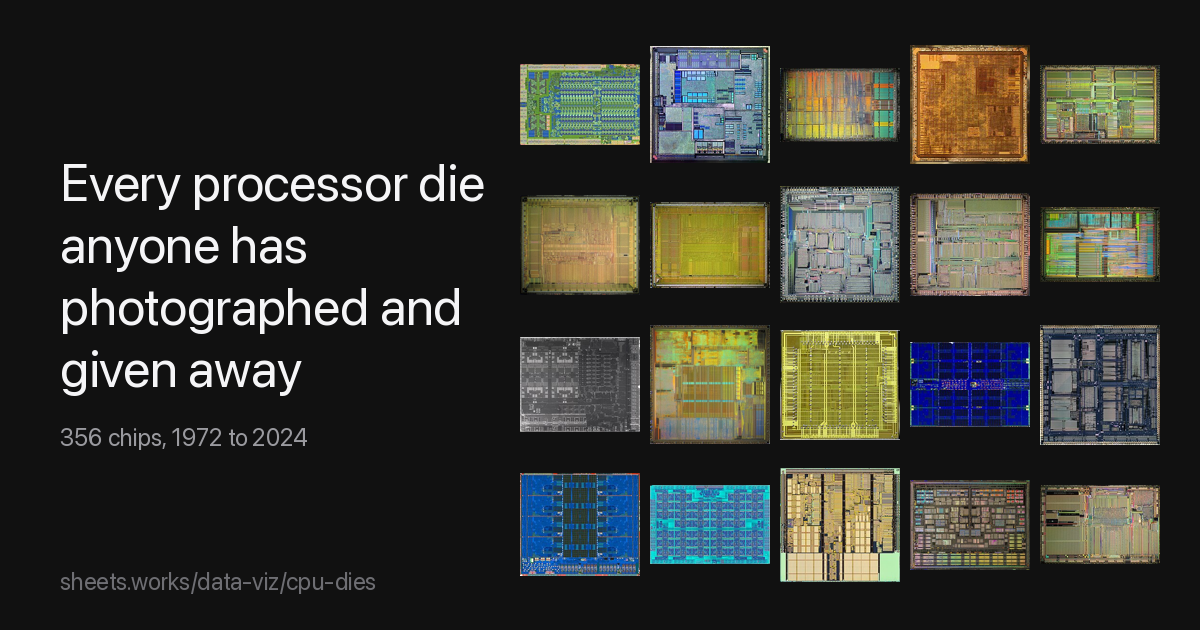
A curated web project has assembled 356 photographs of processor dies — the bare pieces of silicon at the heart of every chip — in a single browsable gallery. The images cover more than five decades of hardware, from 1972 to 2024, and all of them have been given away under free licenses by the people who took them. The project surfaced on the Hacker News front page.
How the pictures are made
As the gallery's description explains, a processor's die is a flat sliver of silicon, usually smaller than a fingernail, sealed inside the chip's protective package. Seeing one is a destructive process: the package has to be sanded down or dissolved, and what remains is photographed through a microscope. Only a small number of people practice this craft, and fewer still publish the results for others to reuse.
The photographers behind the archive
The site credits a handful of practitioners as the source of nearly everything in the collection, naming four in particular: Pauli Rautakorpi, the Moscow-based ZeptoBars, John McMaster, and a photographer who posts under the name Fritzchens Fritz. Their combined output, gathered and organized in one place, is what makes up the 356-chip set.
Exploring the collection
The page is built for browsing. Clicking any chip opens a large version of its die photograph. A second mode, labeled true scale, is where the collection becomes more than a wall of images: it draws the 114 processors whose physical dimensions are known at a single shared scale. Seen that way, the distance between eras is stark — a chip from the 1970s reads as a speck next to a modern processor.
Why it matters
Die photography has traditionally lived in scattered corners of the web: personal blogs, photo accounts, forum threads. Consolidating 356 freely licensed images in one explorable place, with the contributors credited, turns a scattered hobbyist corpus into something closer to a dataset that hardware and software readers can actually navigate.
For engineers and enthusiasts, die shots give physical form to abstractions — a reminder that cores, caches and memory controllers occupy real area on real silicon, and that this area has been engineered and re-engineered for fifty years. The true-scale view may be the collection's most direct argument: no chart of transistor counts lands quite the same way as a 1970s die visibly vanishing beside a contemporary one.
The project is also a small case study in what permissive licensing enables. Because the photographers gave their work away, someone else was able to aggregate, organize and visualize hundreds of images they never shot, and publish the result for everyone else to explore.
- #hardware
- #cpu
- #die-photography
- #data-visualization
- #silicon