· via Hacker News – Front Page (native)
Academa writes STEM lecture videos as code so LLMs can generate and maintain them
A startup launched on Hacker News treats lecture videos as maintainable source code, letting LLMs generate long-form STEM lessons, translate them into 80+ languages and personalize them per learner.
The launch
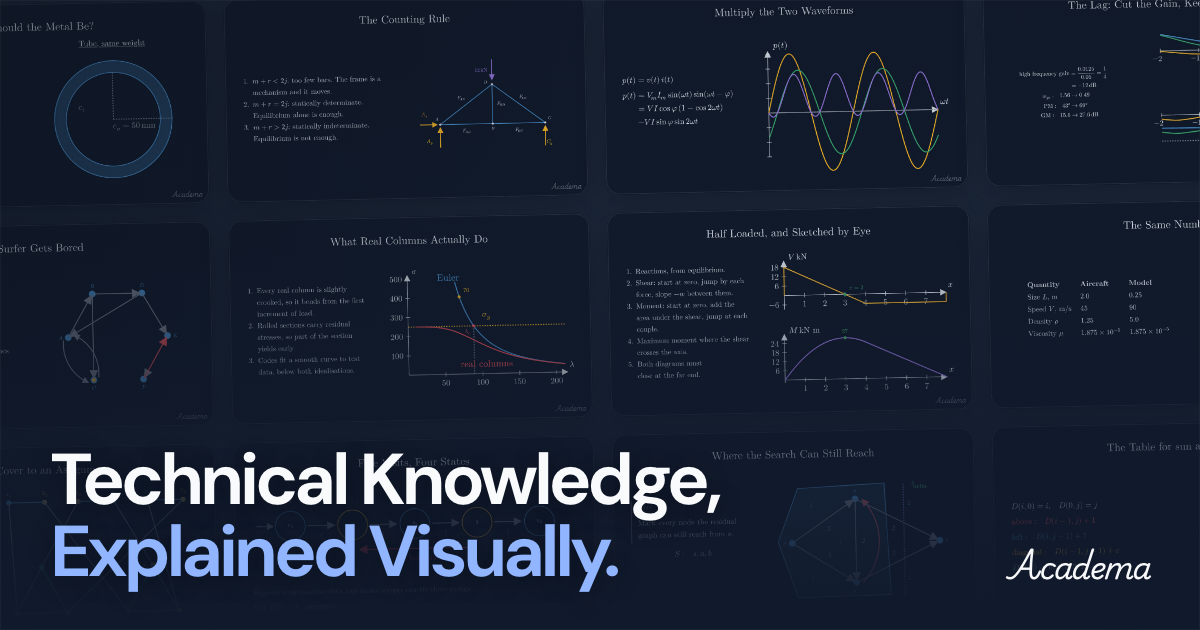
A startup called Academa has launched on Hacker News with a pitch it describes as lectures-as-code: long-form STEM lecture videos expressed as source code, compiled into watchable video with text-to-speech and computer graphics, and written largely by large language models.
According to the company's Show HN post, every video currently on the Academa site was produced by an LLM in a single pass, and the team intends to maintain and improve those videos over time the way developers iterate on software. Visitors can also ask the site's AI to generate a lecture for them.
The problem it starts from
The post opens with an observation about how online STEM education actually works: in practice it is a library of recorded lectures, with Khan Academy, Udemy, Coursera, MIT OpenCourseWare and YouTube cited as the examples. A lecture, in this framing, is a recorded blackboard performance — the teacher talks, writes an equation, circles a term, sketches a plot and points out what matters.
That format carries a maintenance problem, the founders argue. Good lecture videos are expensive to make, and once one is finished, a mistake is effectively frozen in place. If an error surfaces two weeks later, the choice is to leave it in or re-enter production.
Academa's answer borrows directly from software. Developers ship code, find bugs, patch them and re-ship. The team applies the same loop to lectures by describing each teaching action in code — speak a line while drawing a shape, label a side of it, write an expression on the board — and letting a compiler render the result as a finished video with narration and graphics. The lecture becomes editable: fix the mistake in the source, recompile, publish a new version.
What LLMs add
The founders' argument for why this matters now rests on where models have already had their clearest impact: software engineering. LLMs are effective there, they write, because software is text and models read and write text. Represent a lecture as code and it turns into something a model can author and edit directly.
From that premise, the post sketches several consequences:
- Coverage of niche subjects. Nobody spends weeks producing a lecture video for an obscure theorem or a narrow engineering method, since the audience for each is small. With lectures as code, the team claims a model can be asked for a lesson on essentially any technical topic.
- Translation. A lecture can be rendered in more than 80 languages, and the output is presented as a full version of the same lecture rather than a dub or a subtitle track.
- Interactivity and personalization. A learner can pause a lecture mid-way, ask a question and receive the answer as newly generated video. Courses can also follow a user's own syllabus, match their level, spend extra time on areas they struggle with and skip material they already know.
What the post leaves open
The launch text is the founders' own account of the system, and several practical details are absent: which models drive generation, how factual and mathematical accuracy is verified, what generation costs, and how the video library will be curated. Those questions matter for math-heavy content, where a small error can quietly mislead a learner. The company says it will share more in the coming weeks and months.
Why it matters
Academa's core move — representing video as editable text — mirrors the pattern that made code generation the flagship use case for LLMs. If it works in practice, the economics of educational video change: the long tail of subjects too small to justify traditional production becomes addressable, and language stops being a barrier to access.
The launch also frames the real test for AI-generated education. Producing a plausible lecture is no longer the hard part; the open question is whether model-written videos can be corrected, versioned and trusted the way maintained software is. Academa's bet is that maintainability, not raw generation quality, is what makes LLM-made lectures viable.
- #generative-ai
- #llm
- #education
- #edtech
- #video-generation