· via Hacker News – Front Page (native)
Agent Standup renders Claude Code sessions as a live, zero-token stand-up meeting
Agent Standup, an open-source tool that hit Hacker News's front page, turns Claude Code sessions into a live stand-up call showing which sub-agent is blocked or waiting, with no token cost.
What happened
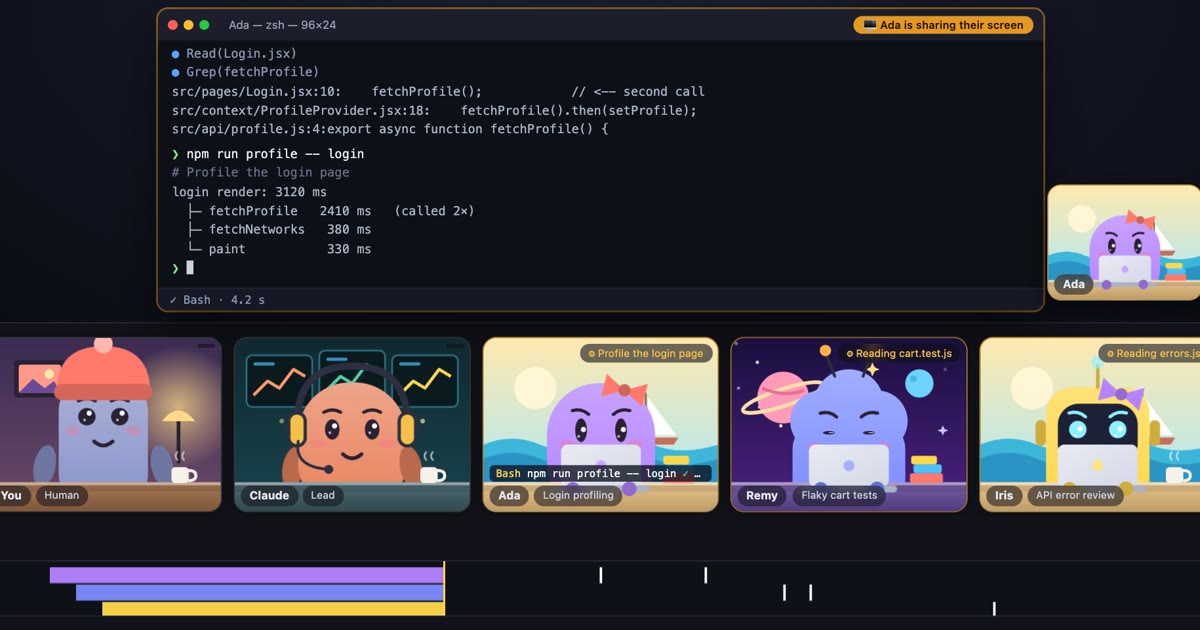
An open-source project called Agent Standup surfaced on Hacker News's front page (the item is dated October 11, 2026). It watches a live Claude Code session and presents it as a stand-up meeting in the style of a video call: a lead agent runs the room, sub-agents dial in, share their screen and report back, then leave when they finish. According to the project's page, the payoff is being able to see which agent is waiting on another and which one is blocked, with no token overhead.
That last point is the pitch that made people look. Instrumentation that works by asking the model questions spends tokens, while a view layered over the session claims to spend none. The page itself frames the tool as a bit silly but weirdly practical.
What you actually get
The live view has voices and, the site stresses, follows your real session rather than a scripted animation; a built-in demo with a fictional team is included for anyone without a session to hand. Each agent carries a single status, sub-agents join and drop off as they are spawned and complete their work, and a context gauge sits alongside token counts so you can see how much headroom each agent has left. Finished sessions can be replayed, with a recap, a tree view and video, and agents can be given custom characters. The interface ships in eight languages.
Ways in
Distribution is described as one small local server with several front doors:
- VS Code users get an extension with a panel and a sidebar view, findable by searching for the tool's name.
- Cursor, Windsurf and VSCodium can install the same extension from a VSIX file.
- Any terminal works, with no editor involved at all.
- A desktop app offers its own window plus a menu-bar indicator; the site cautions that the macOS build is not signed by Apple.
- A one-line indicator is available for the Claude Code status line and for tmux, with details in the README.
- JetBrains IDEs have no native plugin yet.
The only stated prerequisite is that Claude Code has been run at least once on the machine.
Toy or tool
The project page asks whether any of this is serious and answers, in effect, that it is mostly for fun, before undercutting even that. The self-deprecation is part of the presentation, but the underlying idea is straightforward: agentic coding sessions produce a lot of concurrent state, and the stand-up meeting is a format developers already know how to read.
Why it matters
Two things lift this above a novelty. First, the claimed economics: if a coordination view genuinely costs zero tokens, monitoring stops competing with the actual work for context and budget, which matters as sessions run longer and agent counts grow. Second, legibility: multi-agent runs are typically inspected through logs and scrollback, and a live picture of who is waiting on whom turns orchestration state into something glanceable.
The project is free and open source, runs anywhere Claude Code does, and spreads itself across editors, terminals and the desktop rather than betting on one environment. Playful framing aside, it points at a growing niche, observability layers for agentic coding tools, where the meeting-room metaphor may matter less than the fact that someone finally built the window.
- #claude-code
- #ai-agents
- #developer-tools
- #open-source
- #observability