· via Hacker News – Front Page (hnrss.org)
AlphaNIST: one policy learns all 20 NIST assembly tasks from a binary reward
A project page and arXiv paper describe a single learned policy that completes all twenty tasks on NIST's assembly benchmark, including parts as small as 4 mm, using only success or failure as its training signal.
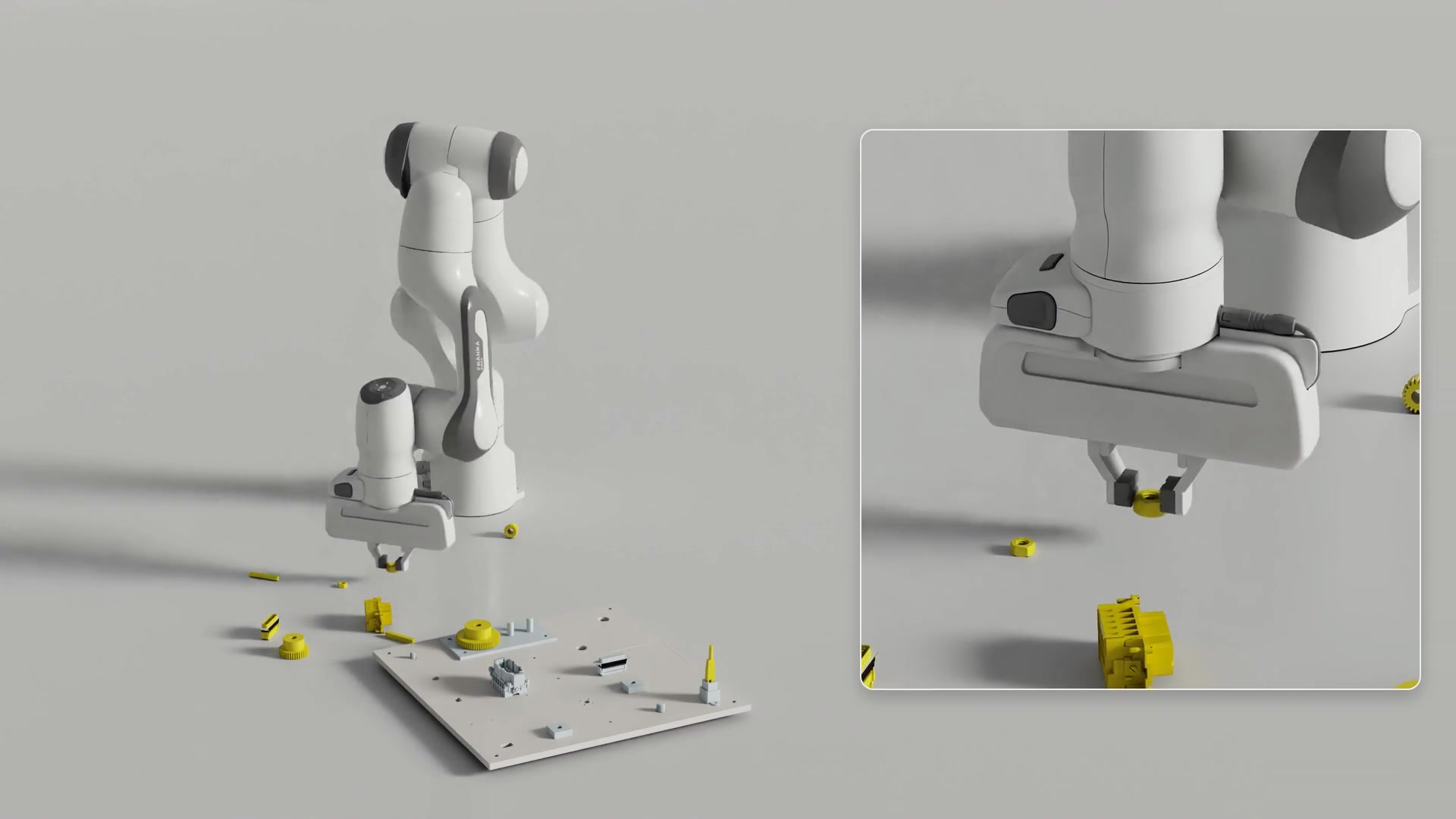
One policy, twenty assemblies
A robotics project called AlphaNIST shows a single learned policy performing all twenty tasks on NIST Assembly Task Board #1, a fine-manipulation benchmark with parts as small as 4 mm, trained with nothing more elaborate than a success signal. The work is described on the project's site and in an arXiv preprint (2610.13354) titled AlphaNIST: Emergent Assembly Skills from Binary Task Rewards, by Octi Zhang, Iretiayo Akinola, Yashraj Narang and co-authors. It reached Hacker News's front page.
A benchmark that punishes imprecision
The NIST board packs twenty assembly operations onto a single test fixture. According to the AlphaNIST project page, fitting even one part may require the gripper to regrasp and reorient it several times, and clearances are tight enough that a nut going in at the wrong angle can jam or ruin the threads. Tasks involving multiple parts add a planning layer: a component that is already installed can obstruct the gripper on a later insertion, so the order of operations matters.
Trading instructions for a reward
The team's starting point is that hand-scripting these maneuvers is fragile. Writing out every motion means predicting in advance how the robot should react as contacts and obstructions change, and a two-finger gripper often needs strategies a human hand would never suggest. Instead, the researchers reduced supervision to a binary task reward, success or failure, and trained the policy through large volumes of varied experience in simulation. This is, in effect, reinforcement learning: the policy improves purely from outcomes. The page's claim is that this leaves room for the robot to find solutions no engineer would have thought to specify, which the paper's title frames as emergent assembly skills.
How the training data is shaped
Two mechanisms do the work. The first is diverse starting states: one policy trains across all twenty dissimilar assemblies, and episodes can begin from scattered parts, from a part already held in the gripper, or from a partly finished assembly pulled from a cache stored in simulation. Beginning episodes near completion lets the robot rehearse finishing an assembly before it can complete one end to end. The cache contributes starting states only, not demonstrations, so no human examples enter the pipeline.
The second is success-guided sampling. Training episodes are drawn with Beta sampling that favors starting states the current policy completes roughly half the time, meaning states that are challenging enough to learn from but not so hard that the reward signal never fires. Every state retains some probability of being sampled, and the weights shift as outcomes change, so a state that becomes newly solvable after progress elsewhere attracts more practice over time.
What was actually run
The page describes a single-component assembly experiment: one policy executes all twenty tasks, with one component assembled per run. That stops short of the multi-part scenario the page itself frames as the hard case, where sequencing and obstruction come into play, and no results are reported for that harder setting in the material published so far.
Why it matters
Fine assembly at millimetre scale is a stubborn gap in robotics. Tolerances that human hands manage by feel tend to defeat scripted machines, and per-task engineering makes automation uneconomical outside high-volume production. A recipe that gets twenty heterogeneous tasks out of one policy and one binary reward points toward generalist manipulation rather than bespoke programming, and the two training tricks, cached partial-assembly states and success-rate-weighted sampling, are task-agnostic ideas other groups could reuse. The open question the page itself sets up is multi-part assembly with ordering and obstruction; answering it would move the result from an impressive benchmark run toward something practical for real manufacturing settings.
- #robotics
- #reinforcement-learning
- #robot-manipulation
- #benchmark
- #assembly