· via Hacker News – Front Page (hnrss.org)
Anthropic previews Model Hardware Standard for AI agents operating lab equipment
Anthropic has opened a research preview of the Model Hardware Standard, a shared specification that lets AI agents safely operate lab and manufacturing hardware, cutting setup time from weeks to hours.
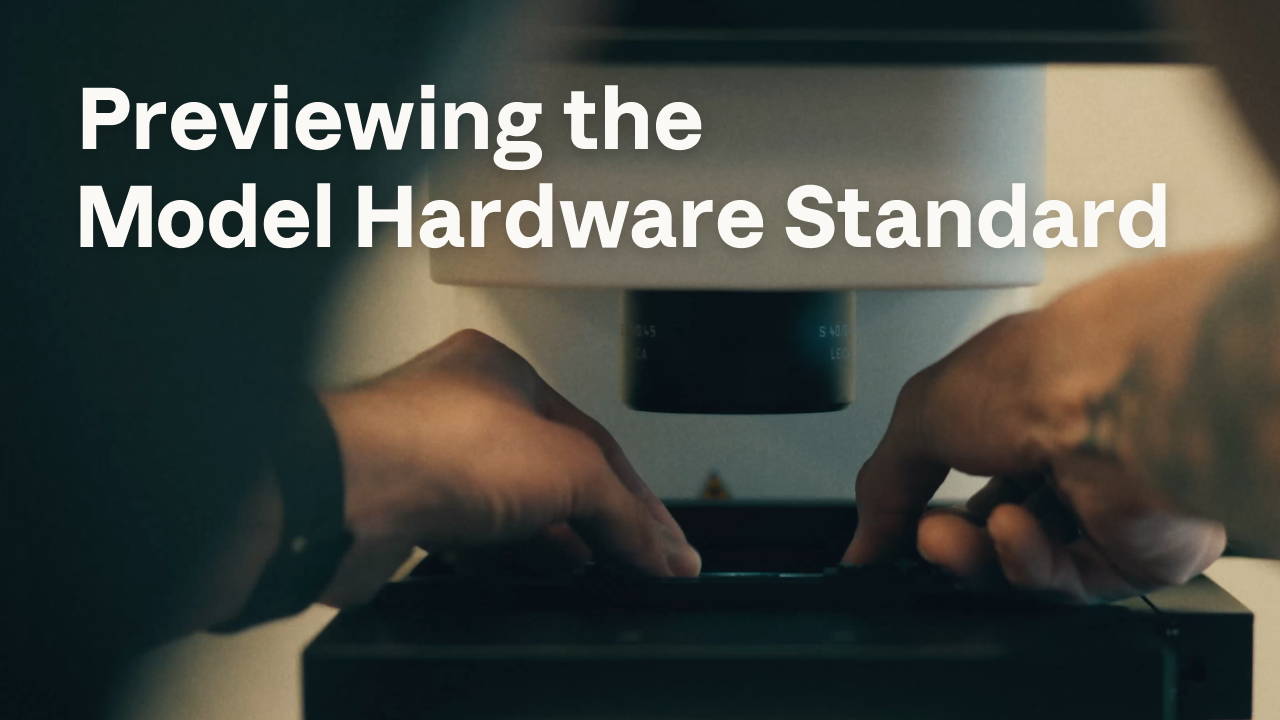
What the Model Hardware Standard is
Anthropic has opened a research preview of the Model Hardware Standard (MHS), a shared specification for letting AI agents operate physical devices safely. According to Anthropic's announcement, the preview is going out to an initial group of scientific research labs and advanced manufacturers, and the work began as a collaboration with the HHMI Janelia Research Campus.
The standard is meant to let one agent run several instruments in parallel — microscopes, liquid handlers and robotic arms are the named examples — and handle tasks ranging from routine drug-discovery experiments to laser calibration on a quantum computer. Anthropic says labs and factories typically spend weeks or months wiring up hardware because most devices cannot talk to each other and need specialists to build custom integrations; with MHS, that setup work reportedly shrinks to hours or minutes.
How the standard works
MHS introduces a standardized driver: software that translates between a computer's operating system and a hardware device. The driver exposes a small set of primitives such as read (get temperature) and write (set temperature), and it makes devices discoverable in a common format so instruments and agents can find each other across a network without a bespoke translator program in between.
A second piece addresses knowledge that has traditionally lived in paper manuals or engineers' heads. The driver carries tags, writable in natural language, that describe properties a machine's code does not reveal — Anthropic's example is the weight of a robot arm, which matters for safe manipulation. From those tags the driver automatically generates a reference file covering what a device can measure, what can be adjusted and which safety limits are enforced, giving an agent what it needs to operate equipment it has never seen before.
Agents control hardware through three mechanisms — the Model Context Protocol, a command line interface and code files (APIs) — which together allow multi-device orchestration from a single line of code. For long-running or high-speed operations, an agent can chain driver commands into code files so devices execute sequences themselves without step-by-step reasoning. Anthropic notes the standard is model-agnostic, works with any device that has a programmable interface, and can be reached by any agent harness using standard protocols such as MCP.
The company also describes observing Claude work with hardware in an exploratory, scientist-like way: in one test the model adjusted a laser, checked the beam's movement through a camera, repeated the cycle to learn the dynamics, then wrote a deterministic script that aligns the laser as a single command.
Early results from partners
Anthropic lists early projects from partners in biotech, robotics, quantum computing and other fields. Genentech ran a proof of concept automating the BCA protein assay — a standard way to measure total protein concentration — coordinating a liquid handler, a robotic arm and a plate reader. At the University of Washington's Baker and Pinglay labs, PhD student Zihao Song built a dashboard for remote instrument monitoring, an agent-supervised qPCR setup that watches amplification curves and halts at the right moment, and a robotic-arm-to-liquid-handler integration for collision-free plate handoffs.
Carnegie Mellon University reports running serial dilution dose-response experiments about three times faster than before, with an agent orchestrating instruments spread across three computers with fundamentally incompatible interfaces. At HHMI Janelia, scientist Virginie Ruetten of the Ahrens lab used MHS to unify a microscopy rig that previously required seven separate vendor programs with no shared interface. Quantum computing company QuEra gave an agent control over parts of the laser system inside its neutral-atom machines; according to Anthropic, the agent's controller recovers the laser's precise frequency lock 99.3% of the time without human intervention.
Access to the research preview is by application. Anthropic says it is sharing an early version with partners across science, robotics, electronics and manufacturing so they can jointly build safety evaluations and best practices for AI systems operating physical equipment, ahead of making the standard open source.
Why it matters
Most agent progress so far has stayed inside software. MHS is a concrete move into the physical world: a common protocol, machine-readable safety limits and standard control surfaces for equipment that can genuinely break things. If the integration savings hold beyond early partners, autonomous round-the-clock experiments become a routine capability rather than a bespoke engineering project. The open-source intent and the model-agnostic, MCP-based design mean MHS could become shared infrastructure rather than a Claude-only feature — and how the safety questions get settled now, while the spec is still young, will shape how much access AI agents earn to real hardware.
- #anthropic
- #ai-agents
- #lab-automation
- #robotics
- #model-context-protocol