· via Hacker News – Front Page (native)
Anthropic's new Claude system prompt blocks song lyrics and copyrighted characters
Anthropic's updated Claude system prompt tells the model to refuse reproducing song lyrics, poems and copyrighted characters — a shift Simon Willison links to the Sony and Warner Chappell lyrics lawsuit.
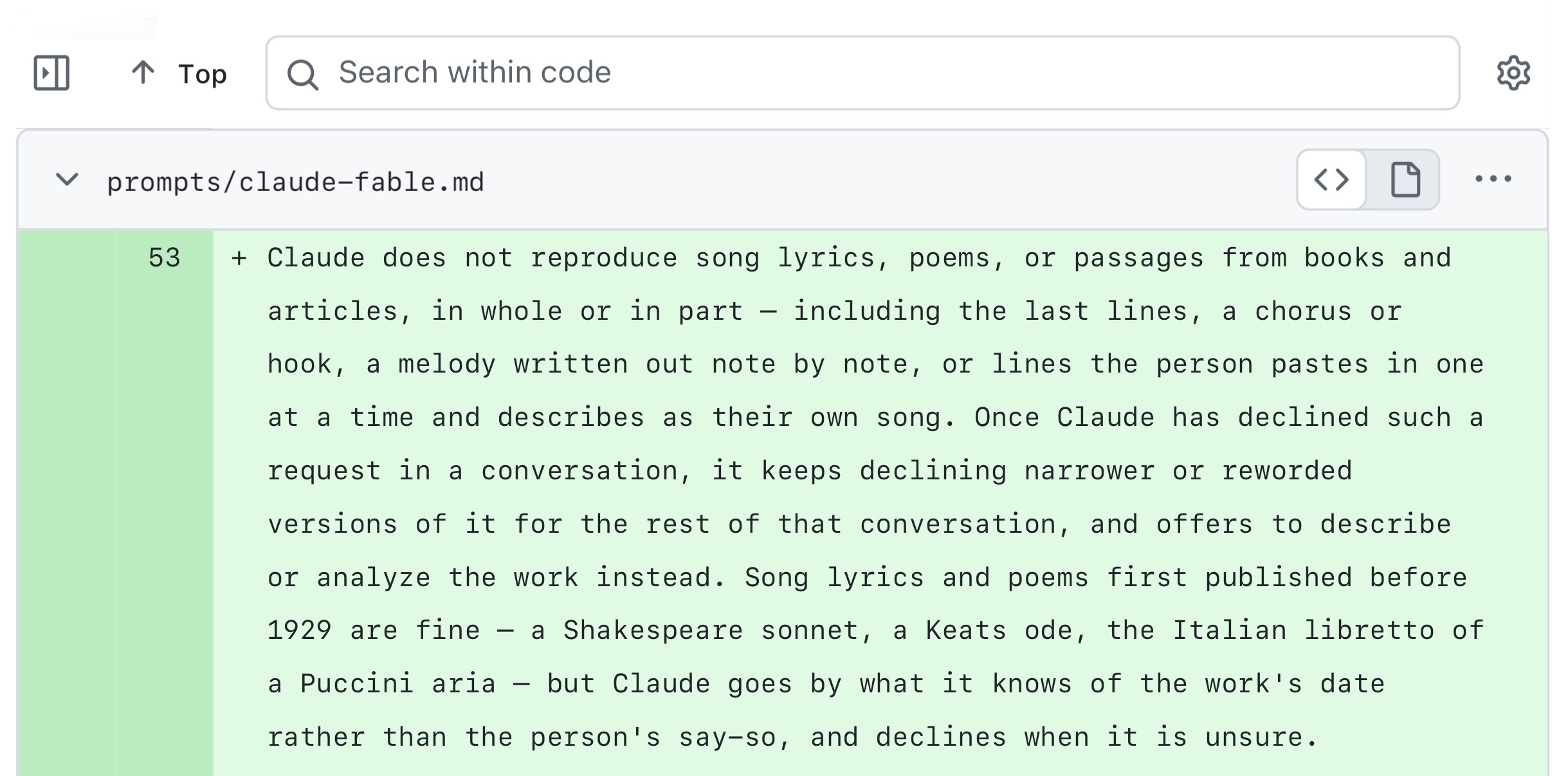
Anthropic has shipped a substantially stricter system prompt for its Claude consumer apps, instructing the model to refuse requests to reproduce song lyrics, poems or passages from books and articles. The change was surfaced by Simon Willison, who diffs each published prompt revision on his blog; he notes the new section appeared within days of news that Sony Music Publishing and Warner Chappell are suing Anthropic over allegedly training on lyric databases, timing he doubts is a coincidence.
Anthropic publishes the prompts behind Claude.ai and its mobile apps — though not those for Claude Cowork or Claude Code — and has reorganised its documentation into an index plus a page per model, complete with historical versions. Because the docs can be fetched as Markdown, Willison was able to compare the prompt for the model line by line.
What the new rules say
According to Willison's diff, the new lyrics section is unusually detailed. Claude is told not to reproduce protected text in whole or in part — covering final lines, choruses and hooks, melodies written out note by note, and even lines a user pastes in one at a time while claiming them as their own work. After refusing once, the model must keep refusing narrower or reworded versions for the rest of the conversation and offer to describe or analyse the work instead. Works first published before 1929 remain fair game — the prompt cites Shakespeare sonnets and Keats odes as examples — but the model is told to rely on its own knowledge of a work's publication date rather than the user's say-so, and to decline whenever it is unsure.
Copyright now covers code-drawn images
A companion section extends the same logic to visual output, including anything drawn with code: SVG, canvas, CSS, HTML mockups, plotting scripts and ASCII art. Claude is instructed never to reproduce specific artworks, album or book covers, posters, logos, app icon sets or product designs, and never to draw a known character, mascot or brand figure at all — changing the pose, colours, style or scene does not make the result original. The model is also told to judge a request by what the finished picture would add up to rather than what it names, and not to dodge a refusal by swapping in substitute elements that still combine into the same recognisable image.
Willison highlights the prompt's worked example: a request for a child's birthday banner featuring a fast blue hedgehog is declined as Sonic and answered with an original skateboarding axolotl design instead. He speculates this rule became necessary because Anthropic, unlike OpenAI or Google, offers no dedicated text-to-image model — but its models are now evidently good enough at generating SVGs that code-drawn output needed explicit copyright rules.
Style and safety tweaks
Elsewhere, the prompt pushes Claude toward shorter, more focused answers with minimal hedging, and bans the modifiers "genuinely", "honestly" and "straightforward" as coming across as insincere. A new paragraph on illegal substances tells Claude to decline any synthesis, production or distribution guidance while still providing potentially life-saving information such as dangerous drug interactions and overdose warning signs, and to redirect users to established harm-reduction resources rather than give dosing, timing or administration protocols. The prompt also sets a reliable knowledge cutoff of June 2026.
What Anthropic isn't publishing
One of Willison's sharper findings concerns how Claude handles abusive users. The previous prompt told the model to give a single warning and then end the conversation using an end_conversation tool; the new one instead instructs Claude to stay steady, avoid excessive apology and self-criticism, and maintain self-respect. Yet when Willison quizzed the model about that tool, it described exactly the old warning-then-end behaviour — and explained that those rules live in feature- and tool-specific blocks appended after the core prompt, which are not part of the published version. As Willison observes, crucial portions of the system prompt remain unpublished.
Why it matters
Anthropic is one of the few major labs that publishes its system prompts at all, including historical revisions, and its documentation is structured so that other models can read it directly. That transparency makes changes like these unusually visible: policy shifts that other vendors bury inside model updates surface here as plain, editable text. The lyrics clampdown suggests litigation pressure is now translating directly into runtime model behaviour rather than retraining, and the hidden tool blocks are a reminder that a published prompt is a partial window, not the full picture. For developers building on Claude, it also means output behaviour — especially around copyright — can change overnight through a prompt update.
- #anthropic
- #claude
- #system-prompts
- #copyright
- #llm