· via Hacker News – Front Page (native)
Anthropic's reported Q3 revenue hits $16.8B as sequential growth flattens
Anthropic reportedly booked $16.8 billion in Q3 revenue, but sequential growth slowed versus Q2, and a missing September run-rate figure has analysts questioning the pace of AI demand.
What the numbers show
Anthropic shared headline financials for the third quarter with investors this week, according to New York Times reporters Andrew Ross Sorkin, Lauren Hirsch and Sri Muppidi. The company reportedly booked $16.8 billion in revenue for the quarter.
On its own, the figure is remarkable: quarterly revenue has climbed from a reported $4.8 billion in Q1 to $11.6 billion in Q2 and then $16.8 billion in Q3. But as the newsletter Regenerator points out, the quarter-on-quarter arithmetic tells a less flattering story. Anthropic added $6.8 billion of new revenue between the first and second quarters, a sequential gain of 141%, but only $5.2 billion between the second and third, a 45% rise. In other words, the company added less new revenue in Q3 than it did in Q2.
Flattening beneath the surface
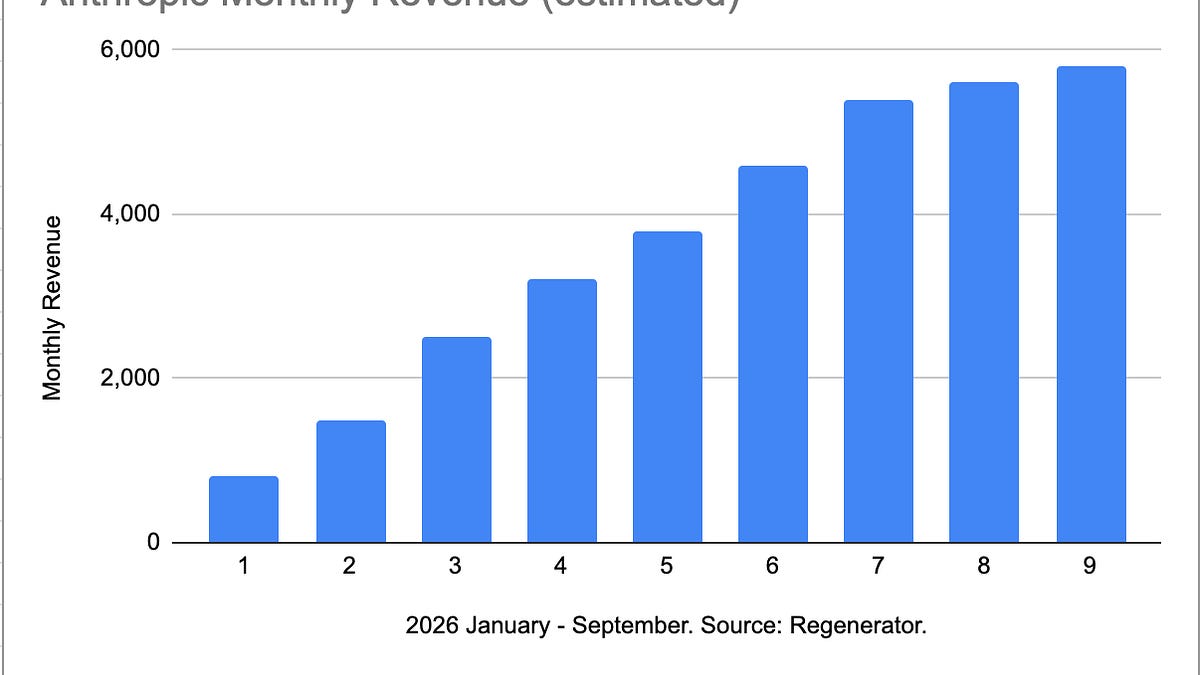
The monthly trend looks weaker still, according to Regenerator's estimates. Combining the reported quarterly totals with another data point, a $65 billion annualized run-rate in July equivalent to roughly $5.4 billion for that month, the analysis concludes that growth in August and September was likely modest.
By Regenerator's math, average monthly revenue growth decelerated from about $760 million per month during Q2 to about $580 million per month in Q3. And because July alone appears to have brought in around $5.4 billion, much of the quarter's total may already have been in place by its midpoint, leaving little room for meaningful expansion over the final two months.
DealBook, the Times' business newsletter, added a telling detail: Anthropic did not disclose an annualized revenue figure based on September at the investor meeting. Regenerator reads that omission as a sign the September number would not have compared favourably with July's.
Three possible explanations
Regenerator lays out several readings of the slowdown:
- Seasonality. August is often a soft month for enterprise demand, though the analyst notes it is early in a product cycle for such a sharp seasonal dip, and September growth should ordinarily have picked back up.
- Supply constraints. Anthropic may simply be unable to provision enough capacity to serve demand. If so, the analyst argues, this is a benign problem that would not alter the broader trajectory of AI spending.
- Genuinely moderating demand. Companies may be reining in spending or shifting some workloads to cheaper models from Chinese providers. Regenerator says usage data suggests this substitution is already underway.
The first two explanations would be largely harmless for the sector. Only the third implies a structural change in how fast AI revenue can compound.
Knock-on effects for AI infrastructure
The analysis links the flattening to pressure on neocloud providers such as CoreWeave, whose share prices have been falling. These companies have borrowed tens of billions of dollars on the premise that demand for AI compute would keep outrunning consensus forecasts for years. Rising interest rates have already increased the cost of carrying that debt, and a plateau in near-term AI revenue growth compounds the risk to the whole financing model.
Why it matters
Anthropic is widely treated as the bellwether of the commercial AI market, and its reported results are among the closest things the industry has to a real-time demand gauge. If the flattening is a supply problem, the AI build-out likely continues largely unchanged. If it reflects demand, whether from budget discipline or substitution toward cheaper Chinese models, the implications reach well beyond one company: sector valuations, an anticipated Anthropic IPO, and the debt-financed data centre expansion of providers like CoreWeave all rest on the assumption that AI revenue keeps compounding at extraordinary rates. Regenerator's broader warning is that speculative booms tend to deflate once supply catches up with demand, and the Q3 numbers, if accurate, suggest that moment may be nearer than markets have priced in. These figures are press reports and estimates rather than audited disclosures, so the picture could still change, but the burden of proof has arguably shifted.
- #anthropic
- #ai
- #revenue-growth
- #coreweave
- #ai-investment