· via Hacker News – Front Page (hnrss.org)
Apple's M6 Mac mini brings strong gains and a $300 price hike over the M4
The 2026 Mac mini debuts Apple's M6 chip with notable performance gains, but its $899 starting price ends the $599 M4 era of desktop value, according to reviews from Ars Technica and The Verge.
What launched
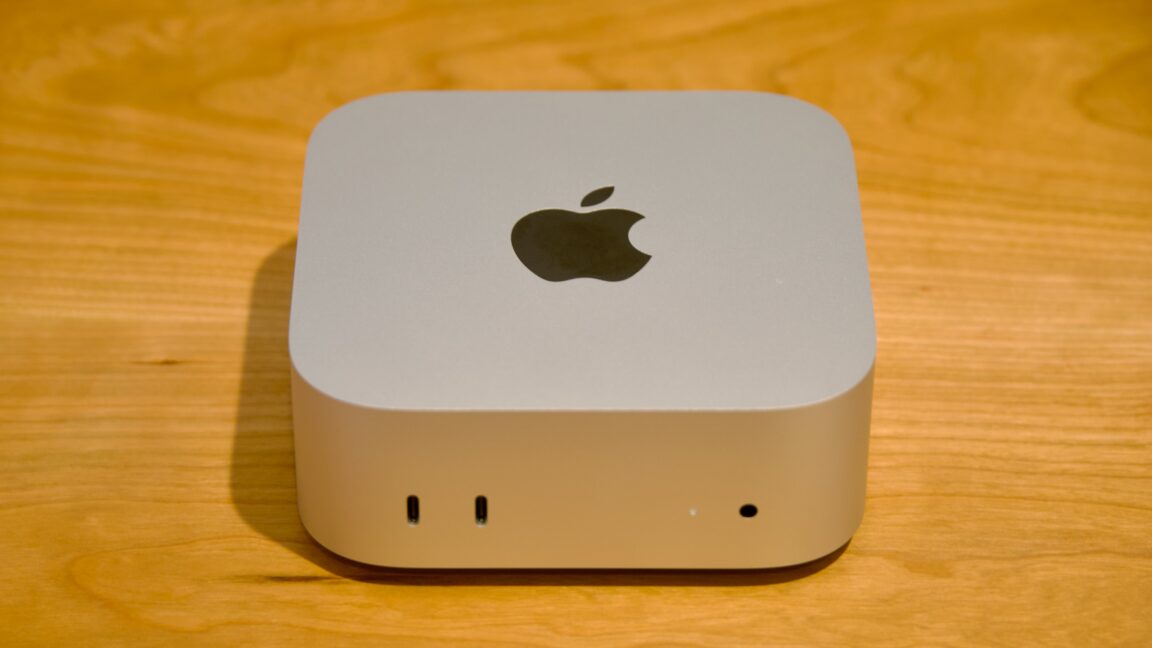
Apple's 2026 Mac mini keeps the chassis introduced with the 2024 redesign but swaps in new silicon and a higher sticker. The base M6 model starts at $899 with 16GB of RAM and 256GB of storage, a $300 increase over the same configuration in the $599 M4 Mac mini from 2024, as Ars Technica notes in its review. Both Ars Technica and The Verge came away impressed by the performance, but the two outlets differ on how much the pricing change hurts the mini's value proposition.
A chip with three kinds of CPU cores
The M6 is the first Apple chip to ship in the Mac mini, and Ars Technica calls it the biggest upgrade to Apple's lower-end silicon since the M4 generation. It combines two of Apple's "Super" cores, four regular performance cores and six efficiency cores for a 12-core CPU, alongside a 12-core GPU — the first GPU core count increase since the M2. The M4 and M5 both had 10 CPU cores.
To keep the scheduler simple, macOS groups the Super and performance cores into a single six-core cluster with shared clock speeds of 1.44 to 4.79 GHz and a shared 20MB pool of L2 cache, so the operating system effectively treats the chip as if it still has only two core types. The Super cores do carry larger L1 caches, according to Ars Technica's analysis with powermetrics.
Benchmarks favor the M6 — until the M5 Pro shows up
The Verge tested a $1,299 M6 configuration with 24GB of RAM and 512GB of storage, and found the M6 now leads the pack in single-core performance — not just among Macs. Its Super cores run roughly 10 percent faster than the M5's cores in single-threaded work and a little over 20 percent faster than the M4's. In Geekbench 6, the M6 scored 4,653 single-core and 2,100 multi-core, versus 3,777 and 1,475 for the M4.
In The Verge's 4K Adobe Premiere export test, the M6 finished in 2 minutes 34 seconds, about 40 seconds faster than an M4 iMac. Storage speeds have roughly doubled over the M4 mini. The M5 Pro model, which starts at $1,699 and pairs six Super cores with 12 performance cores and no efficiency cores, finished the same export in 1:51 — nearly a third faster than the M6 and quicker than an M1 Max. The Verge measured the M5 Pro at 40 to 50 percent faster than the M6 in multi-threaded CPU and GPU benchmarks.
In everyday creative work the gap narrows: a 1,253-image 50-megapixel RAW import into Lightroom Classic took 6 minutes 13 seconds on the M6, only about 30 seconds behind the M5 Pro. But a heavier batch edit with AI subject detection pushed the 24GB M6 into swap memory mid-task, while the M5 Pro stayed fast throughout, according to The Verge.
Design and ports carry over
The enclosure remains the same 0.82-liter, 5-by-5-inch design as the M4 generation, with active cooling. The front holds two 10Gbps USB-C ports and a headphone jack; the back has three Thunderbolt ports — Thunderbolt 4 on the M6, topping out at 40Gbps, and Thunderbolt 5 at up to 120Gbps on the M5 Pro — plus HDMI and 2.5Gb Ethernet standard, with 10Gb optional. Ars Technica points out that Thunderbolt 5 matters if you want to daisy-chain machines into a compute cluster. There is still no USB-A, no SD card slot, and the power button remains awkwardly placed on the bottom rear.
Why the price went up
Ars Technica attributes the increase to 2026's memory crunch upending Apple's usual same-price refresh cycle. The Verge adds that Apple discontinued the $599 M4 model in May due to supply constraints — partly driven by people buying minis in bulk to run OpenClaw — leaving a $799 model as the cheapest option. That makes the base M6 technically only $100 more than the last available M4, but $300 over the original price.
Why it matters
The Mac mini has long been Apple's entry point for people wanting desktop performance without paying for a screen or a Pro chip. Ars Technica argues the M6 is a great general-purpose desktop but no longer one of Apple's best values, while The Verge still calls it the best value in the Mac lineup simply because everything else costs more now. The disagreement itself signals a shift: refresh-year pricing can no longer be assumed. Both reviews also note Apple is pushing the mini as a local AI compute machine, mentioning AI capabilities nearly 40 times in its press materials — and buyers who missed the $599 M4 window are the ones who will feel the difference most.
- #apple
- #mac-mini
- #apple-silicon
- #m6-chip
- #hardware