· via Hacker News – Front Page (native)
Archive of 69 preserved company UI style guides spans early 1980s to today
Marcin Wichary has published an archive of 69 preserved company UI style guides spanning the early 1980s to today, with cleaned-up mirrors and a single downloadable bundle.
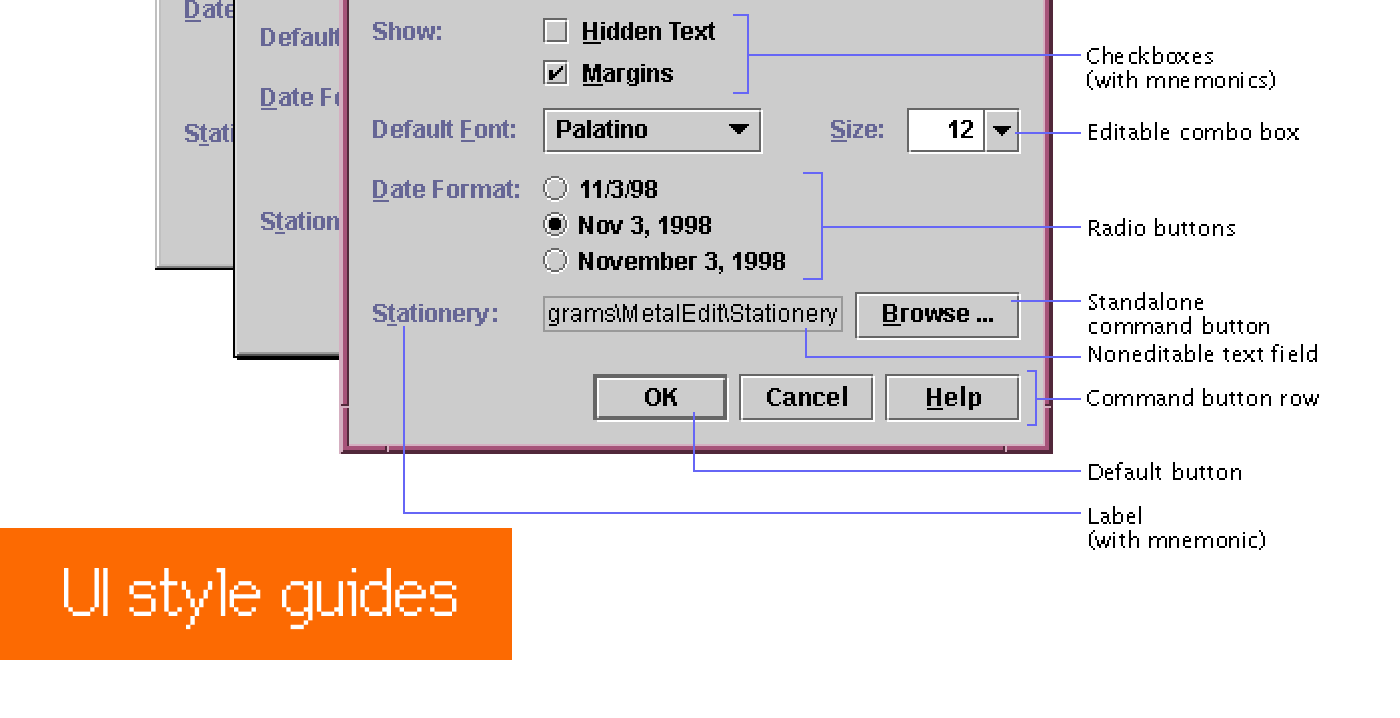
Marcin Wichary has published an online archive of 69 preserved user-interface style guides, the documents companies once issued to define how software on their platforms should look and behave. According to the collection's page on his aresluna.org site, dated 25 November 2026, the set of guides, also called interface guidelines, stretches from the early 1980s to the present. The project subsequently appeared on the front page of Hacker News.
What the archive holds
The guides come from a range of companies, including several whose platforms no longer exist. Two entries on the site illustrate the kind of material involved.
One is the PenPoint UI Design Guidelines from 1991. The archive's description notes that PenPoint was an early tablet operating system built by GO Corporation for a line of devices that was not commercially successful. The document is offered both as a PDF and through an Internet Archive viewer.
The other is Taligent's Human Interface Guidelines from 1995. Taligent, per the same descriptions, was a struggling software company formed as a partnership between Apple and IBM, and one of its outputs was the CommonPoint application framework. Its guide survives as a mirrored website, with a secondary external mirror linked as well.
Documents like these typically shipped alongside platforms and developer kits. They set out rules and recommendations covering menus, dialogs, typography, keyboard behaviour and terminology, written to help third-party software feel consistent with a vendor's own products. For many long-dead platforms, they are the most complete written record of the design thinking behind the interface.
Preservation work behind the mirrors
Wichary says some of the mirrored guides were tidied up so they are easier to consume. Images were processed so their pixels render cleanly, pictures that had been left as separate links were embedded directly into the pages, and broken YouTube embeds were repaired.
For durability, the entire set can be downloaded in a single archive, giving researchers and designers a local copy that does not depend on any one mirror staying online.
The collection also builds on earlier efforts. Wichary credits collections by Geof Crowl, Matt Sephton (with help from Mario Guzmán and Brendan Donohoe), Matthias Rauterberg, and Přemysl Eric Janouch, and points readers to them on the grounds that each offers a different take and presentation. He closes with a request for feedback, asking readers to flag any style guides missing from the list so the archive can keep growing.
Why it matters
Interface guidelines are primary sources for the history of computing, and much of that history is fragile. The two companies highlighted on the page are cautionary examples: GO Corporation's tablet hardware failed, and Taligent did not survive as a going concern. When vendors disappear, the manuals and bundled documentation that explained their interfaces often become scarce, and guides from the web era are additionally exposed to ordinary link rot. A mirrored, downloadable archive turns scarce material into something anyone can consult.
The documents are also useful beyond nostalgia. They record not just what interfaces looked like, but what companies believed users needed, which conventions they argued over, and how constraints like screen resolution and input methods shaped design. A 1991 guide for a tablet operating system, for instance, is a reminder that tablet interface design predates the modern touch era by a wide margin. For designers and researchers tracing where today's conventions came from, one organised collection of 69 guides spanning more than four decades is a practical resource, and a freely downloadable one at that.
- #ui-design
- #design-history
- #digital-preservation
- #archives
- #retro-computing