· via Hacker News – Front Page (native)
AROS Now Boots Bare Metal on Raspberry Pi in 32-bit and 64-bit Builds
The Amiga-derived AROS operating system now boots directly on Raspberry Pi hardware in 32-bit and 64-bit ARM builds, dropping the Linux virtualization layer that earlier setups required.
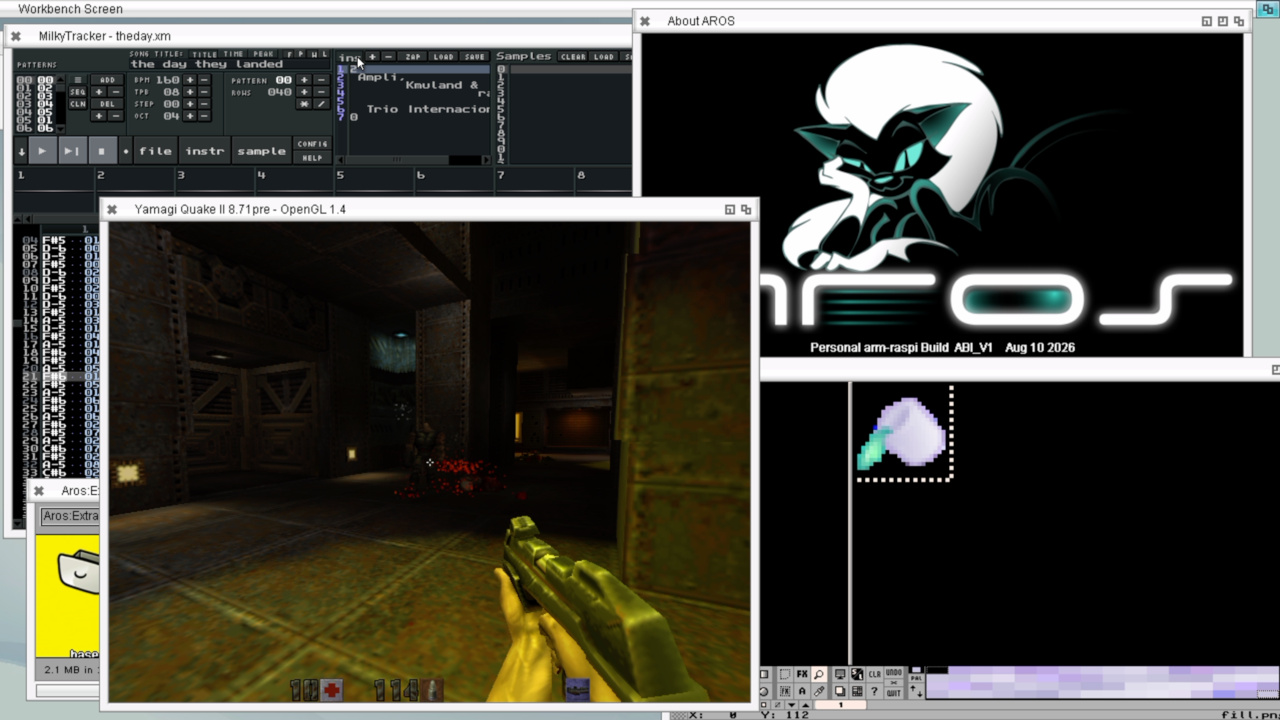
AROS now boots directly on Raspberry Pi hardware
The AROS Research Operating System, an open-source project that recreates the classic Amiga environment, has been ported to run bare metal on the Raspberry Pi, according to Hackaday. The release covers both 32-bit and 64-bit variants, which means a 64-bit Amiga-compatible operating system now runs natively on ARM processors.
The "bare metal" part is the headline. Until now, running AROS on a Pi meant running it virtualized inside Linux, which put it in roughly the same camp as the many Amiga emulators already available. The new port boots straight onto the hardware with no host operating system in between, turning the Pi into an AROS machine rather than a Linux box imitating one.
One more port in a crowded family
AROS has a long history of jumping between processor architectures. As Hackaday notes, builds already exist for x86 and PowerPC — the PowerPC work contributed code to MorphOS, another Amiga-descended system — alongside a back-port that brings AROS to original 68000-series Amiga hardware. There is even a RISC-V build. The Raspberry Pi port extends that pattern, with the project deliberately keeping the Amiga software tradition untethered from any single hardware generation.
Light on its feet
Two practical attractions stand out. Hackaday describes the port as an extremely lightweight OS option for the Pi, with boot speeds in the same league as RISC OS, long the benchmark for lean ARM systems. And for former Amiga users, it offers a modern, cheap, easily bought platform to play with instead of hardware approaching four decades in age.
Early days, thin ARM software
Some applications have already been recompiled for ARM, but Hackaday is upfront that the ARM software selection is not yet as complete as the x86 catalogue, a gap expected to narrow as the port matures. The project remains a work in progress. The Raspberry Pi 3 is the current target, though forum discussions referenced by Hackaday talk about extending support to the Pi 4 and even the tiny Zero 2 W. A demonstration video by Dan Wood, sent to the site by reader Stephen Walters, shows the system in action.
Why it matters
For the Amiga community, the release provides a way to run Amiga-compatible software on current, purchasable hardware without an emulation layer sitting between the OS and the machine — simpler to deploy and free of virtualization overhead. For the wider hobbyist OS scene, it is evidence that alternative operating systems remain practical on mainstream ARM boards: the Pi already hosts Linux distributions and RISC OS, and now adds a third lineage rooted in 1980s personal computing. Because AROS already spans x86, PowerPC, 68k and RISC-V, the ARM port makes it one of the more portable hobbyist OS projects around, and improves the odds that the Amiga software library outlives the machines it was originally written for.
- #amiga
- #aros
- #raspberry-pi
- #arm
- #retro-computing
- #operating-systems