· via Hacker News – Front Page (native)
Bitly confirms hijacked old links in Burger King, McDonald's and Trump tweets
Bitly says attackers re-registered dormant short links, sending 2011 Burger King and McDonald's tweets to unrelated Wikipedia pages, and has deactivated the affected URLs.
What happened
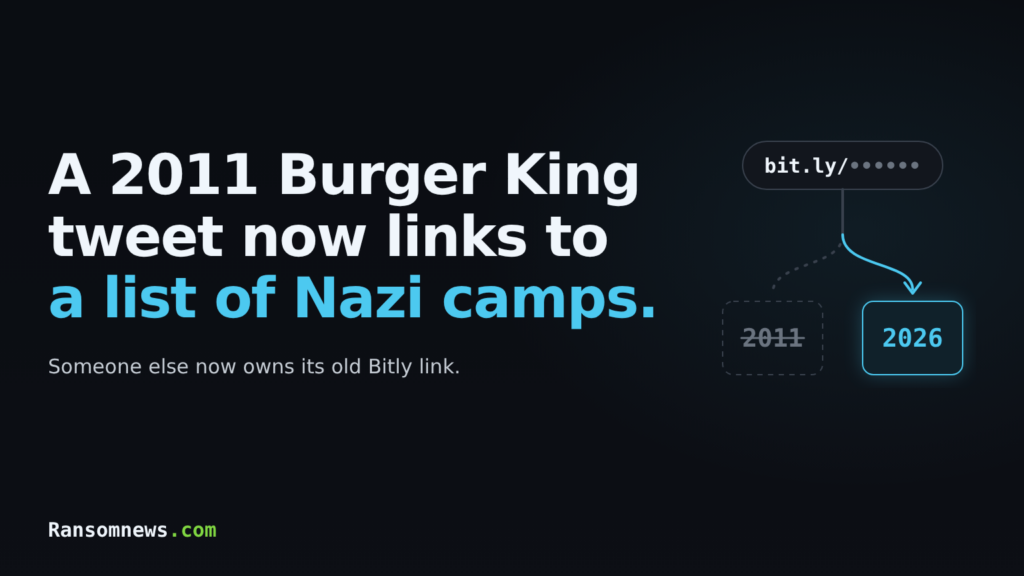
On 15 November 2026, a fifteen-year-old Burger King tweet began sending anyone who clicked its short link to a Wikipedia article listing Nazi concentration camps. The chain's X account had not been broken into; the tweet still read as it always had, promoting a restaurant locator. What changed was the destination of the Bitly link embedded inside it.
According to reporting by Ransomnews, the link was re-registered on Bitly at 05:32 UTC that morning by someone with no connection to Burger King. An X post drawing attention to the redirect gathered more than 2 million views within hours, and the original tweet later became unavailable. It is not known whether Burger King or X removed it.
Eighteen minutes earlier, a Bitly link inside a McDonald's tweet from June 2011 had been claimed the same way, this time pointing at Wikipedia's article on the September 11 attacks.
Bitly confirms the incident
Bitly initially posted nothing publicly. By 19:13 UTC it had acknowledged the problem on X, saying it had found an issue that let attackers take over certain dormant links and send people to content unrelated to the original posts. The company said it suspended the accounts involved and was disabling the affected links. Ransomnews verified that by 19:22 UTC both the Burger King and McDonald's links returned Bitly's "Link Deactivated" page.
How the hijack works
A short link has two parts: the domain and the "back-half," the string after the slash. Bitly generates that string at random or lets users pick a custom one. If a back-half from a dead link can be claimed again, whoever claims it decides where every tweet, email, PDF or printed QR code carrying that link now leads. No password is stolen and no account is breached, so the brand that posted the link years ago sees nothing wrong.
That mechanism contradicts Bitly's own documentation. Its help pages state that a bit.ly back-half cannot be reused even after the account behind it is deleted, and a separate page says accounts left inactive for three years are deleted. Yet Ransomnews found back-halves appearing in tweets from 2009 to 2012 attached to links created between 2023 and 2026.
The reporting method is simple: Bitly keeps a public information page for every short link, reached by adding a plus sign to the address, which shows the destination and creation date. Ransomnews tested this on links nobody disputes, and the creation dates on the hijacked ones plainly do not match the tweets they sit in.
A wider pattern
Ransomnews also examined 97 Bitly links in Donald Trump tweets from 2009 to 2013, taken from a public archive. Forty remained original. Forty-nine had been re-created later but still led where the tweets suggested, 48 of them in a 17-minute stretch on 26 May 2023. Seven pointed somewhere new and one was blocked by Bitly as malicious or spam. Four of those seven were registered on 15 November 2026 between 07:49 and 09:57 UTC, opening a Roblox profile, a YouTube video and a Wikipedia article about Trump and Jeffrey Epstein. One April 2011 tweet containing three links to videos of Trump's children had all three replaced.
Nor is this the first occurrence. In February 2025, Disruptionist reported that memecoin promoters had seized Bitly links in 2013 posts by Donald and Melania Trump and pointed them at token listings, using a bug that let back-halves be claimed once the original link or account was gone. Bitly reportedly fixed that bug — but the links created on 15 November 2026 show the same manipulation is possible again.
The X user Alex Greenland, who noticed the near-identical timestamps on the Burger King and McDonald's links, suggested one person or group is probably behind both changes; nothing confirms this. By late evening UTC, none of the seven Trump links pointing somewhere new still redirected.
Why it matters
Short links are woven through decades of published material — old tweets, news articles, documentation, printed collateral — and most readers assume a URL inside a brand's own post is trustworthy. This incident shows that trust rests entirely on a third party's account lifecycle rules holding firm. If a back-half can be re-registered years later, every dormant short link becomes a latent attack surface, and the organisation that posted it may never notice. The practical lesson for anyone with archives full of legacy short links is to audit them, replace them with URLs on a domain you control, or accept that what an old post says and where it actually sends people can quietly diverge.
- #security
- #bitly
- #short-links
- #url-shorteners
- #social-media