· via Hacker News – Front Page (native)
ChatGPT-style client runs on Super Nintendo via 2.2M-parameter Super FX model
An unofficial project puts a ChatGPT-style chat interface on the Super Nintendo, running a roughly 2.2-million-parameter language model on the cartridge's Super FX 2 chip, with an optional 150,000-article fact book.
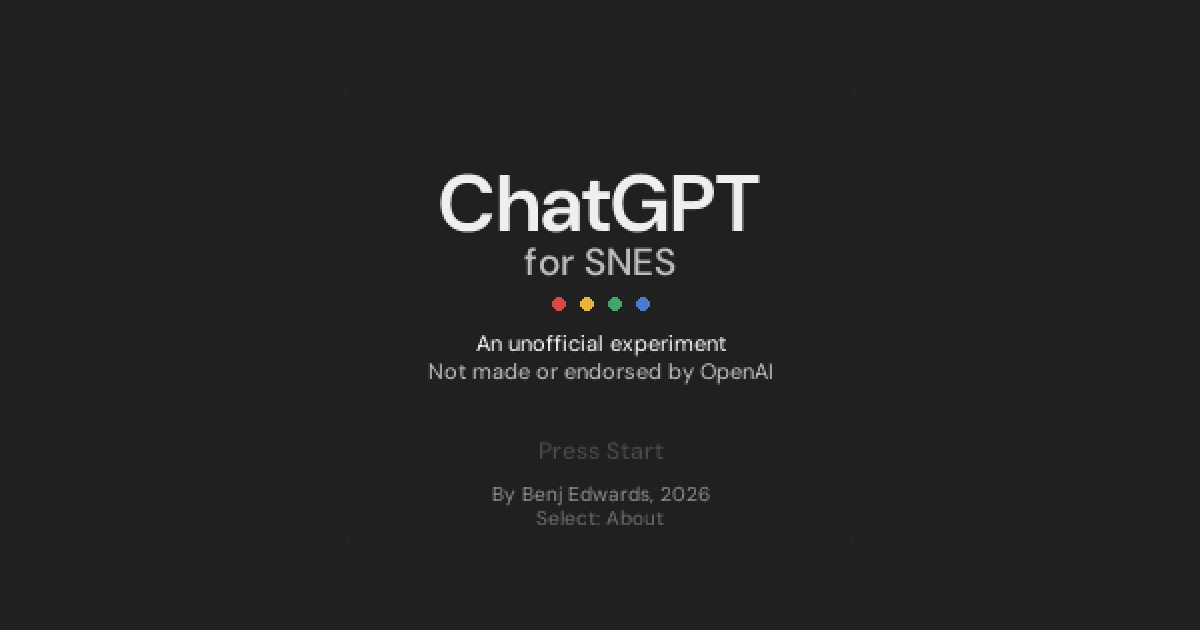
A hobbyist project has produced a working ChatGPT-style chat client for the Super Nintendo. According to the project's site, which reached Hacker News's front page, ChatGPT for SNES was designed by Benj Edwards and coded by AI agents; the current release is version 0.7, dated 2 November 2026. The page is explicit that the experiment is unofficial and neither made nor endorsed by OpenAI.
A language model on a cartridge co-processor
The unusual part is where the model runs. The project page says a small language model of roughly 2.2 million parameters executes on the Super FX 2 chip in the cartridge, an enhancement chip that some Super Nintendo cartridges used to go beyond the stock console hardware. The model generates each answer a word at a time, and in the standard build every word it writes comes from the model itself rather than from stored text.
The conversations used to train the model were written by gpt-oss-120b, OpenAI's open-weight model. Capability is deliberately modest: per the page, the model has a vocabulary of about 8,000 words, is millions of times smaller than the systems that power ChatGPT, and often gets things wrong, sometimes with full confidence.
A fact book stands in for web search
A second build adds what the page calls a fact book: the first sentences of 150,000 Simple English Wikipedia articles, stored in the cartridge's MSU-1 data file. The mechanics parallel web search in a modern chatbot, in that the model itself decides when to look something up and then prints what the book contains. The page cautions that the fact book can carry mistakes of its own.
How to try it
The simplest route is the browser. The site runs the ROM in the Snes9x emulator, loading about 4 MB on a first visit, or 19 MB with the fact book. After pressing Start on the title screen, users type and press Enter to send; Page Up and Page Down scroll, and Backspace deletes. The keyboard also stands in for a controller (arrows for the d-pad, X for A, Z for B, A for Y, Enter for Start), and typing works by moving a cursor across the game's on-screen keyboard, so each letter appears after a brief pause.
On real hardware, the v0.7 download is a 1.5 MB zip containing a single .sfc file, and it requires a Super FX-capable flash cart, such as an FXPak Pro or an sd2snes with current firmware, with the SuperFX speed option left at Normal. The fact-book variant is a 17 MB zip holding the .sfc file plus an .msu file; it needs MSU-1 support, and both files must sit in the same folder under unchanged filenames. Photographs on the page show the client running on an original console and a CRT television from an sd2snes flash cart.
The project page also points to a kindred effort, Séance, which runs a tiny language model on original NES hardware.
Why it matters
Nobody should expect real assistance from this thing, and the page is blunt about that. Its interest is as a limit test: it shows how far a modern chat interface can be shrunk before it stops resembling one at all, and it makes the scale gap concrete by pairing an 8,000-word, 2.2-million-parameter model with 1990s console silicon. It is also a compact case study in AI-assisted development, with AI agents writing the code and an open-weight model producing the training conversations. And with its fact-book lookups, it sketches in miniature the same generate-then-retrieve pattern that full-scale chatbots use when they search the web.
- #snes
- #retro-computing
- #language-models
- #homebrew
- #emulation