· via Hacker News – Front Page (native)
Energy-Based Reasoners hit 99.9% on Sudoku-Extreme with 345x less inference compute
Researchers from Duke, UIUC and Harvard recast looped reasoning models as energy-based models that score, refine and stop their own latent states, hitting 99.9% on Sudoku-Extreme with 345x less inference compute.
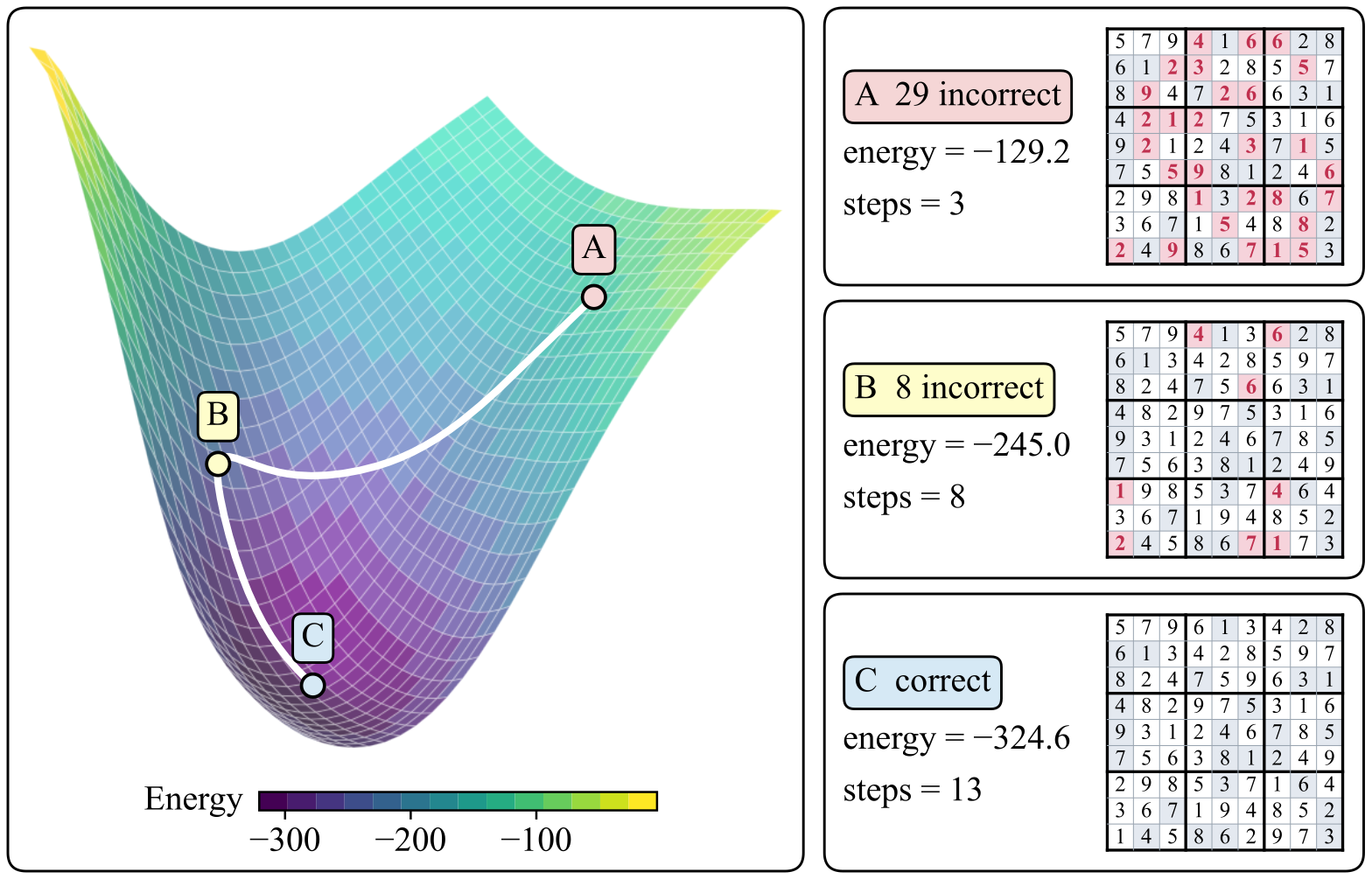
Energy-based reasoning with a built-in stopping rule
A research team from Duke University, the University of Illinois Urbana-Champaign and Harvard has introduced Energy-Based Reasoners (EBRs), reasoning models that train a network to assign an energy value to each latent reasoning state and treat every pass of the reasoning loop as a gradient-descent step that lowers that energy. According to the paper, an EBR with only 1.8 million parameters reaches 99.9% accuracy on Sudoku-Extreme while using 345× less inference compute than the next-best model. The project page, which surfaced on Hacker News's front page, argues in its title that recurrent reasoners should be built this way.
How the model works
Looped models repeatedly apply a recurrent block so they can scale their effective depth and reason in latent space. The authors' critique is that existing looped reasoners update their latent state with no explicit signal of progress, so there is no principled way to decide when to stop iterating or whether the current state is any good. EBRs address this by learning an energy function that rates how compatible a latent state is with the input, where lower energy means better compatibility. That one function plays four roles: it scores states, its gradient supplies a direction for refinement, a shrunken gradient marks a stationary state and therefore a natural place to stop, and the lowest-energy candidate wins when several solutions are proposed. Because the model grades its own states, no external verifier is needed. For training, the authors introduce exploration-based training, which pushes the model to find additional solution modes and shape the energy landscape across a wider range of states. Since the update behaves like stochastic gradient descent, the model can settle into different low-energy basins and surface many distinct valid solutions for problems that have several.
Benchmark results
Across four algorithmic reasoning benchmarks, EBRs match or outperform prior recurrent reasoning models. On Sudoku-Extreme, the 1.8M-parameter EBR achieves 99.4% single-sample accuracy, the best among the compared reasoning models, which range from 5–10M parameters (TRM, EqR, FPRM, GRAM and looped flows). With five samples it reaches 99.9% on Sudoku-Extreme and 88.3% on Maze-Hard, ahead of EqR, which needs 128 samples to hit 99.8%. The paper reports EBRs reach EqR's best accuracy with 7× fewer iterations and 43× fewer samples. Adaptive stopping, which ends each trajectory once its energy gradient falls below a threshold, lets easy puzzles finish in a few steps while hard ones keep going; it preserves 99.9% accuracy while using 10.9× fewer FLOPs than a fixed-depth EBR and 345× fewer FLOPs than EqR overall, at comparable training compute. On multi-solution problems, EBRs solve N-Queens at 100% (8×8) and 99.5% (10×10) single-sample accuracy with zero conflicts, and with 20 samples they cover 98.1% and 92.0% of distinct valid solutions. On Graph Coloring they cover 88.6% (8-vertex) and 54.5% (10-vertex) of solutions, ahead of the GRAM and TRM baselines.
Caveats
Two things are worth noting. The project's headline claims 385× efficiency, but every figure in the paper itself states 345×; this article uses the paper's number. Also, all four benchmarks are algorithmic puzzles with clean, mechanically checkable solutions, precisely the setting where an energy landscape is easiest to learn. The paper does not report results on open-ended language reasoning, so any effect on production inference costs remains prospective rather than demonstrated.
Why it matters
Inference cost dominates the expense of deployed reasoning models, and much of it comes from chain-of-thought loops that run without a dependable signal of when to stop. EBRs attack that directly: the same function that refines an answer also grades it and decides when to quit, removing the need for a separate verifier and cutting wasted iterations. Adaptive stopping makes compute roughly proportional to difficulty, so cheap inputs cost little while hard inputs earn more, which is exactly the profile serving infrastructure wants under mixed workloads. And a 1.8M-parameter model matching systems three to five times its size points to genuine architectural efficiency. Whether energy-based objectives transfer from Sudoku grids to large language models is the open question, but the benchmark gap reported here is large enough that anyone optimising AI serving costs will take it seriously.
- #energy-based-models
- #machine-learning
- #inference-efficiency
- #reasoning-models
- #research