· via Hacker News – Front Page (native)
Erin Brockovich launches map tracking US AI data centers and community pushback
Environmental advocate Erin Brockovich has launched a public map of US AI data center projects by status, layered with resident-submitted concerns and built partly on open data from Compute Atlas and Epoch AI.
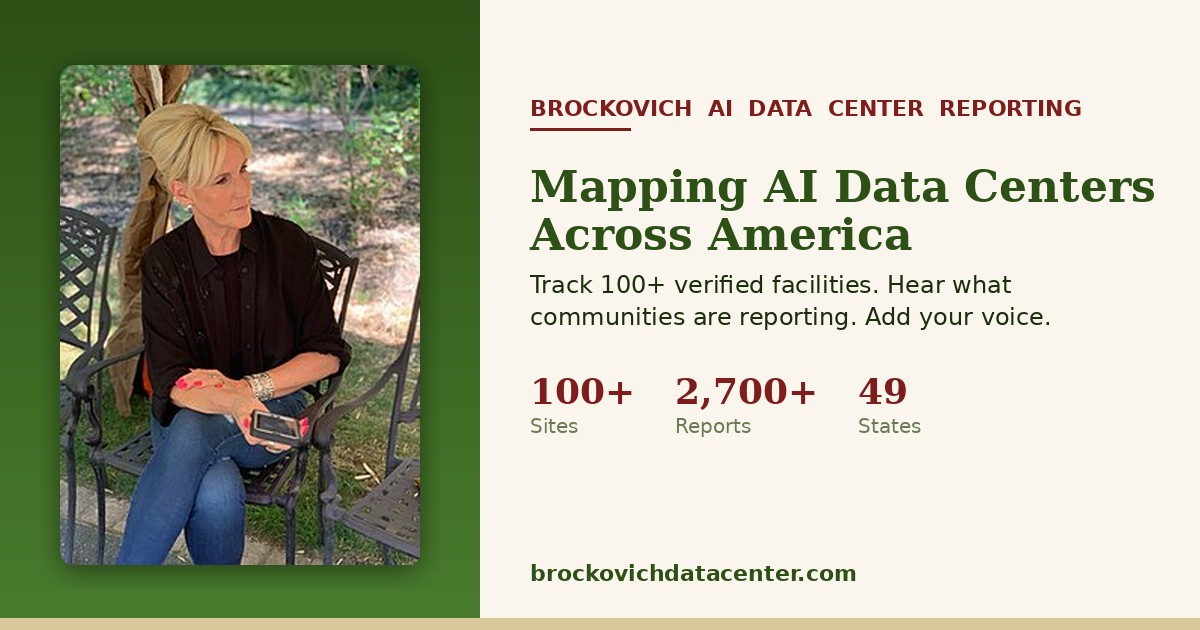
Environmental advocate Erin Brockovich has launched a public map that tracks AI data center construction across the United States alongside reports of local concern submitted by residents. The project, published on the Brockovich Data Center Reporting site, frames the AI buildout as something unfolding community by community — with some projects welcomed and others slowed, fought over or called off entirely. Its data was last updated on October 4, 2026, according to the site, and the project gained wider visibility after a link reached the front page of Hacker News on October 10.
What the map shows
The map plots major AI-focused and hyperscale facilities in five categories: operational, under construction, permitted, proposed, and cancelled. A sixth layer, labeled "community reported," marks locations where residents have written in with concerns about nearby data centers. Clicking a marker opens details about the site, and each popup lists the citations behind it, the site says.
The project is explicit about its limits. It covers publicly announced, major facilities — including ones that were withdrawn or blocked — and is not a registry of every data center in the country. Smaller or unannounced sites are left out, and the site invites visitors to submit missing entries. Community-reported pins are also approximate: according to the site, they may reflect a reported ZIP code or a nearby area rather than an exact location.
How the data is assembled
According to the site, facility locations are compiled from Compute Atlas and Epoch AI, two datasets released under the CC BY 4.0 license, supplemented by news reporting and public filings. Some coordinates are approximate, and popups flag those cases.
One detail stands out: each popup states whether a site sits inside a municipality's boundaries or on unincorporated county land. That distinction determines who runs the zoning hearing — a city council answerable to nearby residents, or county commissioners whose districts may not include the closest neighbors. The site says coordinates are checked against US Census Bureau TIGER boundary data, and where a pin is imprecise or the mapped county conflicts with the county on record, the popup says so rather than asserting a boundary the data cannot support.
The concerns it raises
Alongside the map, the project lists six areas of concern: energy consumption and its effect on local utility costs, water usage by cooling systems, electronic waste from frequent hardware replacement, siting risks in areas exposed to natural disasters or flooding, strain on local planning from rapid scaling, and noise from cooling systems, generators and substations. A reporting form lets residents describe what they have witnessed where they live, feeding the community layer of the map.
In her introduction on the site, Brockovich describes watching communities show up and speak out, and invokes a Mark Twain line about the value of simply getting started.
Why it matters
Most public visibility into AI infrastructure comes from company announcements, analyst estimates and scattered local news stories. This tracker stitches those threads together and adds a layer that is rarely captured anywhere: where residents are actively pushing back. For communities, it aggregates information about projects that often move through permitting with little attention until construction begins. For journalists and researchers, it packages open-licensed datasets with a conflict overlay that is difficult to assemble by hand.
The caveats matter as much as the map. Community reports are unverified, locations can be approximate, and coverage stops at major projects. But the inclusion of a "cancelled" category is a quiet acknowledgment that opposition sometimes succeeds. As AI compute demand pushes large-scale construction into places that never hosted data centers before, disputes over power, water and noise are where national AI ambitions meet local politics — and this project is an attempt to hand communities a clearer picture of what is arriving around them.
- #data-centers
- #ai-infrastructure
- #environment
- #public-data
- #mapping