· via Hacker News – Front Page (native)
FAA nationwide ground stop clears U.S. skies while Amtrak booking fails under the rush
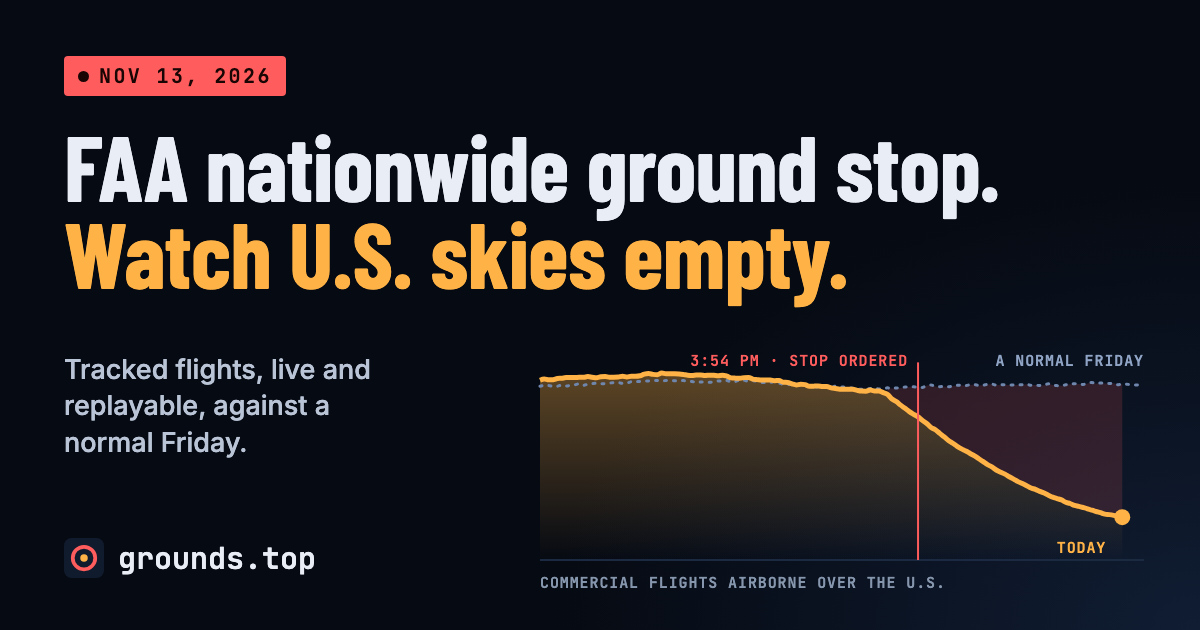
The FAA halted departures at every U.S. airport at 3:54 p.m. ET on Nov. 13, 2026, citing a telecom outage; Amtrak's booking systems failed as travelers rerouted, and an unofficial map visualized the emptied skies.
A rare nationwide stop
On the evening of Friday, Nov. 13, 2026, the Federal Aviation Administration ordered a ground stop covering every airport in the United States, issued at 3:54 p.m. ET according to the description on an unofficial tracking page built for the event. FOX 5 DC reports that the order was the first nationwide ground stop since January 2023 and only the second since the attacks of Sept. 11, 2001. The FAA attributed the decision to what it called a "temporary telecommunications outage."
The immediate effect was thousands of stranded travelers scrambling for alternatives — and one of those alternatives promptly buckled.
Amtrak's booking pipeline fails
According to FOX 5 DC, Amtrak's ticket-booking website and app began returning errors Friday afternoon, with travelers posting screenshots of the failures on social media. The outage tracker DownDetector logged hundreds of reports starting shortly before 5 p.m., followed by a second surge just before 6 p.m.
Amtrak's own explanations pointed in two directions. Communications Director W. Kyle Anderson told the station that train service itself was running normally and that the railroad was simply seeing unusually heavy demand across its network. Separately, in a reply to a frustrated customer on X, Amtrak officials linked the booking problems to a system-wide update, without providing further detail. When FOX 5 DC called the support number shown alongside the error message, an automated recording said calls could not be taken because of unusually high call volume.
The two accounts — a demand surge and a scheduled update — are not necessarily contradictory, but Amtrak did not reconcile them, leaving open how much of the failure was load and how much was the upgrade.
A replayable map of a country not flying
The aviation side of the story received a striking visual treatment: a page titled Ground Stop Watch, which reached the Hacker News front page, plots tracked aircraft over the United States live and lets visitors replay the event against the same time window one week earlier.
Commercial flights are binned by altitude — below 10,000 feet, between 10,000 and 28,000 feet, and above 28,000 feet — so the low-altitude layer visibly thins out as climbs and approaches stop. Each airport carries a color-coded dot summarizing departures in the previous 30 minutes compared with a week earlier: red for almost none, amber for reduced, green for near normal. The page also counts flights that are "missing from the sky," meaning aircraft that were airborne at the same moment the previous Friday but had no counterpart during the stop.
The site is transparent about its methodology. Flight positions come from adsb.fi's community ADS-B receiver network, and airport delay information is drawn from the FAA's own NAS Status feed. The estimated count of missed departures since 3:30 p.m. ET is calculated per airport as last week's total for the same hours minus this week's, derived from tracking data rather than official FAA figures. The page also notes a limitation of the FAA feed: during a nationwide stop, every airport is affected whether or not it has a specific entry listed.
Why it matters
Two things make this incident worth attention beyond Friday's disrupted travel. First, it exposes how tightly coupled American transportation infrastructure is. A telecommunications fault inside the FAA grounded the entire national airspace, displaced travelers pivoted to rail, and Amtrak's booking systems failed at precisely the moment demand peaked — whether from that surge, an internal update, or a combination the railroad has not clarified. One weak link produced failures across two networks.
Second, the map demonstrates what community-run data infrastructure can achieve during a crisis. Using volunteer ADS-B receivers and a public FAA feed, an independent developer produced a live, replayable record of an event that has happened only twice in a quarter century, with week-over-week baselines that turn scattered dots into measurable evidence of disruption. As regulators face questions about the resilience of the systems behind the stop, artifacts like this one are likely to become the reference point for understanding what an emptied national airspace actually looked like.
- #faa
- #aviation
- #amtrak
- #outage
- #data-visualization