· via Hacker News – Front Page (hnrss.org)
Fields medalist at UC Berkeley stops grading homework as AI use makes scores meaningless
UC Berkeley professor and Fields medalist Richard Borcherds says he now grades homework only on completion because AI makes correctness scores meaningless, and he is unsure whether to advise students to pursue mathematics.
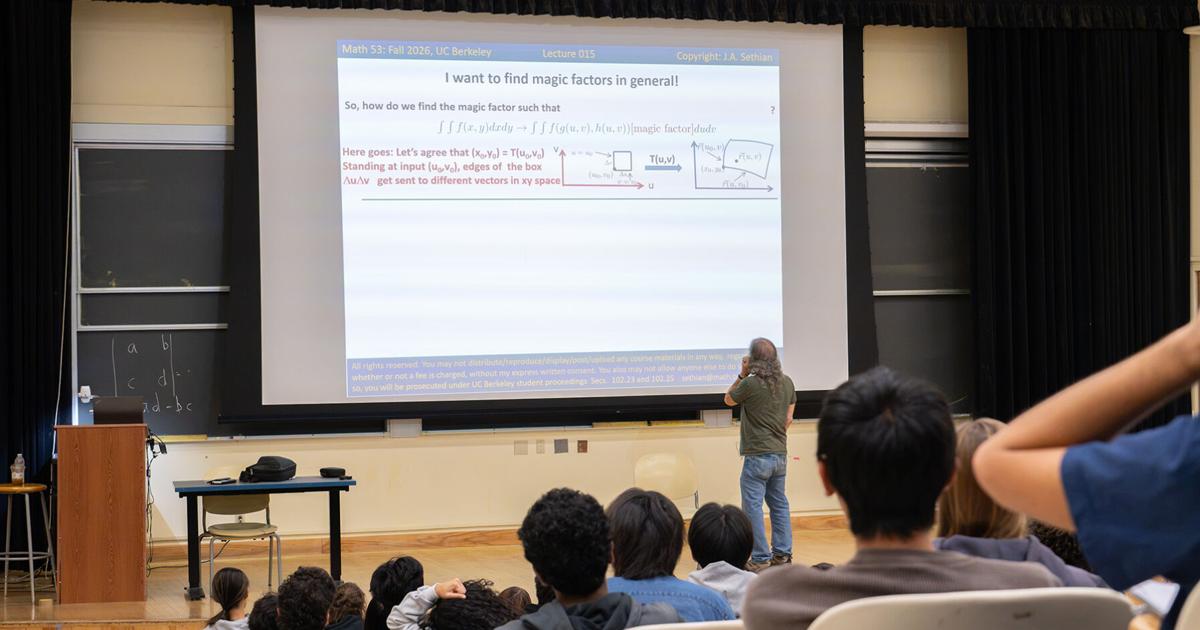
A Fields medalist gives up on grading correctness
Richard Borcherds, a mathematics professor at UC Berkeley and a Fields medalist, has stopped grading his students' homework for correctness. According to The Daily Californian, which interviewed him, Borcherds made the change after watching students use AI to consistently earn top marks, leaving what he called "no point" in paying readers to grade homework for correctness. AI use, in his assessment, has become unavoidable.
His replacement system is minimal: homework is now graded on completion if it is handed in at all. Borcherds conceded to the student newspaper that this is "not a very good system," but said that for the moment he sees no alternative.
The timing: a claimed breakthrough in mathematics
The Daily Californian reports that Borcherds disclosed the change in an interview that followed OpenAI's announcement that its AI agents had apparently solved the Navier–Stokes existence and smoothness problem, one of the most difficult unsolved problems in mathematics. Against that backdrop, Borcherds offered a stark forecast: if AI keeps improving at its present rate, within a few years there will be nothing human mathematicians can do that AI cannot do better.
Doubts about advising students into mathematics
Borcherds said he no longer knows what to tell students considering the field. Five years ago, he noted, becoming a mathematician looked like one of the safest career bets in an AI-driven economy, and that assumption has now collapsed. He said he has even posed the question of what to advise to ChatGPT, and that the chatbot itself said it had no idea what was going to happen.
He also expects the academic system to react slowly. Describing substantial inertia in how universities operate, he said he would not be surprised if the math department carried on as usual for a couple more years despite AI progress, comparing the situation to print journals, which in his view have been "utterly pointless" for two decades and still publish. He placed the disruption in historical context: looms ended hand weaving and motor cars ended the era of horses, but nothing comparable had ever happened in mathematics before.
How UC Berkeley is handling AI coursework
At the campus level, policy remains decentralized. The Berkeley Division of the Academic Senate asks faculty to include a statement about course expectations, covering the use of AI tools, in their syllabi, according to Anne Marie Richard, assistant vice provost for undergraduate education and chief academic technology officer. The actual rules vary dramatically depending on course level and subject area.
The university has tested several AI-detection tools, including Turnitin and Rumi, but concluded that none is reliable enough to be standardized campus-wide. Faculty who want guidance can pull sample AI-use statements from the campus AI Hub, the university's directory of AI tools, training and policies.
Why it matters
A Fields medalist deciding that correctness-graded homework no longer measures anything is a concrete marker of how deeply generative AI has penetrated assessment. The story is not about one professor's preference; it reflects a structural problem. Homework correctness has been a backbone of mathematics instruction, and it is now trivially gameable, while the detection tools Berkeley evaluated were judged inadequate for institution-wide use. That leaves individual instructors to improvise, and in Borcherds's case the improvisation amounts to abandoning homework as an evaluation signal altogether.
Borcherds's uncertainty about career advice matters just as much. Mathematics was widely considered one of the fields most insulated from automation, and a leading practitioner now says he cannot say whether students should enter it. His expectation that academia will drift on unchanged for years, the way he argues print journals have, suggests the gap between AI capability and institutional response is likely to widen before it closes.
- #ai
- #education
- #uc-berkeley
- #mathematics
- #academic-policy