· via Hacker News – Front Page (native)
Firenook launches Rust Firebase emulator replacement claiming 40x faster writes and 10x less memory
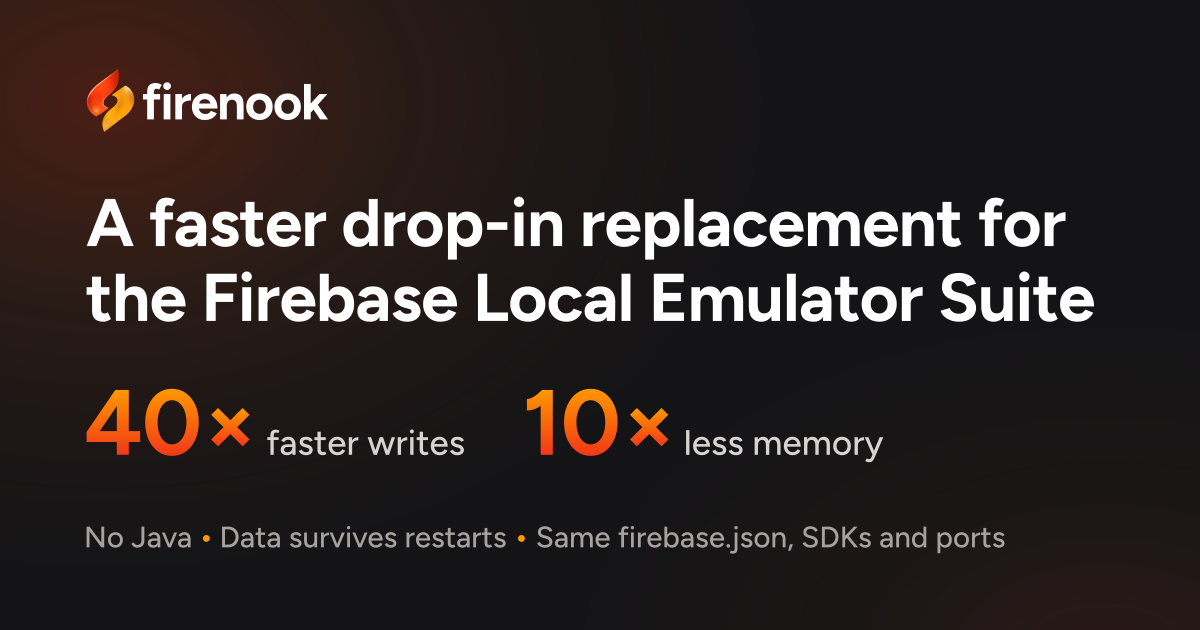
Firenook, a Rust rewrite of Google's Firebase Local Emulator Suite that reached Hacker News' front page, claims 40x faster writes and a tenth of the memory while keeping existing configs, ports and SDKs.
What launched
Firenook, a Rust reimplementation of Google's Firebase Local Emulator Suite, appeared on the Hacker News front page on November 6, 2026. The project pitches itself as a near drop-in substitute: developers swap firebase emulators:start for firenook emulators:start in their package scripts and leave the rest — the firebase.json config, SDK setup, ports and import/export format — as it is. Google's firebase-tools CLI is still needed for deploying, and the project intends the two to sit side by side.
The performance claims
The headline figures on the project's site come from a benchmark it ran itself: two hours of a production app's traffic replayed against each emulator suite in turn, on a single server, with every operation timed from the client side. The test app held 211,205 Firestore documents and 6.7 GB in Cloud Storage.
By Firenook's measurements, median writes took 5.1 ms against 208.2 ms for the official emulator, peak memory was 2.11 GiB against 22.57 GiB, and a restart with data preserved finished in 0.59 s versus 30.8 s. Listener updates came out roughly 19 times faster, a small ordered query 8 times faster, and total CPU use over the run fell by about 61 percent, from 1,586 s to 616 s. The project reports its suite answered 25 of 26 query shapes more quickly and tied on the remaining one. These are the vendor's own numbers and have not been independently verified.
Compatibility and coverage
Firenook emulates eight services on their usual ports: Firestore (8080), Authentication (9099), Cloud Storage (9199), Cloud Functions (5001), Pub/Sub (8085), Cloud Tasks (9499), Eventarc (9299) and Extensions. Firestore support includes realtime listeners, Security Rules and named databases; the Auth emulator covers password, email link, phone, MFA, passkeys, tenants and blocking functions; Functions handle HTTP, callable and streaming entry points, with code reloading on save.
Realtime Database, Hosting, App Hosting and Data Connect are not emulated, though the project says a firebase.json that configures them will still start, with a warning. Data moves between the two suites in the official export format in both directions, so returning to Google's emulator remains possible.
Persistence, tests and tooling
A --keep-data flag keeps Firestore, Auth and Storage state across restarts — the project claims a return in about half a second even with millions of documents — removing the export-then-import cycle the official suite needs between runs. On a crash, Firenook says at most the final second of writes is lost, where the official emulator can lose everything since its last export.
emulators:exec starts the suite, runs a command once everything is ready and forwards the exit code, which is aimed at CI pipelines; there is no Java runtime to provision, though Node is still what executes Functions, as in production.
Two features go beyond parity with Google's tools. A built-in console, served on the Emulator UI port, shows live calls and outcomes for Functions, Pub/Sub, Cloud Tasks and Eventarc — services that Google's own Emulator UI only surfaces as a log. And firenook mcp exposes 54 tools to coding agents such as Claude Code, Cursor and VS Code, letting an agent inspect failed function calls, ask why Security Rules denied a request and replay invocations locally.
Why it matters
The Firebase emulators sit in the inner loop of a large number of development and CI workflows, and their Java footprint, memory appetite and restart cost are recurring complaints. If Firenook's numbers hold up outside its own benchmark, the practical effect is faster test cycles, cheaper CI runners and local suites that survive restarts — without touching application code. The MCP integration also tracks a broader shift toward agent-driven development, where giving an autonomous assistant safe, read-and-replay access to a local environment is becoming expected. The trade-offs are that this is early-stage software — the current release is 0.2.1 — with incomplete service coverage, so teams relying on Realtime Database or Hosting will still need Google's suite alongside it.
- #rust
- #firebase
- #developer-tools
- #local-development
- #testing