· via Hacker News – Front Page (native)
First text read from carbonised Herculaneum scroll PHerc 343 wins $50k prize
The Vesuvius Challenge has awarded its $50,000 First Letters Prize to Dutch engineer Erwin Nieuwlaar for the first-ever text read from the still-rolled scroll PHerc 343, carbonised in the AD 79 eruption.
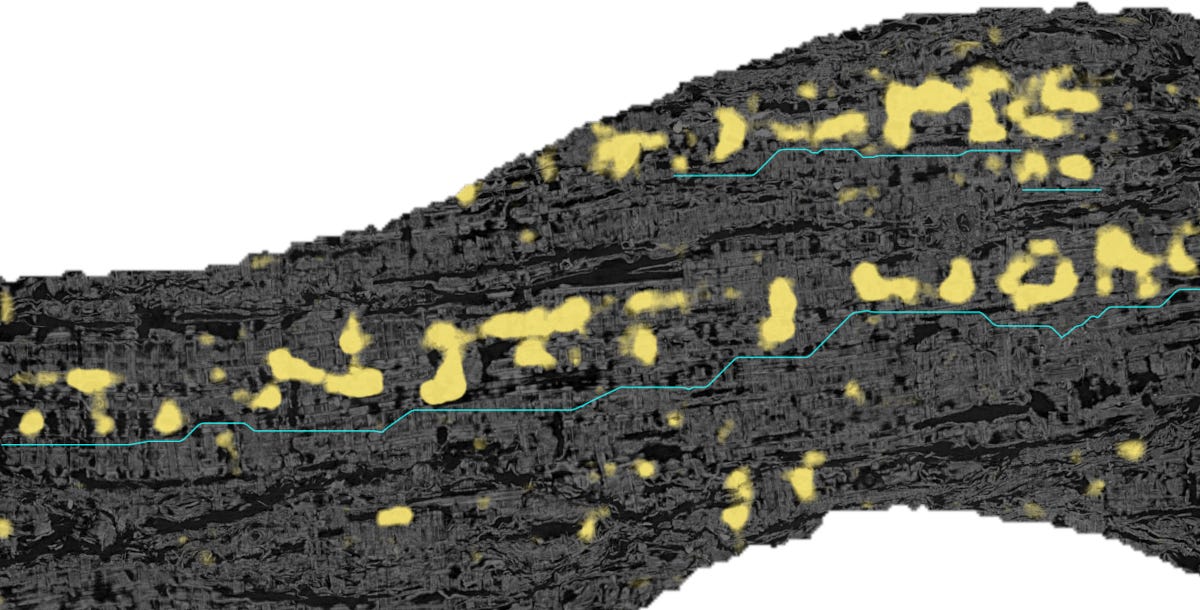
First letters from a sealed scroll
The Vesuvius Challenge has awarded its $50,000 First Letters Prize to Erwin Nieuwlaar, a freelance software engineer from the Netherlands, for producing the first text ever read from the Herculaneum scroll PHerc 343 since it was buried in AD 79. According to the announcement on the Scroll Prize blog, his submission was the first to clear the competition's strict technical and papyrological bar: ten readable letters within four square centimetres of papyrus.
The scroll, held at the Biblioteca Nazionale di Napoli and about 14 centimetres long, has never been physically unrolled. Nieuwlaar read it non-invasively, using CT scanning and machine-learning ink detection. The winning segment contains portions of four lines, with the third the most legible. On its own that line meets the ten-character target, showing the Greek sequence πα̣ντ̣ογιν̣ομ̣, which most of the project's papyrologists read as part of the expression πᾶν τὸ γινόμενον — "everything that happens" or "everything that is generated".
How the reading was produced
According to the Vesuvius Challenge, Nieuwlaar traced the scroll's inner surface using the project's open-source spiral-fitter, originally developed by Paul Henderson and Sean Johnson. He adapted the tool to run on an 8.64 µm scan of PHerc 343 and supplied his own estimate of the scroll's central axis, the umbilicus. He also devised a new technique for snapping the extracted surface segments more precisely onto the papyrus. The letters sit on two adjacent windings of the roll, whose meshes he joined into a single segment.
For ink detection, he ran four existing models trained on 9 µm scans and averaged their outputs: two variants of ink_9um originally trained by Elian Rafael, Hecate created by Giorgio Angelotti, and dense_native, his own fine-tune trained on a different scroll, PHerc 0139. Crucially, none of these models had been trained on PHerc 343 itself, and the organisers present this as evidence that ink-detection models are now generalising across scrolls rather than memorising a single object.
From bug fixes to a first prize
In his own account on the Scroll Prize blog, Nieuwlaar, who works on digital identity for the Netherlands Chamber of Commerce, says the challenge initially felt impossible to contribute to, so he started small by fixing bugs. That led to a first prize in July and, he says, a large boost in confidence. He then travelled to Naples, where staff at the Officina dei Papiri made an exception and gave him a tour of the scrolls, after which he bought a second-hand RTX 3090 and rented GPUs for the heavier runs — roughly $300 in rental costs so far. When he first spotted the letters, he says he shouted at his screen, in Dutch, that it was simply ink.
Other readings from the same scroll
The announcement also acknowledges later submissions on PHerc 343. Gabriel Munoz Mendonca's entry fell short of the ten-letter target but offered the sequences θεν and μ̣ουϲ̣, which cannot be securely interpreted without surrounding context. A team led by Ben Kyles, using its own ScrollFiesta! unwrapping pipeline on a different area of the scroll, found a participle of the Greek verb ἐξεργάζομαι, meaning "to bring to completion", followed by the clear letters μουϲικ, suggesting a reference to music. The Vesuvius Challenge notes that the philosopher Philodemus wrote a treatise On Music (PHerc 1497) and that music also appears in PHerc Paris 4, but says more of PHerc 343 will need to be read before the connection can be judged.
Why it matters
This is the latest marker in a fast-moving year for the project. The research team fully virtually unwrapped PHerc 1667 and revealed its ink in June, and ink has since been found in PHerc 1447, building momentum across the community to locate ink in more papyri. The PHerc 343 result carries extra technical weight because the ink models transferred from other scrolls, suggesting the method can scale rather than requiring bespoke training for every fragile object. And because the Vesuvius Challenge is an open-science effort with reproducible pipelines and shared models, an independent contributor with a consumer graphics card and a few hundred dollars of rented compute has now added text unread for some 2,000 years. The hunt for the challenge's Grand Prize is on.
- #vesuvius-challenge
- #machine-learning
- #papyrology
- #digital-humanities
- #open-source