· via Hacker News – Front Page (native)
Flapping-wing drone mimicking a bird evaded counter-drone sensors at Air Force exercise
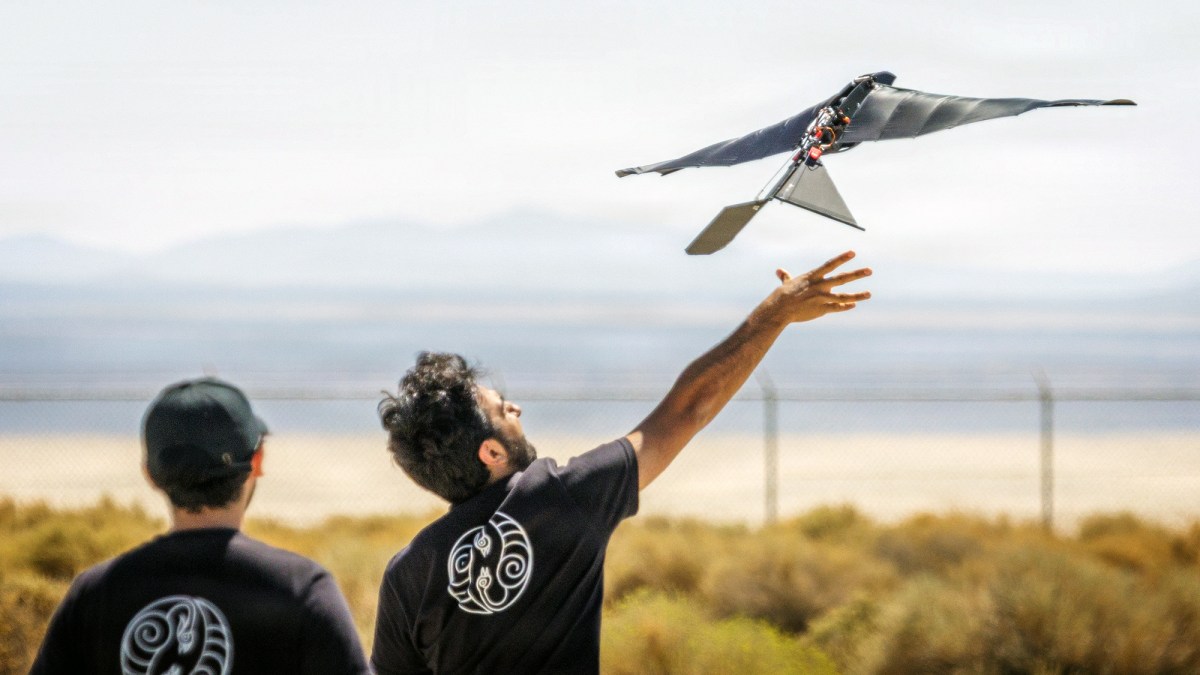
Ornadyne's O1 ornithopter, a flapping-wing drone built to resemble a bird, went undetected by counter-UAS sensors at an Air Force exercise in California, registering as a bird.
A drone disguised as a bird beat the sensors
At a U.S. Air Force technology exercise in September, a small unmanned aircraft that stays airborne by flapping its wings slipped past detection equipment fielded by other companies, according to Task & Purpose. The aircraft, the O1 from U.S. manufacturer Ornadyne, is an ornithopter — a machine that uses flapping wings rather than propellers or jets — and it is deliberately built to be mistaken for a bird.
The event, called "Game of Drones," ran at Edwards Air Force Base in Southern California's Mojave Desert, a base that hosts drone exercises each quarter. It was sponsored by the Air Force 412th Test Wing's Experimental Test Force and by the Defense Contract Management Agency's Blue List team, which approves commercial drones for sale to the U.S. military.
How the drone hides
Most drones built to evade detection try to hide the signals they emit: masking signatures, switching frequencies, using mobile SIM cards, flying autonomous pre-planned routes, or trailing fiber-optic cable to sidestep electronic surveillance. Ornadyne's approach is conceptually simpler — look like something the sky is already full of.
"It looks like a bird, it moves similar to a bird, and humans and counter-UAS systems can misclassify it as a bird," Armen Arakelyan, an Ornadyne co-founder and former SpaceX engineer, said in a Department of Defense release. He added that replacing propellers with flapping wings also makes the aircraft considerably quieter.
The company says the O1's color, wingspan, proportions and silhouette can be altered to match bird species native to the region where it flies. During the September evaluation it was configured to resemble a crow.
The result at Edwards
The exercise marked the first time Ornadyne tested the aircraft against detection systems built by other private companies, Arakelyan said. "We learned during 'Game of Drones' that sensors deployed by the other companies here could not establish our drone using their detection equipment," co-founder Geourg Kivijian said, according to Task & Purpose. "It registered as a bird, which is exactly what we wanted."
A company fact sheet puts the O1's weight at one pound, with a range of up to 10 kilometers — a little more than six miles — and endurance of over an hour. It can carry a small payload such as a camera used for target recognition on surveillance missions.
Bird drones are a category, not a one-off
Ornadyne is not the first to pursue the idea. Ornithopters are an established category of unmanned systems that imitate birds or insects in flight. Task & Purpose points to video from a 2024 People's Liberation Army exercise showing Chinese commandos, comparable to U.S. Navy SEALs, releasing a bird-like drone resembling a Eurasian tree sparrow. The publication also notes, with a wink, the satirical "Birds Aren't Real" movement, whose adherents claim the U.S. government replaced birds with surveillance drones.
Why it matters
Counter-drone defense leans heavily on classification: a sensor has to decide whether a small, slow, low-flying contact is wildlife or a threat. The O1 is engineered to land on the harmless side of that judgment, and at Edwards it did — against commercial detection systems, in what the company itself described as a first such test. That is a narrow result, but it exposes a structural weakness. As small drones grow quieter, cheaper and better at imitation, airspace monitoring that treats birds as background noise becomes easier to exploit, and defenders may need to tell aircraft from animals by behavior and context rather than silhouette alone. The same property also explains the military interest: an aircraft that defenders wave off as a crow is a discreet platform for low-altitude intelligence collection.
- #drones
- #air-force
- #surveillance
- #sensors
- #counter-uas