· via Hacker News – Front Page (native)
From latching relays to mercury tubes: a widely shared essay recovers RAM's early history
A coredump.cx essay that reached Hacker News's front page argues computer history overpraises Babbage and underplays working memory, tracing RAM from latching relays to mercury delay lines.
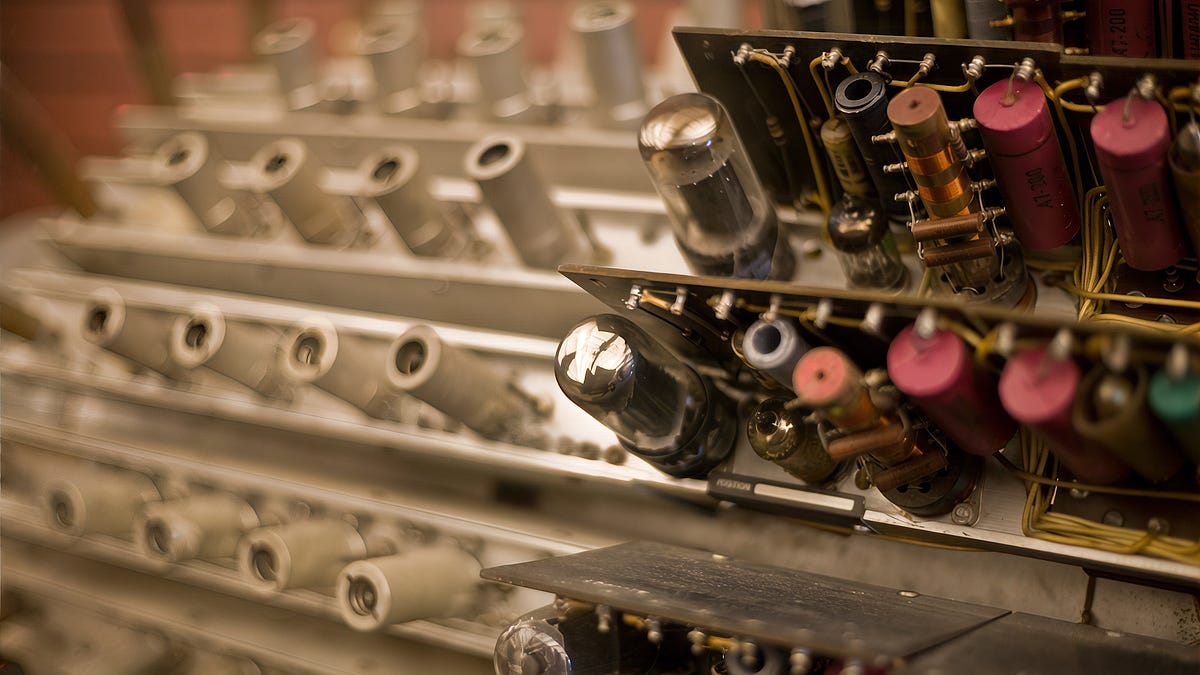
A blog essay titled "RAM: the forgotten history," published on coredump.cx and surfaced on the front page of Hacker News, makes a pointed argument: we teach the history of computers badly, and the casualty is memory itself.
Babbage and the missing chapter
The author opens by revisiting a complaint first made in a 2023 article about the evolution of calculators. Standard histories, the argument goes, hand Charles Babbage far too much credit. Mechanical calculation had existed since at least the 17th century, and the notion of programmable machinery predates his writings by a wide margin. What actually held computing back was moving data around mechanically — beyond a modest scale, gears and cams became too cumbersome for shuffling values inside a sufficiently complex machine.
According to the post, the real breakthrough was the electronically controlled register: a circuit that could lock a computed result in place and then route it wherever a sprawling design needed it. Yet this working memory receives far less attention than Babbage's engines, and histories tend to blur it together with bulk storage and input/output. The author calls that a distortion, noting that memory constraints remained the most significant drag on personal computing until the final years of the 20th century.
Relays, tubes and a 1918 latch
The first practical form of electronic memory, per the essay, was the relay — an electromagnet-actuated switch that can be wired to stay closed after being set, storing a single bit. Konrad Zuse's Z3, which the author calls probably the first true electronic computer, leaned on relay memory heavily: its memory unit took roughly 2,000 relays versus about 600 for the rest of the machine. Zuse understood from the start that relays were a dead end, the author writes, but pursued them anyway while seeking longer-term funding from the Nazi regime — funding that never arrived. On the Allied side, early codebreaking successes made more expensive vacuum tube designs viable.
The tube-based memory cell traces to William Eccles and Frank Wilfred Jordan, a largely forgotten British pair whose 1918 patent described a bistable circuit intended as a relay replacement. In modern terms it is a set-reset latch, and the author points out that cells built on the same fundamental principle sit in the SRAM on most processor and microcontroller dies today. Even so, most vacuum tube machines did not use tube memory in bulk: tubes were costly and their heater filaments drew constant power. Until large-scale integration arrived in the mid-1970s, main memory had to be built some other way.
Storing bits in fleeting physics
That other way was "dynamic" memory — schemes that exploit short-lived physical phenomena and therefore need constant refresh. The essay cites the Atanasoff-Berry machine's 1942 spinning drum of mechanically switched capacitors as, in effect, the ancestor of DRAM: today's chips still store bits as capacitor charge on silicon, accepting slower speeds and higher power draw in exchange for far fewer components per bit.
The post also examines delay-line memory, which encoded data as sound waves pumped through a medium, keeping bits literally in flight inside an electro-acoustic loop. A 1952 UNIVAC I example used mercury as the medium, and the author disputes Wikipedia's acoustic-impedance explanation: reading the original patent, the author suspects mercury simply offered the best storage capacity of the era, since sound travels too fast through solids to pack many bits into a given length while more compressible liquids attenuated high frequencies. A later refinement, torsion memory — twisting acoustic waves in loosely coiled spring wire, photographed in a 1970 Monroe calculator — ended the mercury era.
Why it matters
The essay works on two levels. As pedagogy, it argues that if computing history is the story of removing bottlenecks, then the data register — not the programmable calculator — is the pivotal invention, and curricula should reflect that. As engineering, it shows how little has fundamentally changed: a latch concept from a 1918 patent still powers SRAM, refreshed capacitors from the 1940s still power DRAM, and the speed-versus-density tradeoff between them still shapes every device we use. The traction the piece found on Hacker News suggests a real appetite for technically grounded histories of the machines underneath our software.
- #hardware
- #computer-history
- #ram
- #hacker-news
- #retrocomputing