· via Hacker News – Front Page (native)
Frostbite: Architect Labs says AI-designed CPU hits 4.59x performance-per-watt
Architect Labs says its AI systems autonomously designed and verified Frostbite, a CPU built on interaction nets, and reports 4.59x performance-per-watt over a dual-issue in-order core across 25 workloads.
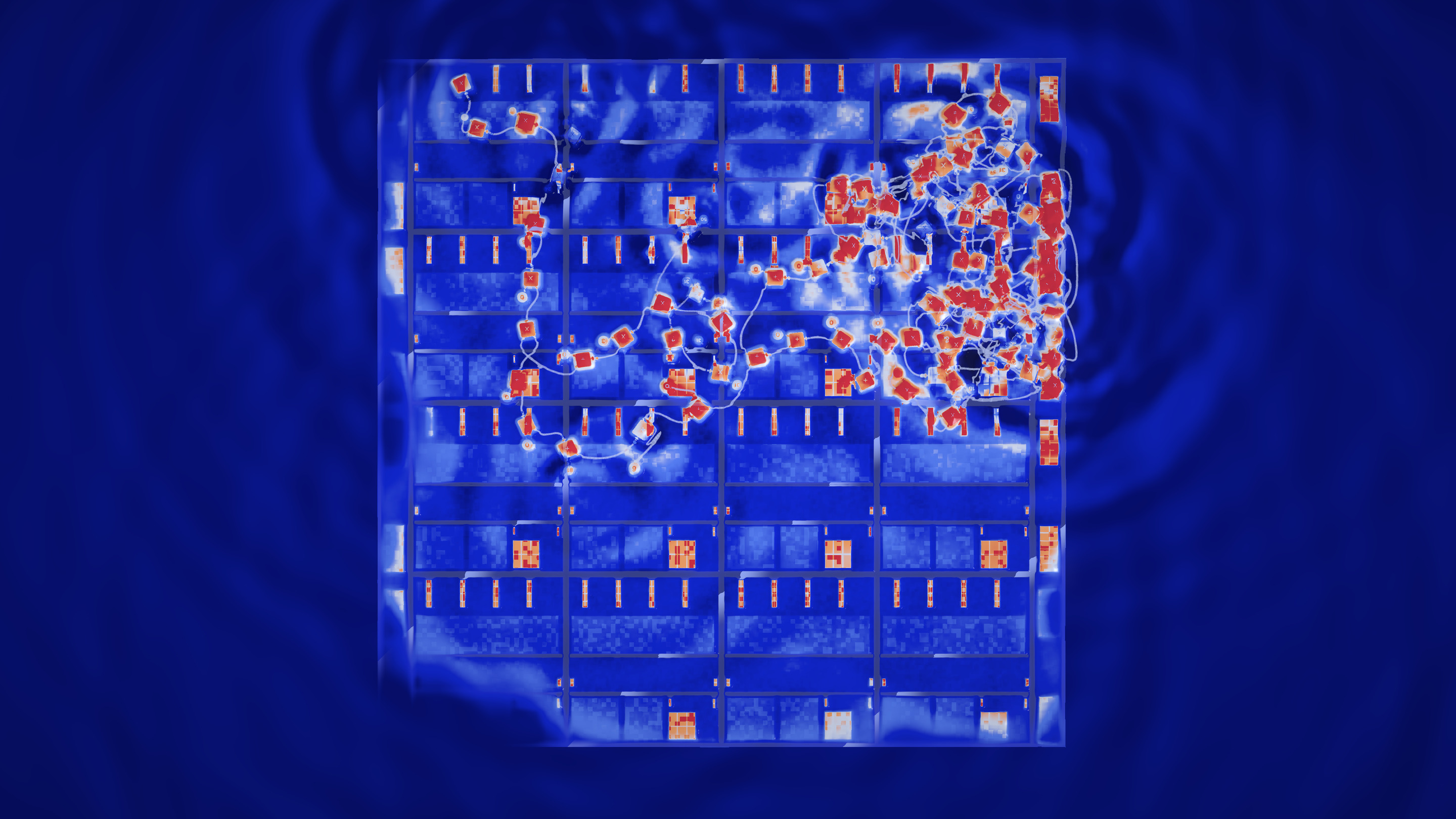
Architect Labs has announced Frostbite, a general-purpose CPU whose instruction set, microarchitecture, RTL and verification were produced autonomously by the company's AI systems. According to the firm's blog post, the design achieves 4.59 times the performance per watt of a superscalar, dual-issue, in-order core that the company describes as modern and silicon-proven, measured across 25 workloads — 15 of which were withheld from the design process until the final evaluation.
A CPU organised around interaction nets
The post argues that conventional languages and processors discard dependency information: because any code can read or write shared mutable state, hardware must rediscover instruction dependencies at runtime. Interaction nets take the opposite approach. A program is a graph of nodes, computation happens by rewriting connected node pairs, each rewrite touches only a local neighbourhood, and every node has a single principal port so active pairs never overlap. Rewrites can therefore run in any order, or all at once, and always produce the same result. The model is also linear: every value is consumed exactly once, so there is no shared state for hardware to guard. Architect Labs notes that languages such as Vine compile ordinary-looking programs into this form.
The company illustrates the difference with a five-queens puzzle: a sequential C++ version walks candidates one at a time, while the interaction-net version performs 3,183 interactions with a critical path of only 262 steps, averaging roughly twelve interactions ready to fire at each step — without the program having been rewritten.
The claimed payoffs are twofold. Parallelism emerges directly from the program rather than from threads, locks or out-of-order hardware, and data can sit in small local memories next to where it is used, shrinking the cache hierarchies and coherence machinery that dominate area and power on conventional multicores. Architect Labs situates this against the single-core stagnation that has persisted since the early 2000s and pushed the industry toward chips such as Intel Xeon and AMD Zen.
How the agents designed it
Frostbite was developed without built-in architectural assumptions, using multiple agent swarms. Work began by classifying how programs expose work — many independent pieces, rounds of parallel work, long sequential chains, data-dependent branches and recursion — and building a search set and a held-out set under each category. The held-out group later gained five practical workloads: a Kalman filter, PCA, finite element analysis, an LU solve and LZ4 decompression. The FFT, radixsort and LU kernels follow SPLASH-2 implementations, run 64 times smaller than standard sizes to suit exploratory work.
Agents digested research papers and existing benchmarks and used Python models to weigh high-level architectural options before settling on a single concept, written up in a 141-page PDF covering the programming model, runtime and top-level chip blocks. That document was deleted once the first RTL existed, because many of its estimates turned out to be physically unrealistic.
The team also created a specification language called ASL and expressed the chip's system model, Arcmodel, in it. ASL supports checkable mappings and refinements across RTL, system models, UVM and SVA artifacts; its power and performance estimates land within 1–5% of reality, it runs roughly 200 times faster than RTL simulation, and it can be formally verified through contracts — an answer to the English-language specification documents that human architects traditionally hand to implementation and verification teams.
According to Architect Labs, the agents iterated on their own across the compiler, ISA, architecture, microarchitecture, RTL, verification and final GDS, and the resulting design contains hardware mechanisms and runtime features the team says would have been difficult for people to architect deliberately.
Reasons for caution
Every figure comes from Architect Labs' own announcement, and no independent evaluation is described. The comparison baseline, though labelled modern and silicon-proven, is a dual-issue in-order core rather than a high-end out-of-order design, and several benchmark kernels were run at greatly reduced sizes. Frostbite itself is reported as reaching a final GDS, not shipping silicon.
Why it matters
If the results survive scrutiny, AI-driven co-design of hardware and software would reopen a design space that has been largely closed through two decades of limited single-core gains, and Architect Labs predicts comparable architectural shifts for every chip class, from datacenter CPUs and AI accelerators to networking switches and NICs. The work also extends the company's earlier Redwood project, in which AI implemented an architecture humans had chosen; here the AI discovered the architecture itself. Even setting the headline number aside, the workflow — formally checkable specifications, fast executable models and agent swarms spanning compiler to layout — sketches a plausible new template for how chips get designed.
- #ai
- #hardware
- #cpu-architecture
- #chip-design
- #semiconductors