· via Hacker News – Front Page (hnrss.org)
Gemini 4 Neon takes first place on the Models Engineering Index
Google's Gemini 4 Neon tops the Models Engineering Index at 69.5, edging Anthropic's Fable 5.2 while carrying a far lower cost multiplier on the index's price comparison.
Gemini 4 Neon leads the Models Engineering Index
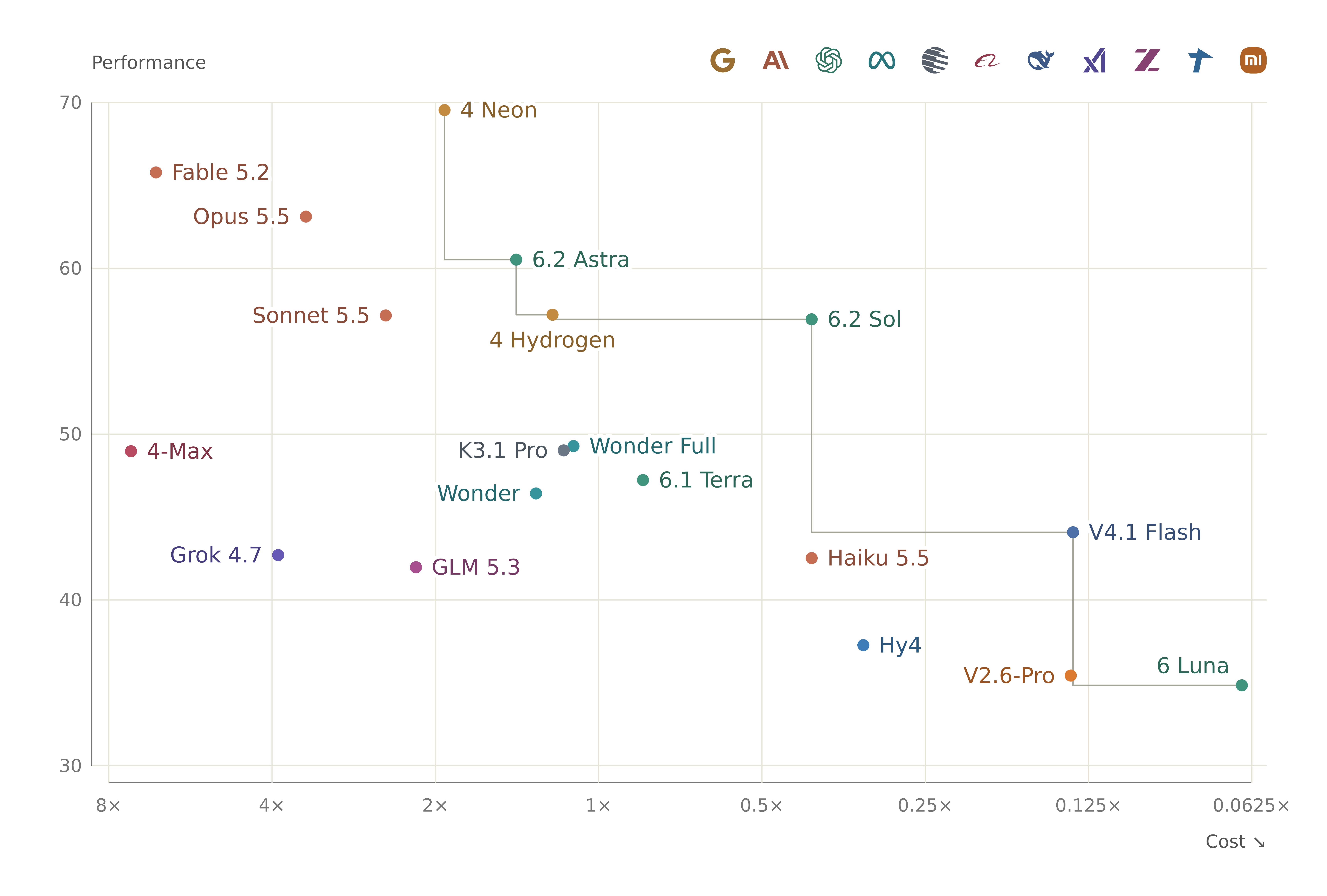
Google's Gemini 4 Neon has taken the number one spot on the Models Engineering Index (Mei), an independent ranking that scores how well language models handle real engineering work. According to the index, whose latest update surfaced on Hacker News's front page, Neon posts a score of 69.5, ahead of Anthropic's Fable 5.2 at 65.8 and Opus 5.5 at 63.1.
Mei presents its results along three axes — performance, cost and token usage — and lets visitors compare two models head to head across engineering-focused benchmarks including CursorBench, FrontierCode, Code Migration, IOI, ProgramBench, Terminal-Bench and Vibe Code.
What the top of the table looks like
Behind the top three, OpenAI's 6.2 Astra sits fourth at 60.5. Google places a second model in the top five, with Gemini 4 Hydrogen at 57.2, tied on score with Anthropic's Sonnet 5.5, which the index lists one place lower in sixth. OpenAI's 6.2 Sol follows at 56.9.
A cluster of challengers fills out the top ten: Meta's Wonder Full at 49.3, Moonshot's K3.1 Pro at 49.0, Alibaba's 4-Max at 49.0 and OpenAI's 6.1 Terra at 47.2. Meta's smaller Wonder model lands twelfth at 46.4. Further down, DeepSeek's V4.1 Flash reaches 44.1, xAI's Grok 4.7 manages 42.7, and Anthropic's Haiku 5.5 scores 42.5, just ahead of Z.ai's GLM 5.3 at 42.0. Tencent's Hy4 (37.3), Xiaomi's V2.6-Pro (35.4) and OpenAI's 6 Luna (34.8) close out the nineteen-model table.
Cost is half the story
The index pairs each score with relative cost and token multipliers, and that is where Neon's lead becomes notable. Neon is listed at 1.9× on cost with token usage at 1×, while second-place Fable 5.2 carries a 6.5× cost multiplier and 2.1× token usage. Opus 5.5 sits at 3.5× cost. The model at the top of the table is not the most expensive one on it — that distinction goes to Alibaba's 4-Max at 7.3×, which ranks tenth overall.
Cheaper options remain competitive on value. OpenAI's 6.2 Sol scores 56.9 at 0.4× cost, and DeepSeek's V4.1 Flash hits 44.1 at 0.13×. At the very bottom of the price range, OpenAI's 6 Luna costs 0.065× but scores 34.8.
Why it matters
For developers picking a model for coding and engineering tasks, Mei's headline result is a value signal as much as a performance one. The index's top scorer is mid-priced rather than premium-priced, and its token usage is listed at the 1× mark while a higher-scoring rival costs more than three times as much. That combination — leading engineering performance without leading cost — is exactly what teams shopping for a default coding model look for.
The usual caveats apply. This is a single independent index rather than an established standard, the public page offers limited methodological detail, and rankings on any one benchmark family routinely diverge from others. But as a snapshot of the current market, the picture is familiar: Anthropic models sit close behind on raw score, Google holds the value lead at the top, OpenAI's cheaper variants compete on price-performance, and specialist challengers from Moonshot, DeepSeek and Alibaba cluster below the 50-point line. Capability is converging at the front of the pack, and price is increasingly the differentiator.
- #gemini
- #llm-benchmarks
- #anthropic
- #ai-models