· via GitHub Blog
GitHub Copilot's HydraFusion matches Opus 5 coding quality at up to 67% lower cost
GitHub shipped a Copilot research preview that routes each coding task through single-model, cascade or critique workflows, matching or nearing Claude Opus 5 quality on three agentic benchmarks at far lower estimated cost.
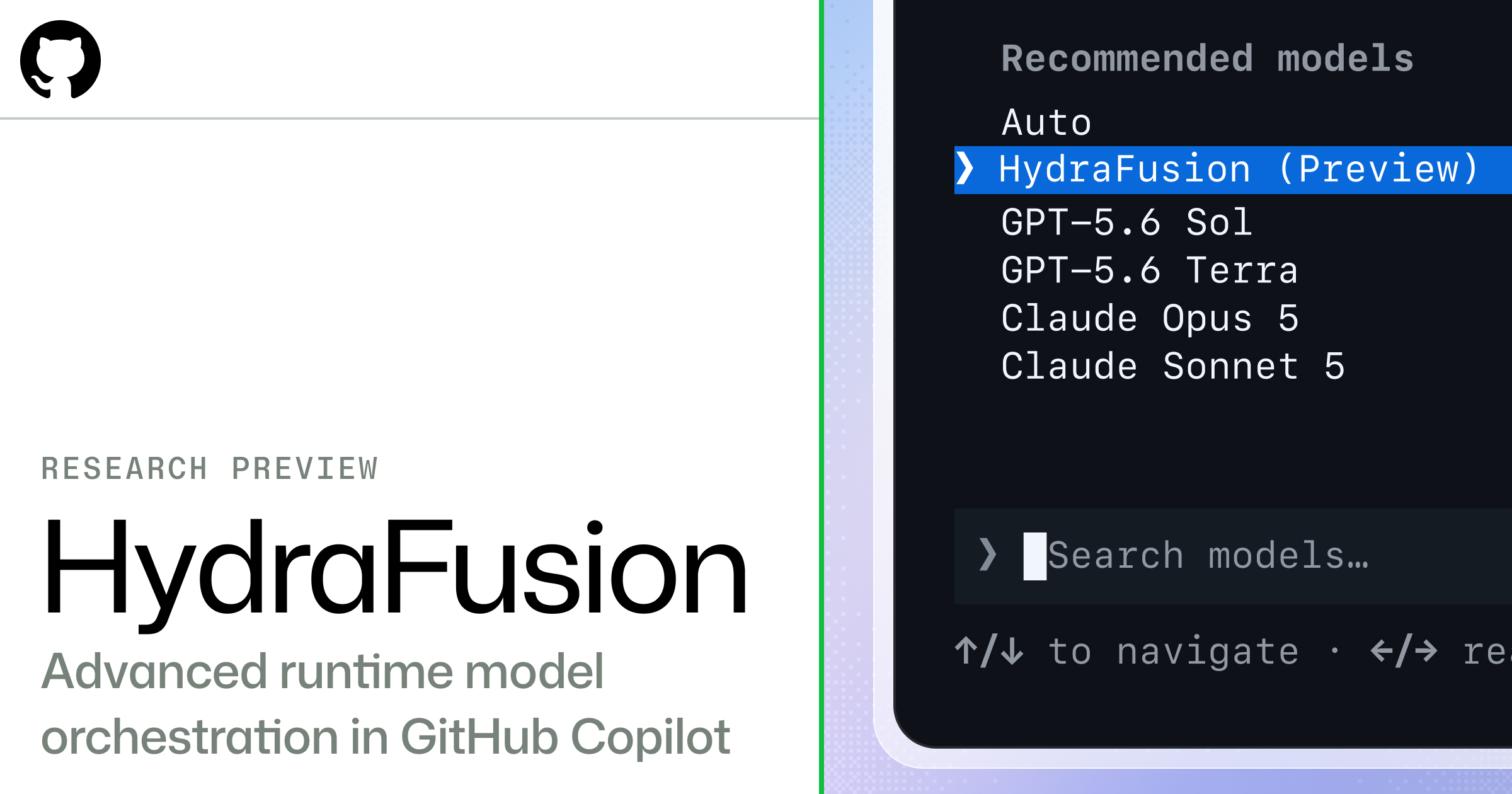
GitHub has launched Project HydraFusion, a research preview inside GitHub Copilot that orchestrates multiple AI models at runtime instead of depending on a single large model. According to the GitHub Blog, the system builds an execution plan for each request, selecting from models across multiple providers to draft, critique, revise or escalate work. In GitHub's controlled offline evaluations it matched or approached Claude Opus 5 coding quality while cutting estimated workflow cost by as much as 67 percent.
How the orchestration works
The GitHub Blog frames the routing decision as an optimization problem. HydraFusion scores capability signals for reasoning, code generation, debugging and tool use, then chooses the simplest pattern likely to clear the quality bar. Three execution patterns exist in the preview:
- Single: one chosen model solves the task directly.
- Cascade: an efficient model drafts a solution, and a quality gate decides whether to accept it or escalate to a stronger model.
- Critique: one model drafts a result, an independent read-only critic from a different model family reviews it, and the drafting model revises once.
The critique step follows the same review pattern as Copilot's Rubber Duck feature, and critics run in tool-less contexts so they can judge the work without touching the repository. Selectivity is the core idea: additional model calls happen only when they are likely to improve the result, which is how the system balances quality, cost and latency.
GitHub positions HydraFusion as part of a broader move toward automated routing between local, cloud and compound models, extending the Auto model selection feature introduced earlier this year. Developers see none of that machinery — HydraFusion appears in the model picker like any other option. Because the model pool is swappable, new models added to Copilot can be evaluated and folded into HydraFusion as they arrive.
Guardrails for repository-level work
Pointing several models at a real repository demands tight control, and the post lays out five operating principles. Complete accounting aggregates cost and usage across every leg, including drafting, critique, revision, escalation, retry and fallback. Bounded execution gives each leg explicit timeout and cancellation behavior. Isolated review keeps critique steps out of the tool loop while solver steps use the shared workspace and the normal permission-aware agent loop. Fail-safe application blocks any patch when a workflow is cancelled or fails validation, and validated routing verifies workflow definitions, model bindings, fallback behavior and model availability before execution begins.
Internally, the runtime logs the role, outcome, cost, latency and diagnostics of each leg so a workflow can be reconstructed after the fact. Externally, the developer gets one unified response and one change set that goes through the usual permission checks.
What the benchmarks show
GitHub evaluated fixed HydraFusion policies on three agentic coding benchmarks — TerminalBench 2.1, DeepSWE, and CheckpointBench, an internal benchmark curated from real Copilot sessions — with Claude Opus 5 and GPT-5.6 Sol as comparison baselines. All runs used the same task inputs, tools, execution limits, pricing assumptions, grading conditions and treatment of missing results, with every model set to the same medium reasoning level. The figures below come from the best tuned configuration and are measured against Opus 5:
- TerminalBench 2.1: verified task quality up 4.9 percentage points at 67 percent lower estimated cost
- DeepSWE: down 1.5 points at 36 percent lower cost
- CheckpointBench: down 0.1 points at 65 percent lower cost
HydraFusion therefore beat Opus 5 outright on TerminalBench 2.1's multi-step terminal tasks and came within 1.5 points on the other two. GitHub also cites early internal feedback from a principal software engineer at Microsoft, who said its reasoning and task-solving capability is "at or better than Opus."
Why it matters
The result challenges the assumption that frontier coding quality requires paying frontier-model prices on every call. If drafting with cheaper models, escalating only when a quality gate rejects the candidate, and adding an independent critic where review actually helps can hold the quality bar at a fraction of the cost, the unit economics of agentic coding change — particularly for teams running high volumes of automated tasks.
It also signals where the product layer is heading: model choice becomes an implementation detail decided by the runtime, and model quality becomes a pool the orchestrator draws on rather than a single bet. The caveats are real, though. GitHub notes the numbers are specific to the evaluated benchmark revisions, workflow configurations, model pool and pricing assumptions, and says the research preview exists to test how they translate to real developer workloads before it optimizes for production quality, latency, reliability, caching efficiency, cost and safety.
- #github-copilot
- #ai-agents
- #multi-model
- #llm-routing
- #developer-tools