· via Hacker News – Front Page (native)
Global stocks slide as Democrat midterm sweep sparks fears of an AI investment cooldown
Global equities tumbled after the Democrats' midterm win raised fears of tighter scrutiny of AI and data centres, with over $3.2tn wiped off US stocks and chipmakers leading the falls.
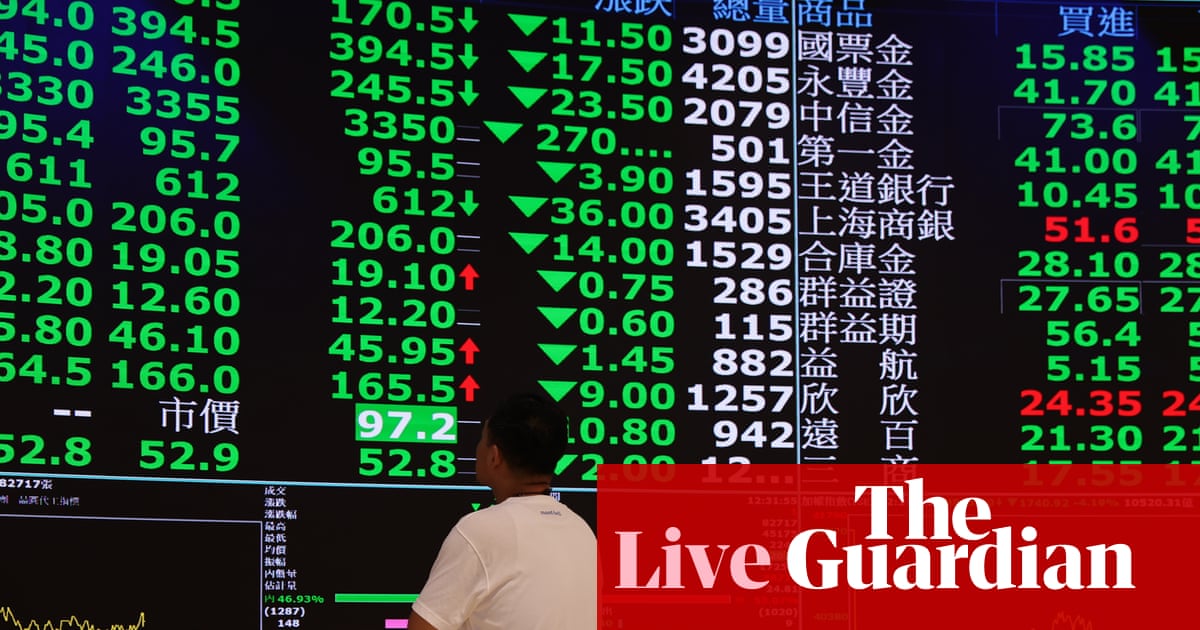
Markets slide from Tokyo to London
Global stock markets fell sharply on Friday, extending a Wall Street rout that has wiped more than $3.2 trillion off US equities, as investors bet that the Democratic Party's success in this week's midterm elections will slow the AI investment boom.
According to The Guardian's rolling market coverage, fears that a Democrat-controlled Congress will cool support for data centres and AI infrastructure triggered a broad flight out of technology stocks. Japan's Nikkei slumped almost 6%, its worst one-day drop since April 2025 during the tariff panic of that spring, The Guardian reports. South Korea's KOSPI fell 6.7% and Taiwan's TAIEX lost 4.5%.
The selling spread to Europe: London's FTSE 100 dropped 1.75%, on track for its biggest daily fall since March, while the MSCI Emerging Markets index hit a seven-month low and headed for a sixth consecutive weekly decline, Reuters reported via The Guardian. The US dollar strengthened, a classic sign of investors seeking safety, pushing the pound lower.
Chip and AI names lead the losses
The damage on Wall Street in the previous session was severe. The Guardian reports the Nasdaq fell 5.5%, tipping into correction territory, the Dow Jones Industrial Average lost 1,833 points, or 3.44%, and the S&P 500 dropped 4.36%.
Companies most exposed to AI data centre spending fared worst. Memory chip maker SanDisk fell 22%, Micron and AMD each lost 17%, and Nvidia dropped more than 9% to lead the Dow's fallers.
Politics lands on a shaky trade
Analysts quoted by The Guardian framed the sell-off as a repricing of political risk rather than a reaction to any single company event. Democrats are seen as more critical of data centre expansion, an issue that has drawn public opposition, raising the prospect of slower approvals for AI infrastructure projects.
Christopher Forbes, head of Asia and Middle East at CMC Markets, told Reuters the market action was "a bit of a disaster", and said clients now expect a "six-year structural shift": a pause on AI and data centre growth, approvals and the equity capital markets that fund them.
Kyle Rodda, senior financial market analyst at Capital.com, noted the political risk lands on a trade that was already wobbling. Earnings season has disappointed, with Magnificent Seven results undershooting growth expectations and flashing warning signs that the pace of AI spending is slowing.
Forced selling and margin calls
Leverage appears to have amplified the fall. Dan Coatsworth, head of markets at AJ Bell, described the Nasdaq slump as "mass capitulation", with investors selling tech indiscriminately to lock in past gains. Margin calls forced leveraged investors to put up cash or sell holdings, adding further downward pressure.
Forbes said clients who were long index and stocks were "carried out", with margin calls and complaints arriving through the night. Reuters, cited by The Guardian, reported the tech selloff has wiped out hedge fund gains and led to layoffs.
The rout has also hit the sector's highest-profile backer. According to The Guardian, citing Bloomberg's Billionaires Index, Elon Musk's paper wealth has fallen by around $113 billion since the midterms, including $33.5 billion on Wednesday and $79.7 billion on Thursday, as Tesla fell 10.7% and SpaceX lost 9%. He remains the world's richest person at $785 billion.
A counterpoint on hyperscalers
Not everyone expects the boom to be throttled. Jefferies said it does not see Democrats giving up on AI as a growth engine, The Guardian reports.
Mark Dowding of RBC BlueBay Asset Management argued a slower rollout could actually help the hyperscalers, such as Amazon, Meta, Microsoft and Google, which have been pushed into hectic sales of debt and shares to fund multi-billion-dollar supply deals. A calmer pace could make them more attractive investments.
Why it matters
For anyone building in the AI sector, this week is a reminder that political risk is now a first-order variable in the AI trade. If data centre approvals, energy access and capital markets funding become contingent on the mood in Congress, then startup financing, chip demand and infrastructure timelines all inherit that uncertainty.
It also confirms how concentrated the market has become in AI expectations: a single election outcome was enough to erase trillions in value, trigger margin calls and hit emerging markets far from Washington. Whether Democrats actually restrain AI investment or not, investors will now price that possibility into every data centre announcement and capex forecast — and the next US jobs report, which The Guardian notes markets are watching closely, may determine whether the fear deepens or fades.
- #ai
- #markets
- #semiconductors
- #data-centers
- #policy