· via Hacker News – Front Page (native)
Google and XREAL launch AURA, first wired XR glasses running Android XR with Gemini
Google and XREAL have launched AURA, the first wired XR glasses running Android XR, with Gemini assistance across apps and mirrored laptop screens. Orders are open in the U.S., Canada and Korea from $1,099.
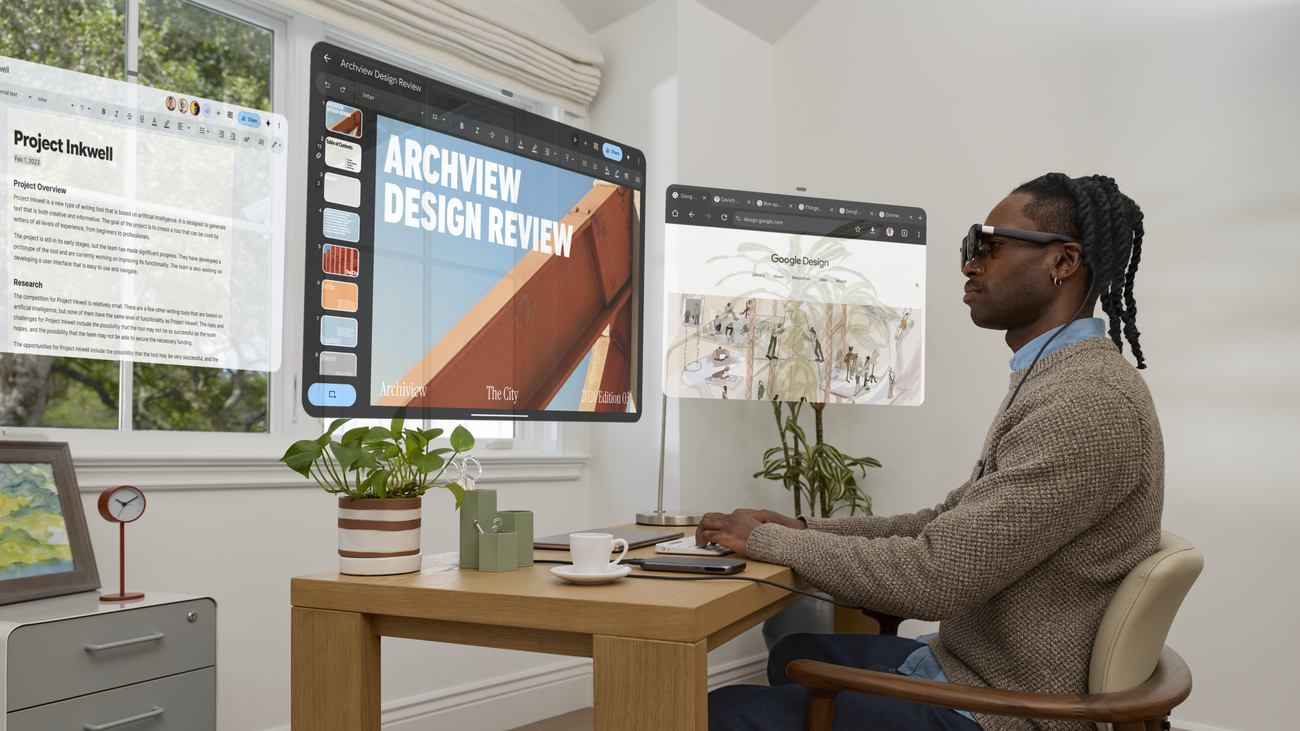
Google and XREAL ship the first wired Android XR glasses
Google and hardware partner XREAL have officially launched XREAL AURA, which Google describes as the first wired XR glasses powered by Android XR. According to Google's announcement, orders opened on October 28 in the United States, Canada and South Korea, with Japan following on November 2. Launch pricing starts at USD 1,099 and holds through the end of the year, with shipments beginning in mid-November.
Glasses on your face, silicon in a puck
AURA's defining design decision is to split the device in two. The glasses weigh under 95 grams and use transparent lenses, so wearers see the real world directly while spatial content is projected into their field of view. The battery and processor live in a separate compute puck tethered by a cable — a puck that debuts Qualcomm's new Snapdragon Reality Elite platform. Google presents the arrangement as a way to deliver high-performance spatial computing without a bulky standalone headset. The optics offer a 70-degree field of view, which the company says leaves room to view several spatial and 2D apps at once.
Because it runs Android XR, AURA also ships with the Google Play catalog behind it: millions of apps in total, more than 150 of them built specifically for XR.
Gemini sees what you are seeing
Gemini is woven through the experience. Google says the assistant is aware of both the wearer's physical surroundings and what is happening on screen, so users can talk through tasks across their apps. A capability arriving with launch lets users share their view, after which Gemini can highlight what to focus on, whether an object in the room or an element of the interface. The assistant also works across the mirrored laptop window described below — Google's examples include asking it to tidy up open windows or brainstorm about whatever is on the display.
A desk that fits in a bag
AURA is pitched first as a portable workspace. Multiple apps, such as a browser, documents and music, can be opened at once, resized and arranged around the wearer. A Bluetooth keyboard and mouse complete the setup, and the compute puck itself can double as a trackpad. Google's suggested scenarios run from a multi-monitor layout on the couch to a hotel desk or an airplane tray table.
Wired Mirroring brings laptops into the picture: connect over a USB-C cable that supports video output and the laptop's screen appears as a resizable, repositionable window, with no software to install, running alongside Android XR apps. Because the display is visible only to the wearer, Google argues a confidential document can be opened safely in public.
A private cinema, a photo wall and an arcade
For entertainment, the glasses aim to turn any seat into the best one in the house. Screens from YouTube, Google TV or a streaming service can be placed wherever is comfortable, and the lenses can be dimmed to fade out the surroundings — returning to transparent automatically when a person comes into view. Alongside the 180- and 360-degree video and 3D movies already on YouTube and Google TV, the launch adds XR-native works including "Nevatars," co-directed by Andy Serkis and Josh Nelson Youssef; "Galapagos: the Last Eden," narrated by Margot Robbie; and the San Francisco Ballet's "Nutcracker."
A spatial view feature converts almost any video, photo or game into 3D with a tap and now handles higher-resolution content, while window follow mode keeps an app centered — or tucks it into a mini view at the edge of vision while walking. Google says a spatial gallery is coming to Google Photos later this year, wrapping a photo library around the wearer and letting them pan from an entire year down to a single day with their hands.
Games get a bigger screen too: thousands of mobile and tablet titles from Google Play run on the device, PC and handheld games can come in through Wired Mirroring, and XR-native games from studios such as Owlchemy Labs and Resolution Games respond to hand input. New titles named for launch include Fallout Factions and Project Hail Mary: Journey Among the Stars. If a player gets stuck, Gemini can talk them through the next move without setting down the controller.
Why it matters
AURA is the first consumer device to ship Android XR in this wired glasses-plus-puck form, making it a real test of Google's platform ambitions beyond the phone. It also moves Gemini onto the face, with an assistant that continuously interprets what the wearer sees — a notable step for ambient AI regardless of how the hardware sells. The design sidesteps the weight problem that has slowed standalone headsets, though at USD 1,099 it remains a considered purchase rather than an accessory. Orders are limited to users 18 and over via XREAL's online store or Best Buy in the U.S., with enterprise deployment options detailed separately. Whether a large virtual display, the Play catalog and a camera-aware assistant are enough to carry a new device category is now a question the market will answer.
- #android-xr
- #xreal
- #google-gemini
- #xr-glasses
- #augmented-reality