· via Hacker News – Front Page (native)
Google announces TPU 8tx and TPU 8i Max, its fourth new TPU system this year
Google expanded its eighth-generation TPU line with TPU 8tx for confidential inference and dual-chip TPU 8i Max for large context windows — its fourth new TPU system in a single year.
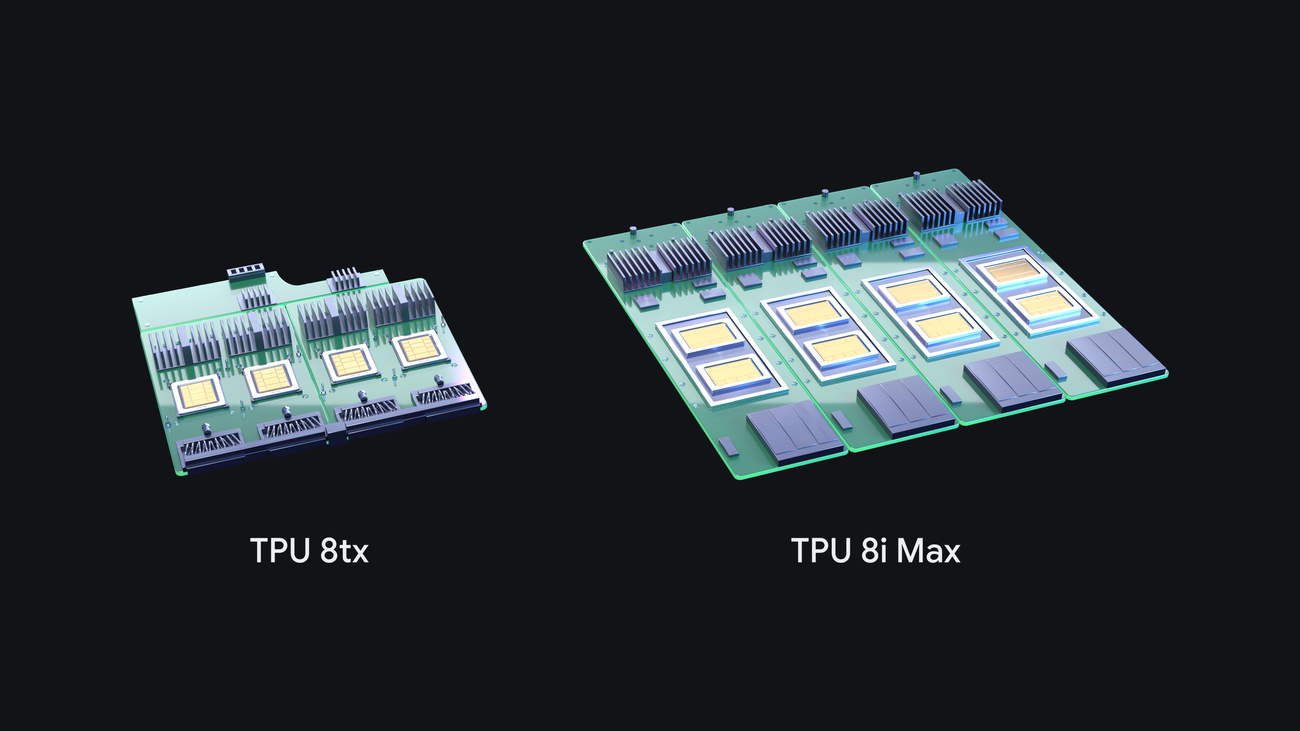
Google has added two more systems to its eighth-generation TPU lineup: TPU 8tx, built for secure and confidential inference, and TPU 8i Max, a dual-chip package designed for very large context windows. According to Google's announcement, this is the first time the company has shipped four TPU systems in a single year.
Four systems in one generation
The eighth-generation portfolio now covers four distinct configurations. TPU 8t and TPU 8i, introduced at Google Cloud Next in April, set the baseline: 8t targets large-scale training and 8i targets real-time reasoning, with Google citing up to 2.7 times better training performance and 80% better inference price-performance than the prior generation. The two new systems extend that foundation — 8tx adds hardware-level confidentiality, and 8i Max doubles compute and memory for context-heavy agentic workloads.
Google notes that TPUs have moved well beyond their original internal uses such as voice recognition and translation. They now handle training and serving of Gemini models, agentic workloads, Google Cloud customer services, and direct deployment into customers' own data centers. The company describes TPUs as a rapidly growing business with nearly 100 customers, including frontier labs, trading firms, retailers and universities.
Systems, not chips
A recurring theme in the announcement is the difference between a chip and a system. Designing a chip is a multi-year process bound by silicon manufacturing, Google explains, whereas a system is about how compute, networking and storage are packaged around that chip. Because Google built its TPUs as modular building blocks within its AI Hypercomputer — with adjustable packaging, high-speed memory, optical networking and security — it can deliver specialized supercomputers in months rather than years. That modularity is what allowed two new configurations to appear within a single year, shaped by Google DeepMind and, increasingly, by feedback from external organizations.
TPU 8tx: confidential inference
TPU 8tx is aimed at governments and regulated businesses running frontier or proprietary models and autonomous agents alongside sensitive data. Data is normally encrypted at rest and in transit but must be unlocked in memory while a computer processes it. TPU 8tx moves protection into the hardware layer, keeping data and model weights isolated even while actively in use, according to Google.
The system uses the same silicon as TPU 8t and is paired with fifth-generation AMD EPYC CPU hosts. It also adopts the low-latency Boardfly network originally created for real-time reasoning, which Google says delivers up to 2x lower latency than TPU 8t with a near-zero performance penalty. Because it combines training-grade compute with a fast inference network, teams can fine-tune models on private data, distill large models into smaller ones, and train agents through reinforcement learning on a single system, without migrating sensitive data between clusters.
TPU 8i Max: attacking the memory wall
TPU 8i Max targets a different bottleneck. When many AI agents work simultaneously across an entire codebase or hours of video, memory bandwidth quickly becomes the constraint. Google's answer was to combine two low-latency TPU 8i chips into a single package, doubling the compute, SRAM and HBM bandwidth of a standalone 8i so that large workloads do not stall waiting for data. Since twice the silicon fits within the existing rack footprint, Google says data centers can pack significantly more processing power into each square foot and watt.
Google also framed the hardware news alongside its recent PyTorch announcements, with the stated goal of opening TPU development to every PyTorch developer and making the accelerators as easy to use as general-purpose hardware.
Why it matters
The headline here is cadence. Four purpose-built systems in twelve months demonstrates that once an accelerator family is modular, Google can specialize for new workloads on a system-level timeline rather than waiting for a new chip generation. That pace matters to cloud buyers deciding between general-purpose GPUs and purpose-built silicon.
The two new systems also target the two most cited blockers to enterprise AI adoption: confidential computing for regulated industries hesitant to expose sensitive data, and memory bandwidth, which increasingly limits long-context, multi-agent workloads more than raw compute does. With nearly 100 external customers, Google is signaling that TPUs are no longer just internal infrastructure but a serious business in the competitive AI accelerator market.
- #google-tpu
- #ai-hardware
- #machine-learning
- #cloud
- #accelerators