· via Google AI blog
Google brings Gemini app to low-memory Android Go devices
Google has re-engineered its Gemini app to run on low-memory Android Go devices, extending Gemini Live voice chat in more than 45 languages and Nano Banana image creation to hundreds of millions of budget phones.
Gemini arrives on Android Go hardware
Google has released its Gemini assistant for eligible devices running Android Go edition, the lightweight build of Android designed for phones with limited memory. According to a November 18 post on the Google AI blog, the goal is to place Google's AI assistant in the hands of hundreds of millions more people, many of whom rely on a lower-spec phone as their everyday route to the internet, education and business.
The company notes that until recently, hardware limits meant those devices offered little beyond basic voice commands rather than a full conversational assistant.
An app reworked for tight memory budgets
To make this possible, Google says it re-engineered the Gemini app so that the core experience runs smoothly on hardware with less memory. The announcement does not explain exactly what changed — there are no memory thresholds, technical specifics or a list of qualifying models — and refers only to eligible Android Go devices. What is clear is that the standard app was not simply shipped as-is; it was adapted to the constraints of entry-level hardware.
Voice and camera take the lead
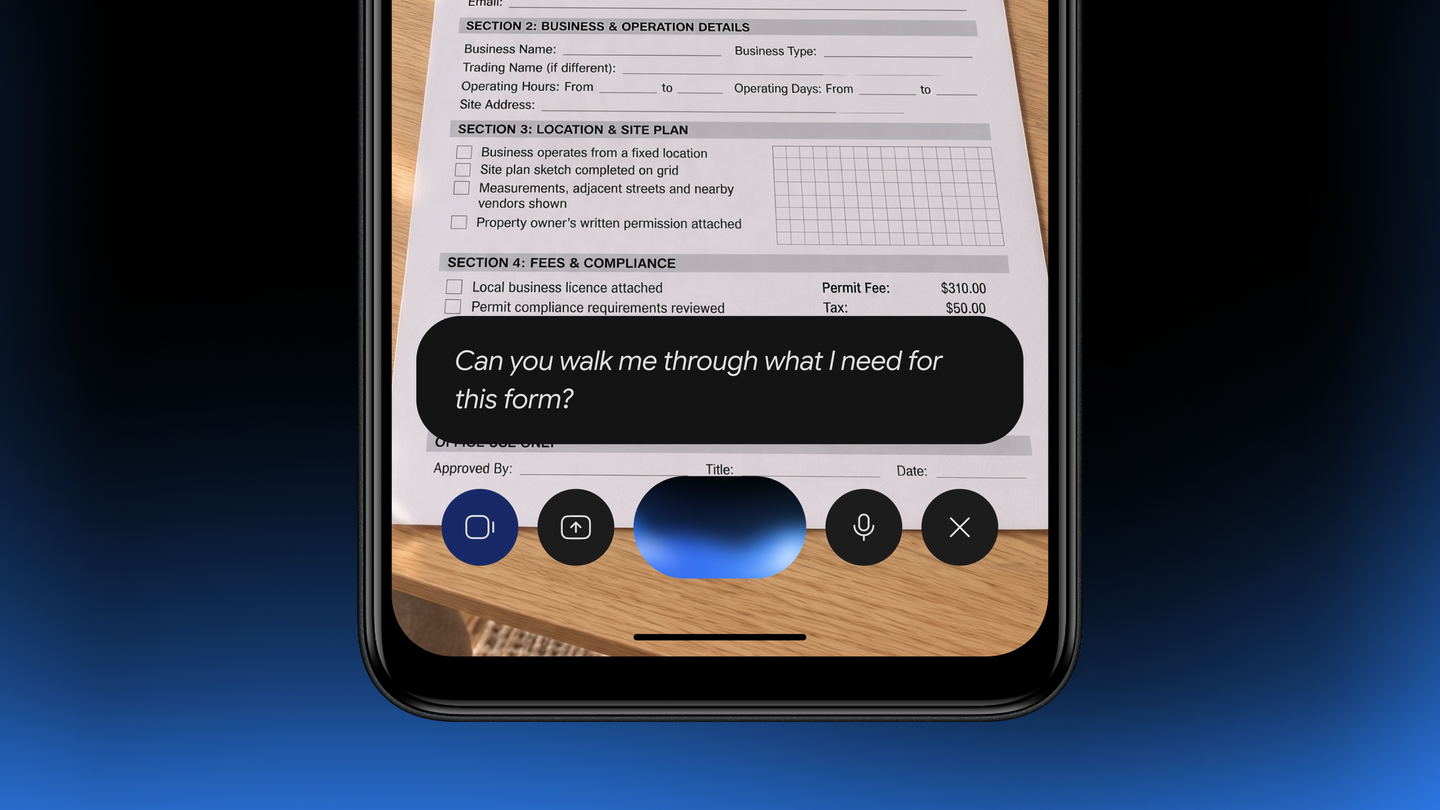
The features Google emphasizes suggest the low-memory version leans on speaking and pointing rather than typing long prompts. Gemini Live lets users talk through a problem or rehearse for a job interview out loud, with support for more than 45 languages. Pointing the camera at notes or forms can be used to learn from and translate printed material. The app also handles image creation through Nano Banana; the example in the blog post is designing a flyer for a weekend bakery sale.
Three ways to get the app
Google lists three access routes in its announcement. The Gemini app can be downloaded from Google Play, opened by pressing and holding the power button on supported phones, or found preloaded on upcoming devices from partners such as Transsion. Preloading in particular signals that Google expects Gemini to be a default experience on entry-level phones going forward, not just an optional download.
Why it matters
Android Go exists precisely because, for a large share of the world, a low-cost phone is the primary computing device. Until now, modern AI assistants have largely been a flagship-phone feature. Extending Gemini to this tier makes conversational AI a baseline part of the Android ecosystem, and it does so in more than 45 languages, in markets where speaking to a phone is often more practical than typing on it.
For Google, the move widens Gemini's reach at a time when AI assistants are competing to become the default interface on every device. For users on budget hardware, it replaces rudimentary voice commands with generative capabilities — live conversation, camera-based understanding and image creation — that were previously out of reach. The open question is real-world performance: the announcement describes the engineering effort but offers no benchmarks, so how smoothly the experience holds up on genuinely constrained devices will only become clear as the rollout reaches users.
- #gemini
- #android-go
- #ai-assistant
- #budget-phones