· via Hacker News – Front Page (hnrss.org)
Google Maps Scraper MCP gives AI agents structured local business search
G Maps Crawl has launched a remote MCP server that lets agents in Claude Code, Cursor, VS Code or Codex search Google Maps and receive up to 20 structured business listings per query.
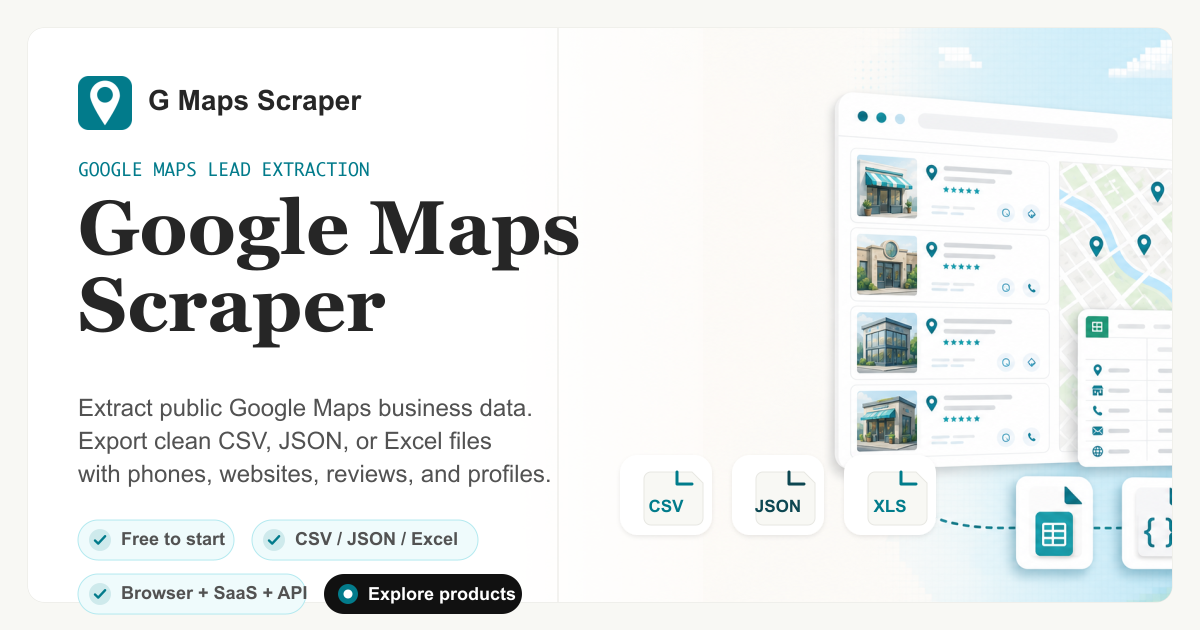
A new Model Context Protocol (MCP) server from G Maps Crawl, a service built for extracting business leads from Google Maps, lets AI agents run local business searches and receive structured listing data in return. The launch was featured on Hacker News as a Show HN post.
What the tool does
According to G Maps Crawl's documentation, the server exposes exactly one tool, search_google_maps. An agent supplies a keyword and a location, and the response arrives as structured JSON containing up to 20 businesses per query. Each result carries whatever the listing has available: name, address, phone number, website, rating and review count.
The vendor's example prompts illustrate the intended workflows: pull a page of Seattle coffee shops with contact details and ratings, compare restaurant categories and ratings across Portland, or format Austin plumbers as a table with names, phone numbers and websites. The suggested use cases lean toward sales prospecting, local market analysis and enriching CRM records.
Setup and client support
The server runs as a remote, stateless Streamable HTTP service at the vendor's /api/mcp endpoint, with an older /mcp path kept as a compatibility alias. Authentication uses a Bearer API key in the authorization header. The documentation is explicit that keys belong in a client's secret configuration or an environment variable — never in a prompt or a URL — and that browser login cookies will not authenticate the endpoint.
Connecting it follows the standard MCP pattern: an .mcp. entry pointing at the endpoint, with the API key injected from an environment variable, GMSCRAPER_API_KEY in the Claude Code example. G Maps Crawl says any client that supports remote HTTP MCP servers and custom authorization headers will work, and it names Claude Code, Cursor, VS Code and Codex specifically.
Limits worth knowing
Two constraints stand out. First, live queries require a paid API entitlement: the MCP server draws on the same usage pool as the company's API, and a regular Online subscription does not include API access. For evaluation, a test credential returns simulated fixture data instead of live results, and the docs suggest asking agents to label test output as simulated.
Second, completeness is not guaranteed. Results include only the fields each listing makes available, and the vendor's own sample prompts ask agents to flag missing values — a signal that gaps in contact details or categories should be expected. Because this is a third-party service that scrapes Google Maps rather than an official Google integration, teams comparing it with Google's own Places API are choosing a very different kind of data source.
Why it matters
Local business data is among the most common things agents are asked to fetch, whether for lead generation, market research or CRM cleanup. Wrapping Google Maps search behind a single authenticated MCP tool means a developer can grant that capability without writing glue code, running a scraper or teaching a model to parse raw pages — the agent calls one tool and gets JSON back.
The launch also shows where agent tooling is heading: established data vendors exposing their products as remote MCP servers, with metered API access layered on top of subscriptions and simulated credentials for safe evaluation. For teams assembling agent workflows, that pattern makes third-party data sources much easier to adopt — provided they check the pricing model before going live.
- #mcp
- #ai-agents
- #google-maps
- #developer-tools
- #apis