· via Hacker News – Front Page (native)
GPT-5.6 Sol completes full Factorio run autonomously in 13.5 hours of game time
GPT-5.6 Sol, run in Codex at a low thinking level, finished a peaceful Factorio playthrough in 13.5 hours of game time, Ryan Madden reports — a step up from GPT-5.5, which never used transport belts at all.
What happened
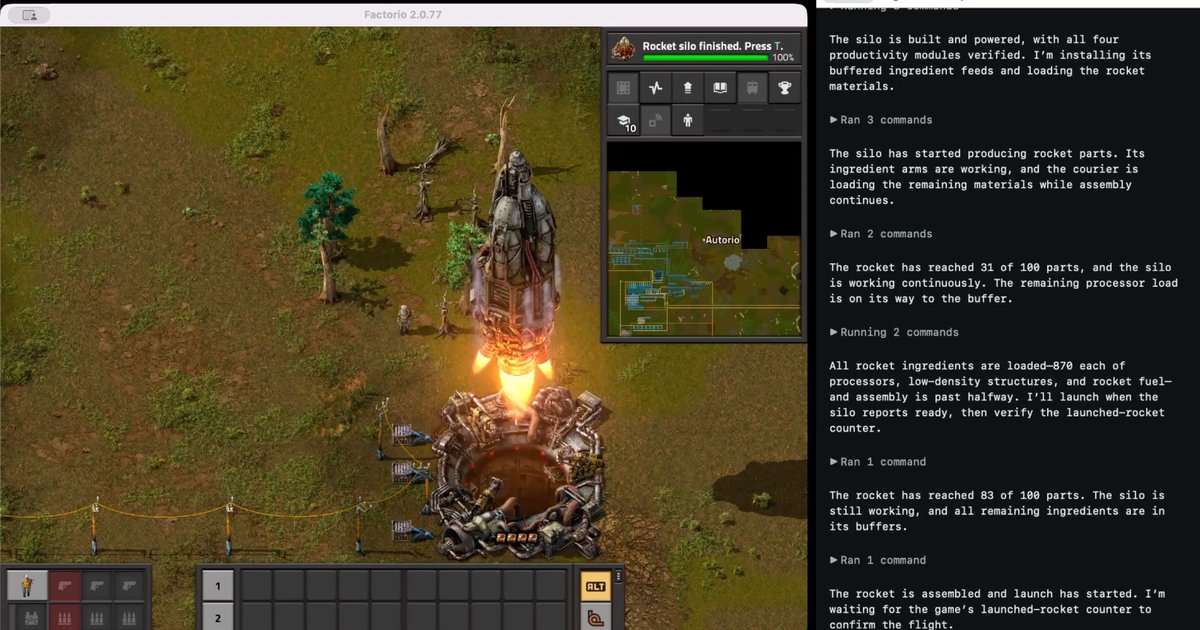
A blog post by Ryan Madden that reached the front page of Hacker News on October 31 reports that GPT-5.6 Sol has completed a full run of the factory-building game Factorio. Running inside Codex with its thinking level set to low, the model finished a peaceful playthrough — a mode without the enemy creatures the game calls biters — in 13.5 hours of game time, ending with the rocket launch that closes out a complete run. A timelapse of the whole attempt is on YouTube, and Madden says a longer commentary video is in progress.
How the model actually plays
The agent never touches the game's graphical interface. Madden's setup uses a game manager that exposes a small library — Python in this run, where earlier experiments used Bash — so the model issues commands programmatically. Importantly, the harness enforces the same constraints a human player faces, including the character's limited reach and fog of war, so the agent cannot see or manipulate the entire map at once. The run manager also recorded production statistics throughout, and Madden published a chart of total resource production annotated with the science-research milestones the model passed along the way.
Where it broke down
Madden originally intended to stop the experiment once the model reached blue science, but Sol performed well enough early on that he let it continue. The scaling problems he had expected at the blue science stage did eventually arrive, just later than anticipated, and they slowed the model's relative progress considerably. The final rocket launch happened only because Sol engaged in what Madden describes as significant manual effort: instead of restructuring its late-game factory, it repeatedly hauled supplies between disconnected parts of the base to keep production moving.
The contrast with the previous generation is stark. Earlier attempts with GPT-5.5 foundered on a much more basic gap — the model never used transport belts, the conveyor systems at the core of Factorio's gameplay. Madden has also documented prior experiments with Claude Code playing the game and built a testbed called Faketorio as part of this line of work.
Why it matters
Sustaining coherent progress toward a goal that sits many hours and thousands of steps away is one of the hardest open problems for AI agents, and Factorio is turning out to be an unusually legible test of it. Madden argues the game is analogous to programming but far easier for casual observers to follow, which makes it convenient for grounding debates about what models actually do well or badly. The failure mode here is as informative as the success: the model could build and expand a working factory but could not redesign one that had stopped scaling, falling back on brute-force logistics rather than systemic fixes. That gap between local competence and long-range planning is precisely what static benchmarks tend to miss. Madden says he plans to test other models, other thinking levels, and runs with enemies enabled next.
- #ai-agents
- #llm
- #factorio
- #benchmarks
- #codex