· via Hacker News – Front Page (native)
GPT-6 Astra decodes a WWI German ADFGVX cipher that sat unsolved for over a century
GPT-6 Astra reportedly solved a 1918 German ADFGVX radio message from a list of unsolved ciphers, recovering the key TRUPPENVERSCHIEBUNG and verifying the result against the cruiser's original logs.
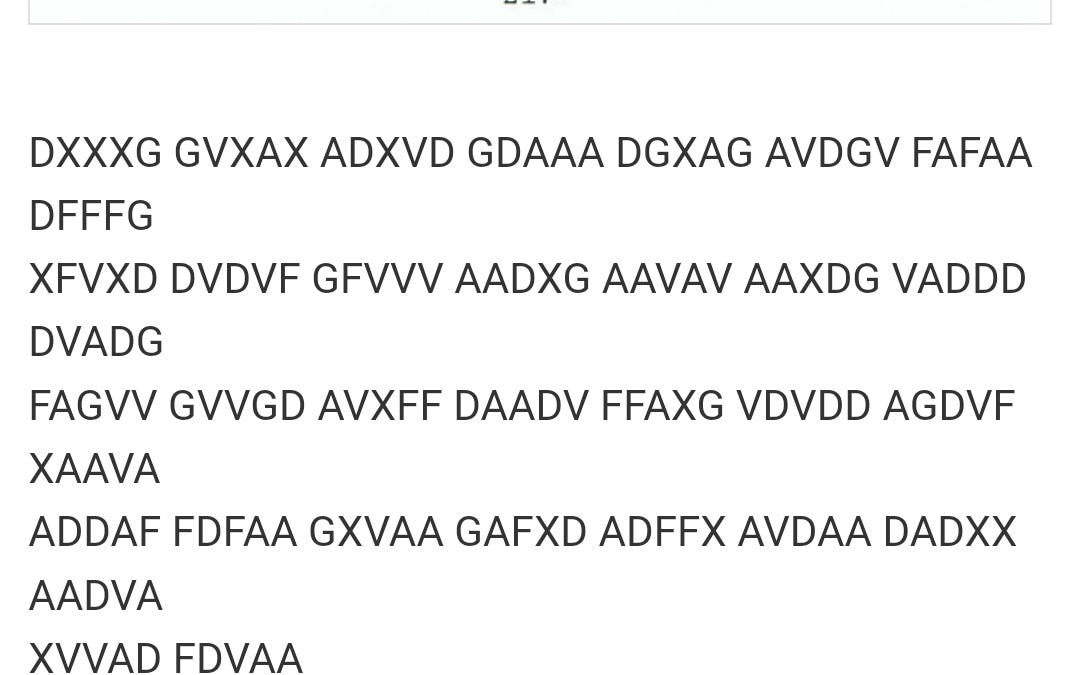
GPT-6 Astra has reportedly decoded a German military radio message from 1918 that had resisted all attempts for more than a century. According to a post on Prinz AI that reached Hacker News's front page on 17 September, the message — an ADFGVX-encrypted transmission dated 27 November 1918, a little over two weeks after the armistice — came from a well-known list of unsolved ciphers, and its author says they are not aware of it ever having been read before.
The puzzle
The message belongs to a set of World War I German radio transmissions tracked on a list of roughly 50 unsolved ciphers maintained by Scienceblogs.de, a German science blogging portal — a list that ranges from cryptograms left by serial killers to the Voynich manuscript. Hundreds of wartime ADFGVX messages have already been decoded, including by the codebreaking expert George Lasry, but the author notes that more than a dozen, including this one, had eluded every effort.
ADFGVX works in two stages. First, each plaintext character — the alphabet plus the digits 0 to 9 — is replaced by a pair drawn from the six letters A, D, F, G, V and X, which serve as row and column coordinates in a 6x6 table whose layout is scrambled by a key word. In the author's example, with the key HOUSE, the pair AA stands for H and AD for O, so PRINZ becomes FX GD DX FV VD. Second, the resulting symbol string passes through a columnar transposition, likewise keyed by a word: the ciphertext is written in rows beneath the key's letters, and the columns are read off in the alphabetical order of those letters.
The solve
Working through the 170-character message, GPT-6 Astra settled on TRUPPENVERSCHIEBUNG — German for troop redeployment — as the key word. It appears on pages 214–215 of J. Rives Childs's The History and Principles of German Military Ciphers, 1914–1918, and it does double duty: its letters scramble the substitution table, and the word itself drives the transposition. With 19 key letters, the 170 ciphertext symbols fill eight rows of 19 plus a final row of 18; reading the columns in the key's alphabetical order recovers the coordinate pairs, which the table then converts back into letters.
The recovered plaintext, as the blog renders it in English:
AN ENGLISH CRUISER ARRIVED AT SEVASTOPOL ON THE ?4TH AN ALLIED SQUADRON FOLLOWS ON THE 26TH
The date element is partly garbled, but the rest is specific enough to check — and the author says the model did exactly that. According to the post, GPT-6 Astra traced the original logs of HMS Canterbury, which record the cruiser arriving in Sevastopol on 24 November 1918, with an allied squadron arriving on 26 November — matching the decoded message on both counts.
Why it stayed unsolved
Astra's own hypothesis, relayed in the post, is that TRUPPENVERSCHIEBUNG was believed to be in use only from 9 December 1918 onwards. Because this message was transmitted on 27 November, anyone working from the documented key schedule would never have tried that key against this ciphertext. Why the key was in service earlier than the record suggests remains unknown, the post concedes.
Caveats
This is a single author's account of one model session, and the claim of a first-ever decode rests on that author's own knowledge of the field. Even so, the corroboration is unusually strong: primary sources independent of the cryptanalysis — the cruiser's logs — line up with both events named in the recovered plaintext, and the garbled "?4TH" is consistent with the logged arrival on the 24th.
Why it matters
This was not a synthetic benchmark but a genuine open problem in historical cryptanalysis. Solving it required locating the right key in century-old literature, executing a two-stage decryption with fiddly bookkeeping (uneven columns, alphabetical reordering of a 19-letter key), forming a hypothesis for why every prior attempt had failed, and then validating the result against archival sources. That full chain — retrieval, reasoning and self-verification — is precisely the kind of multi-step work where frontier LLMs are claimed to be advancing, and a 107-year-old unsolved cipher makes for an unusually legible demonstration. It also suggests a practical role for these models as assistants to historians and archivists: a system that can both decrypt and corroborate could help chip away at the remaining unsolved messages, of which the list still holds more than a dozen.
- #llm
- #cryptography
- #cryptanalysis
- #history
- #wwi