· via Hacker News – Front Page (hnrss.org)
GPT-6 Astra drives a real Toyota Corolla in DrivingBench's cone-course test
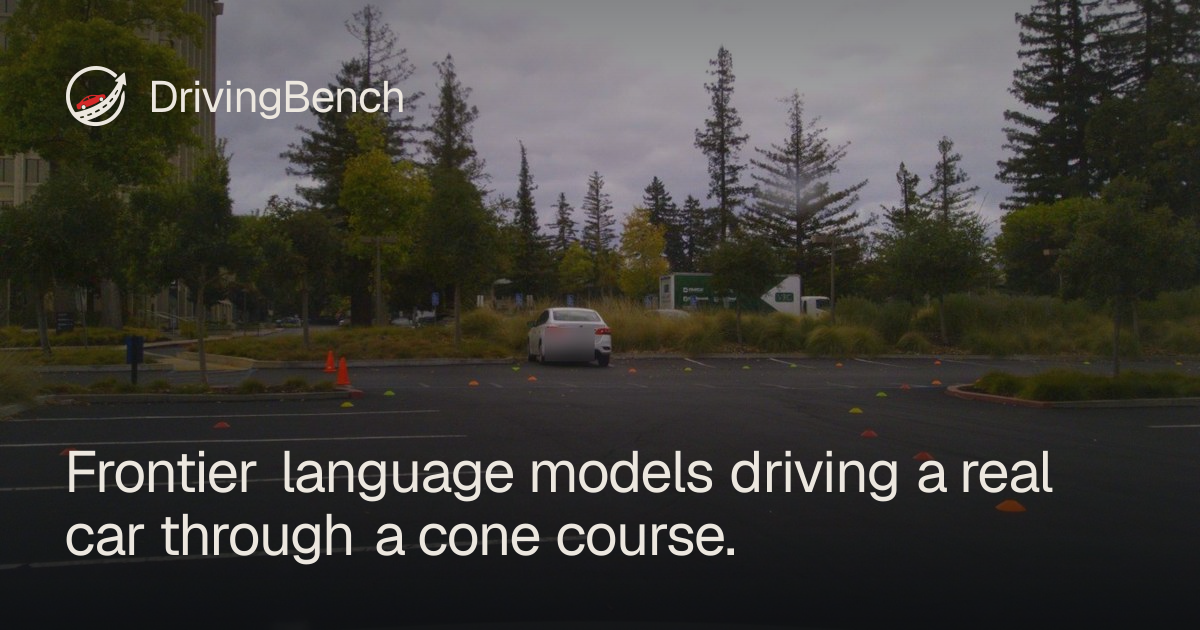
DrivingBench gives frontier AI models control of a real Toyota Corolla's steering, accelerator and brakes on a fixed cone course — and GPT-6 Astra can drive it.
What happened
A project called DrivingBench has set out to answer a blunt question: can frontier AI models drive a real car? According to the project's site, the benchmark hands models control of a Toyota Corolla's steering, accelerator and brakes, then evaluates them on a fixed course laid out with cones. The story travelled widely after reaching Hacker News's front page on 23 September 2026, because the answer, for at least one model, appears to be yes: GPT-6 Astra can drive the course.
How the benchmark works
The control interface is deliberately sparse. A model issues set_motion calls to move the car and a stop_now call to halt it, and the harness logs which of those commands it actually accepted. Scoring is anchored to the course centerline: an attempt earns progress only for ground covered while staying within four metres of that line, and a collision freezes the score at whatever progress came before impact.
Distances are computed by integrating GPS-measured speed, and finish times run from the first accepted set_motion to the end of an attempt's last engagement. Attempts that never reach the finish zone are marked DNF. Results are broken down per attempt across progress, distance, finish time, accepted command count, and tokens and cost — priced at list rates, and including a reflection pass the model performs after the drive. Alongside the leaderboard, the site publishes per-attempt eval traces and trajectory replays, plus a track explorer, so claims can be inspected rather than taken on trust.
GPT-6 Astra at the wheel
DrivingBench's landing page frames the exercise as an open question and evaluates frontier models in the plural, so GPT-6 Astra is a contestant rather than the whole show. But the result driving the attention, as flagged in the Hacker News post, is GPT-6 Astra's demonstrated ability to drive the fixed course — the detail that turned a methodology page into front-page news. The leaderboard carries the scores; the traces and replays carry the evidence.
Why it matters
It is a clean data point for physical AI. Frontier models are nominally general-purpose, but most evaluations stay on the screen. Putting one in closed-loop control of a consumer car's actuators tests a different regime entirely: perception feeding action, under real vehicle dynamics, latency and physical consequences.
It also contrasts with how the autonomous-driving industry works. Production robotaxi programmes run purpose-built perception and planning stacks tuned over enormous distances; DrivingBench asks what a general-purpose model can do with an ordinary car and a short command vocabulary. That measures generality, not engineering maturity — two questions that are often conflated.
The scorecard also normalises economics. Publishing token counts and dollar cost per attempt, reflection included, treats embodied AI as a service with a unit price rather than a bare capability claim.
And safety shapes the whole design. A model with access to a car's brakes is a model whose mistakes are physical. The fixed cone course, the four-metre progress corridor and the model-callable stop_now bound the risk and make failures legible — a collision simply ends the scoring at the point of impact, and the replay shows exactly what happened.
Finally, as a standing leaderboard, DrivingBench can track how quickly each generation of frontier models closes the gap between following a cone course and being trusted anywhere near traffic.
- #ai
- #benchmarks
- #autonomous-driving
- #physical-ai
- #gpt-6-astra