· via Hacker News – Front Page (hnrss.org)
Hacker News essay explains the two kinds of uncertainty that machine learning models carry
A long-form introduction to uncertainty in machine learning, featured on Hacker News's front page, explains where model uncertainty comes from and why decisions need more than a point prediction.
What happened
A long-form introduction to uncertainty in machine learning reached Hacker News's front page on 27 November 2026, according to the site's front-page feed. The essay, published on the chrhenning.com blog, aims to give readers an intuitive working picture of where a model's uncertainty comes from and how to make it useful when decisions ride on the output. The author says the piece grew out of a talk at the University of Alicante and chapters of a PhD thesis, and it leans on statistician George E. P. Box's dictum that all models are wrong but some are useful.
The premise: most of machine learning is probabilistic modelling in disguise, so models carry uncertainty whether or not anyone asked for it, and many decisions go better when that uncertainty is accounted for rather than discarded.
Two kinds of uncertainty
Uncertainty, as the essay defines it, is incomplete knowledge, and probability is its language: a distribution over outcomes states how plausible each is given what is known. From there the author separates two sources. Epistemic uncertainty is what has not been learned yet, such as the true relationship between inputs and outputs, and it shrinks with more data. Aleatoric uncertainty comes from what cannot be observed, so the inputs do not pin down the outcome, and more data of the same kind does not remove it.
The line between them depends on what is measured. A coin flip obeys classical mechanics, but without measuring the throw the honest estimate is 50/50 and the uncertainty is aleatoric; measure the throw and physics determines the landing, turning the problem into an epistemic one that data can settle. Some inputs stay out of reach regardless: because weather is chaotic, disturbances as tiny as a butterfly's wing flap can grow into different weather weeks later, so part of a forecast's uncertainty remains aleatoric however much is measured.
Decisions need more than a prediction
The essay's central practical claim is that a single output value hides what real decisions require: outcomes have to be weighed by both likelihood and cost, including rare outcomes that hurt badly. It gives several settings where modelling uncertainty pays off:
- The stakes belong to people, not the model. A 20 percent chance of rain reads differently for a wedding than for a walk, so the model should report the probability and let each person judge.
- Multiple outcomes can be plausible at once, and tail risk can matter more than the typical case — one number hides both.
- A system can decline to decide. What the essay calls selective automation routes unsure cases to a human, and it works even for aleatoric uncertainty: if dust and an impurity are indistinguishable from the camera's viewpoint, more labels will not help, but a person can turn the part over and look.
- Uncertainty can steer data collection, as in active learning and Bayesian optimization, which request new data where it will be most informative.
- Uncertainty feeds further computation. Kalman filters and sensor fusion weight each input by its reliability: cameras gauge direction well but depth poorly, radar is the reverse, and combining them beats either alone.
The worked example: predicting steering angle
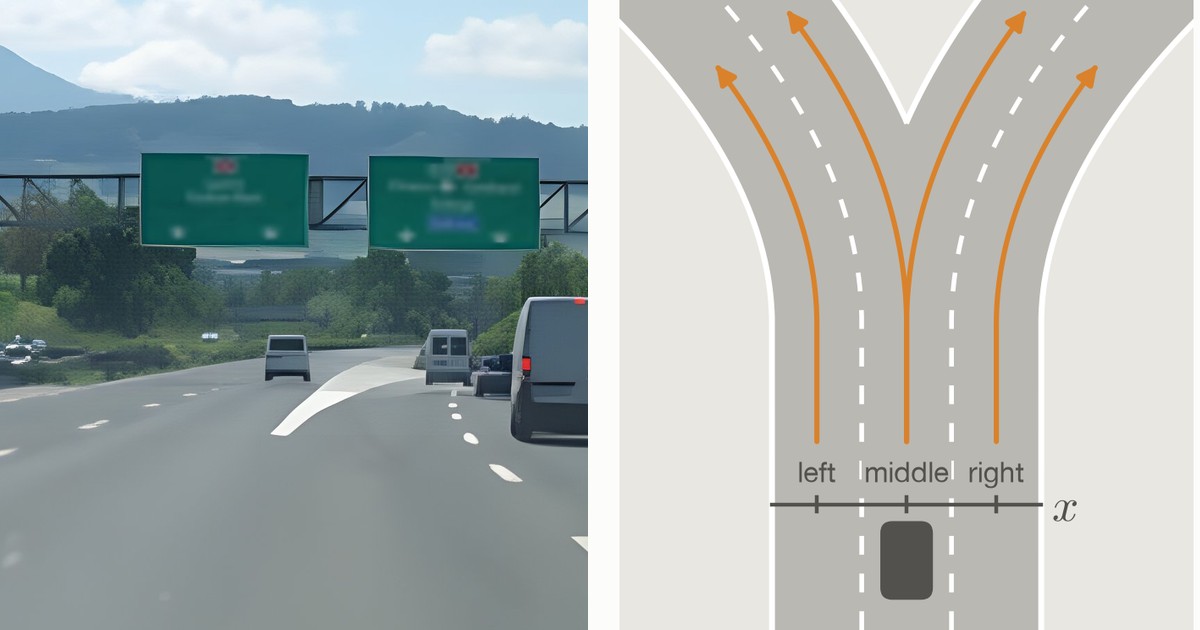
To ground the ideas, the essay uses steering angle prediction from a front-facing car camera. At a lane split, drivers in the left lane mostly go left, those in the right lane mostly go right, and the middle lane splits roughly half and half. The learning target is the conditional distribution of steering angles given the input, simplified in the figures to the car's position across the lanes.
Each such conditional distribution is a hypothesis, and the set of them forms a space in which the truth is one point. A model is a subset of that space, indexed by its parameters. A standard regression choice — a Gaussian whose mean is a neural network and whose variance is fixed — cannot contain the lane-split truth, since one Gaussian has a single peak while the truth in the middle lane has two. The essay also observes that the truth is only defined where inputs actually occur: many hypotheses agree on the road but differ off it, where no data can separate them.
Training selects the hypothesis that best explains the data by minimising negative log-likelihood, and for a fixed-variance Gaussian that objective reduces to mean squared error up to constants. In other words, the most common regression loss already encodes a probabilistic assumption, whether or not the practitioner noticed.
Why it matters
The value of the piece is the reframe more than any single technique. Mean squared error, the workhorse of regression, is quietly a Gaussian noise assumption, so uncertainty is already present in most pipelines — the question is whether it is surfaced and used. The epistemic/aleatoric split also tells practitioners what to do about a model's doubt: gather more data, gather different inputs, or defer to a human, rather than assuming one remedy fits all. And the author is candid that the model will be wrong regardless; the goal is picking assumptions under which its uncertainty estimates stay useful for the decision at hand. As an explicitly introductory map of the territory — what uncertainty is, where it comes from, and what it is for — it is a clear entry point for engineers who want their models to know when to hedge.
- #machine-learning
- #uncertainty
- #probabilistic-models
- #bayesian-statistics
- #deep-learning