· via Hacker News – Front Page (native)
Hackers claim flaw in LED display software let them hijack billboards across several countries
A group calling itself Leakers$ says it exploited a vulnerability in LED display software to push explicit footage onto a Giza highway billboard, and claims it found thousands of exposed screens worldwide.
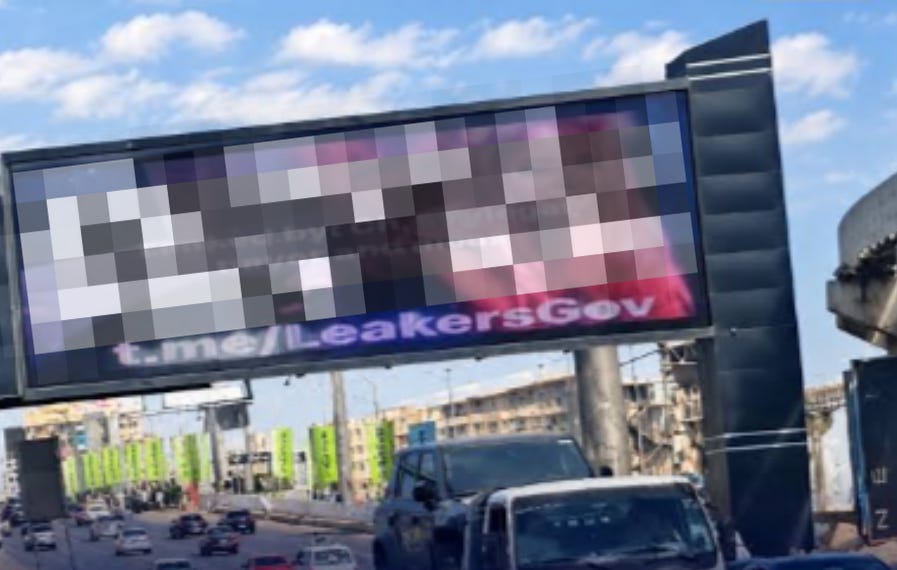
Explicit footage on a Cairo highway screen
On Thursday, October 29, sexually explicit footage began playing on a large electronic billboard overlooking the 26 July Corridor in Giza, one of the busiest roads connecting Cairo with its western suburbs. Clips of the scene spread quickly on social media, and Egyptian authorities responded by suspending advertising screens along the route and opening an investigation, according to The Cairo Report.
The display is operated by Arabian United, an advertising venture founded in 2022 by United Media Services (UMS), an Egyptian media conglomerate tied to the country's intelligence services that controls more than 40 companies, and the Saudi-listed outdoor advertising firm Arabian Contracting Services Co.
Two partial accounts
In a statement that evening, Egypt's Interior Ministry attributed the incident to a breach of an unnamed international advertising company's website, saying the same footage had appeared on screens in several countries simultaneously. As The Cairo Report notes, the ministry did not identify the company, the countries affected or any suspects, and offered no technical explanation of how a website breach would translate into control over roadside displays.
A hacking group operating the Telegram channel Leakers$ has claimed responsibility. The Cairo Report was able to contact the group because its channel address was visible in the footage shown on the Egyptian billboard. A representative said the members exploited a vulnerability in the software used to transmit content to LED displays, rather than targeting the Egyptian screen individually, and that the same weakness affected display systems in Iraq, Malaysia, Brazil, China and elsewhere.
According to the representative, the targets were located through an automated, randomized scan that surfaced thousands of exposed systems in roughly two hours, with several participants using the online handles Never, 19ylegal, CH and Nivex. The group said its aim was to expose security failures rather than demand payment, and claimed the operation required far less skill than outsiders might assume. The Cairo Report cautions that the representative did not provide technical evidence establishing whether a genuine software exploit was used, or whether the group simply accessed poorly protected equipment sitting exposed on the public internet.
Operator response and the scope of the network
Arabian United confirmed that an unknown party had gained unauthorized access to one of its screens, saying it immediately suspended the display and was investigating with the authorities while insisting it holds itself to high security and operating standards. Earlier that day, security sources told the Egyptian newspaper Al-Shorouk that investigators were still weighing whether the footage resulted from an external intrusion or had been uploaded by someone with legitimate access to the screen.
The compromise also highlights the scale of the infrastructure involved. According to the Saudi partner's 2025 annual report, the Egyptian subsidiary operates 1,926 billboards, 239 of them digital, across Cairo, Giza, Alexandria and the North Coast. The Saudi firm holds a 49.99% ownership stake but exercises effective control through 57% of the board seats, per its March 2026 financial statements.
Why it matters
Digital out-of-home advertising depends on networked content-delivery systems, and this incident suggests that layer is widely unhardened. If a two-hour automated scan can surface thousands of exposed display systems across multiple countries, basic protections such as authentication and network segmentation are missing across a whole industry, not just one operator. The breach of a venture connected to Egypt's intelligence apparatus also shows that institutional status provides no substitute for technical security. Finally, the episode exposes a regulatory gap: Egypt's Law No. 208 of 2020 created a National Authority for Roadside Advertising focused on content standards, and Prime Minister Mostafa Madbouly stressed advertising regulation as recently as September 2025, yet far less has been disclosed about security requirements for the digital systems that increasingly deliver that advertising in public spaces.
- #cybersecurity
- #digital-advertising
- #egypt
- #led-displays
- #hacking