· via Hacker News – Front Page (native)
Hackers leak 281 GB of internal AfD emails packaged with AI summaries
Hackers have published 281 GB of internal AfD emails alongside AI-generated summaries. Heist Berlin says the material documents racism, antisemitic content and alleged financial misconduct in the far-right party.
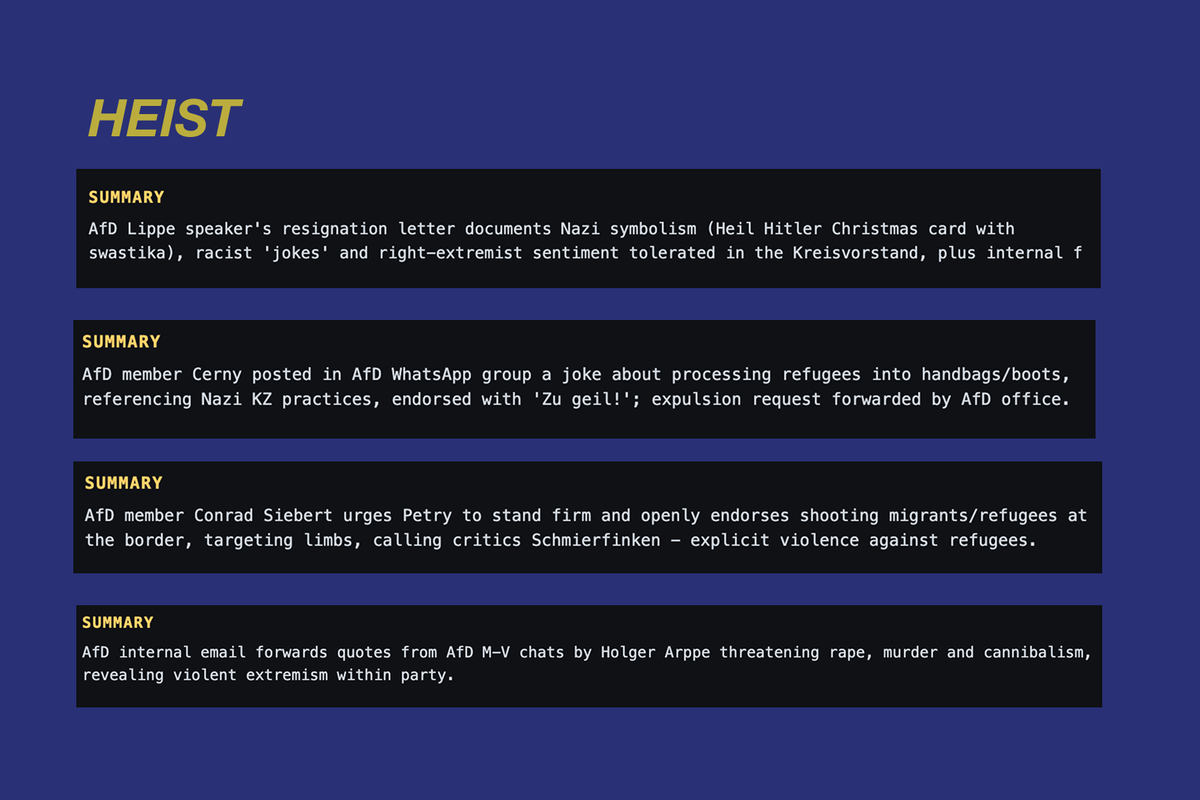
What happened
On Monday, hackers published a large trove of internal emails belonging to Germany's far-right AfD party, according to a report by Heist Berlin. The archive runs to 281 GB and contains 421,179 internal party emails. Unusually for a political leak, the material was released packaged with AI-generated summaries, according to the report, rather than as a raw dump that only a well-resourced newsroom could plausibly work through.
What the emails reportedly contain
Heist Berlin describes the correspondence as showing a consistent pattern of racism and antisemitism among party supporters. Among the examples it cites are messages trading in racist slurs, antisemitic conspiracy theories about Jewish control of the world, and jokes about making handbags and boots out of refugees. The outlet also reports email discussions about shooting refugees at the border, a Christmas card featuring a swastika and the words "Heil Hitler", and one exchange closed with the greeting "Heil und Sieg". A summary of the report additionally points to allegations of financial misconduct.
Heist Berlin presents the archive as a corrective to a debate that dominated German media in the weeks after the Berlin election, when claims of antisemitism around the party drew heavy coverage. The publicly visible portion of the report does not say how the emails were obtained, who carried out the breach, or how the accompanying summaries were produced.
The AI dimension
The summaries are the technically notable part. An archive of more than 400,000 emails is unreadable at human scale; in earlier leaks of comparable size, that filtering work fell to journalists and researchers who could spend weeks inside the raw files. Shipping the leak with machine-generated summaries moves that editorial function to a model selected by the hackers themselves, and makes the material immediately legible to casual readers.
That convenience carries obvious risks. Anyone relying on the summaries is trusting an unknown model, prompted by an anonymous actor, to characterise documents they will almost certainly never open. Summaries can drop context, weight some passages over others, or simply misstate what a document says. The underlying emails remain the only real evidence; the summaries are, at best, an index and, at worst, a narrative delivered under the borrowed credibility of raw data.
Why it matters
The breach itself is a serious security incident. Losing 281 GB of internal correspondence to exfiltration and publication is a reminder that political organisations hold vast amounts of reputational risk in unremarkable inboxes and remain soft, high-value targets.
The AI packaging is the more novel signal. Generative AI has already reshaped how attackers phish and how defenders triage; this leak shows it changing the last mile of disclosure as well — not stealing the data, but pre-digesting it for an audience. If the format proves effective, it is easy to imagine it becoming standard for hacktivist dumps, whistleblower releases and state-linked influence operations alike.
That makes verification the pressing question. AI-summarised leaks collapse the distance between allegation and evidence. Readers, and journalists amplifying the material, should treat the summaries as claims about the emails rather than as the emails themselves, and check the underlying files wherever possible.
- #ai
- #security
- #data-leak
- #germany
- #far-right