· via Hacker News – Front Page (native)
Hex raises $100M at $1.2B valuation and ships a from-scratch rebuild of its data platform
Hex raised $100M at a $1.2B valuation led by Peak XV and 137 Ventures, and simultaneously launched Hex 4.0, a from-scratch rewrite of its six-year-old analytics platform built for AI agents.
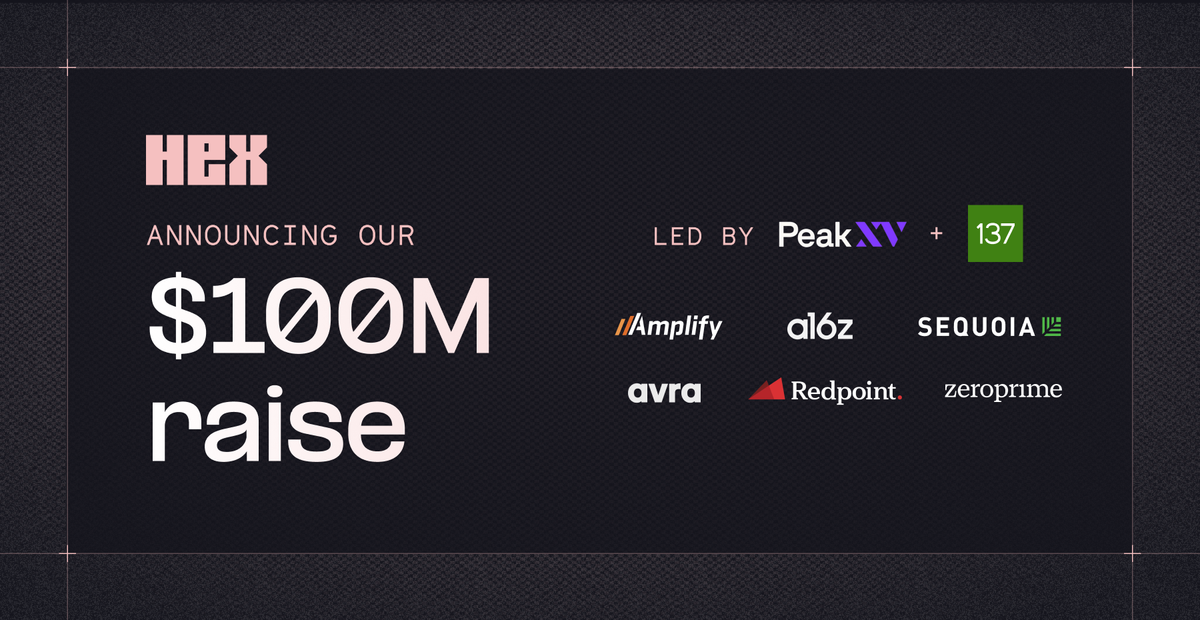
Hex announces a $100M round and a rebuilt platform
Hex, the collaborative analytics company founded in 2019, has closed a $100 million financing round at a $1.2 billion valuation while simultaneously releasing Hex 4.0, a version of its product that was rewritten from zero rather than iterated on. According to the company's announcement, which drew front-page attention on Hacker News, the round was led by Peak XV together with 137 Ventures, with Amplify, Avra, a16z, Redpoint, Sequoia and Zero Prime also participating.
Why the company started over
Hex says the decision to rebuild came shortly after its best quarter to date, when the team asked what the product would look like if it were started today. The existing platform served more than 2,500 customers after six years of development, and Hex had moved early on AI: a text-to-SQL prototype running on GPT-3 before ChatGPT existed, its Magic capabilities in February 2023, a data agent last year, and generative apps earlier this year.
Despite that record, the company argues its data model, architecture and assumptions about user behavior were locked in during 2020 and 2021, before agents became a mainstream way of working with data. That produced three structural problems, per Hex:
- Its internal agent harness had swollen to hundreds of tools whose main job was teaching models how Hex itself works, which the company describes as far outside what models are trained for.
- External agents could only reach Hex through a narrow MCP interface rather than something designed for them.
- Its compute engine was never built for the fast, highly concurrent, back-and-forth sessions that agents tend to run.
Hex also points to a shift in where data work happens: customers increasingly assemble dashboards and reports inside coding tools such as Cursor, Codex, Cognition and Claude, producing artifacts that circulate with no provenance, permissions or context. The old product, the company says, could not bring order to that chaos the way it wanted.
What changes in Hex 4.0
The rewritten platform rests on the premise that data artifacts should be plain code — not a proprietary YAML format — because code is flexible and naturally suited to agents, while work produced across many different tools needs context, access controls and governance to be trusted. Hex also disclosed that agents wrote all of the code for the rewrite, with the company's engineers, who have deep experience building data platforms, providing direction.
The company frames 4.0 as a foundation rather than a finish line, saying there are features it wants to build that would have been impractical on the old architecture but are straightforward on the new one.
The round and the market mood
On the financing, Hex says it wanted more capital to grow its team and go-to-market effort, but found investors earlier in the year deeply skeptical of application software — to the point where, as the company jokes, some appeared to believe only a couple of firms would survive. Peak XV, by contrast, took the view that platforms independent of any single AI model have a bright future and was comfortable backing a first-principles rebuild.
Hex's wider thesis takes aim at business intelligence specifically. The company contends the traditional BI paradigm is over, that grafting a chat assistant onto legacy platforms will not save the category, and that the next stage pairs code-based flexibility with governance. The founding promise of BI — that anyone can ask questions and build things — has finally arrived, Hex argues, but trust has been lost along the way. The post also takes a swipe at older rivals marketing themselves as AI-native without having actually rebuilt their products.
Why it matters
Clean-sheet rewrites of successful, revenue-generating products are rare, and Hex is betting that its architecture, not its feature list, was the real constraint in an agent-driven market. If that bet pays off, it sets a precedent for every data and analytics vendor whose core design predates large language models, and Hex explicitly predicts others will reach the same conclusion. The round itself is a signal too: $100 million at a $1.2 billion valuation, secured in a year when investors reportedly soured on application-layer software, suggests some backers see agent-era platforms as an upgrade cycle rather than an extinction event. Finally, the claim that AI agents wrote the entire new codebase is a notable data point in the ongoing debate over how much production engineering work agents can now handle.
- #data-analytics
- #ai-agents
- #funding
- #startups
- #business-intelligence