· via Hacker News – Front Page (hnrss.org)
Hitachi Y-series CO2 heat pump water heaters add solar-linked tariff controls
Hitachi's Y-series EcoCute water heaters, launching in Japan from November 2026, add selectable daytime and PV-linked tariff controls, HEMS support and a five-year warranty.
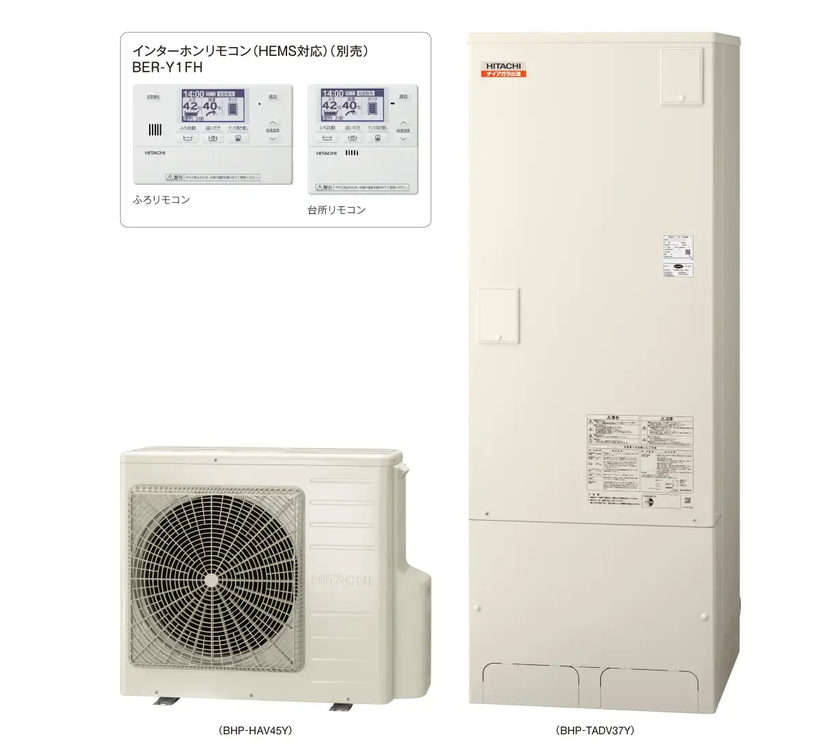
What Hitachi announced
Hitachi Global Life Solutions, a unit of the Japanese conglomerate, has unveiled a new series of residential EcoCute heat pump water heaters for the Japanese market, with sales of the Y series starting progressively in November 2026, pv magazine reports. The range is topped by two fully automatic models, the BHP-FV37YD and BHP-FV46YD, which deliver hot water at direct mains pressure and offer storage capacities of 370 liters and 460 liters respectively.
The units use carbon dioxide as a natural refrigerant, the defining characteristic of Japan's EcoCute product category. According to pv magazine, the 370-liter model is sized for households of roughly three to five people, while the 460-liter version targets homes of four to six.
The headline feature: tariff-aware controls
The most consequential change in the Y series is expanded compatibility with Japanese electricity tariffs that reward customers for shifting consumption into daytime hours. Some Japanese utilities have introduced such plans as growing volumes of solar generation enter the grid, and daytime water heating has become one of the behaviors they want to encourage.
Owners will be able to select a supported electricity contract directly from the water heater's remote controller, with a manual configuration option for other tariffs. Hitachi says the feature is aimed at plans that promote daytime consumption, including those built around household PV systems.
Evolution, not a new heat pump
Hitachi has not yet published complete efficiency specifications for the new models. For reference, the predecessors, the BHP-FV37WD and BHP-FV46WD, carry annual hot-water and heat-retention ratings of 4.2 and 4.1 under Japanese Industrial Standards, and pair with heat pump units designated BHP-HAV45W and BHP-HAV60W respectively.
The manufacturer has also not indicated any new compressor, refrigerant circuit or heat-exchanger architecture. Based on what has been disclosed so far, pv magazine concludes that the Y series looks like an upgrade of Hitachi's existing EcoCute platform rather than a fundamentally new heat pump design.
Connectivity and warranty
The Y series supports Hitachi's home energy management system through a HEMS connection adapter and a wireless LAN adapter. This is not new territory for the company: the previous models already offered connected energy-management functions, including Echonet Lite compatibility and solar-powered water-heating operation. The practical energy-management upgrade here is therefore broader support for utility tariff structures, not the introduction of HEMS connectivity itself.
Hitachi is also introducing a five-year manufacturer warranty for the Y series. It covers the heat pump unit, the hot-water storage unit, specified consumable components, the remote controller and both adapters.
Why it matters
This launch is a clear example of a mainstream household appliance being reshaped around grid economics rather than around hardware performance. As rooftop and utility-scale solar push midday electricity supply up in Japan, tariffs are increasingly structured to encourage consumption when generation is abundant. A tank that stores several hundred liters of hot water is a natural buffer: it can absorb surplus daytime electricity and carry that energy, as heat, into evening use.
For solar households, the notable shift is that the coordination now lives in the appliance's controller instead of depending on the occupant tracking tariff windows manually. Paired with HEMS integration, the water heater becomes an actor in a household energy strategy rather than a standalone device.
The Y series is Japan-only for now, and its thermal-storage logic is specific to how Japanese utilities price electricity. But the underlying pattern, combining storage, tariff awareness and home energy management in an ordinary appliance, is a template for how residential energy management is likely to develop in any market where solar penetration keeps climbing.
- #heat-pumps
- #energy-management
- #solar
- #smart-home
- #japan