· via Hacker News – Front Page (hnrss.org)
HP's GB300-based ZGX Fury AI workstation goes on sale with Red Hat AI Factory in the works
HP's ZGX Fury AI workstation is now orderable with a GB300 superchip and 748GB of unified memory, while Red Hat AI Factory support for the machine is certified but still on the roadmap.
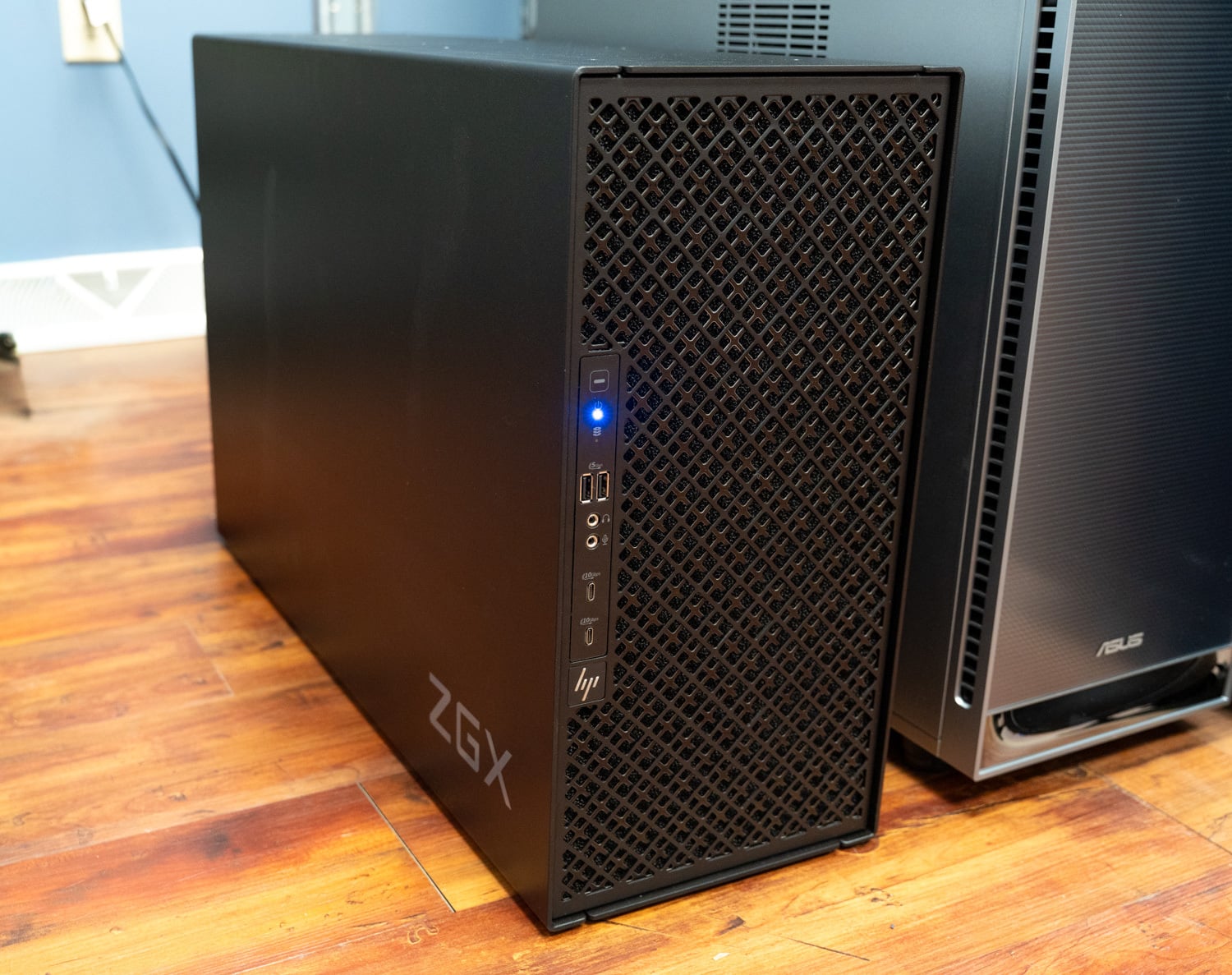
HP is now taking orders for the ZGX Fury, a deskside AI workstation built around NVIDIA's GB300 Grace Blackwell Ultra Desktop Superchip. According to StorageReview, the system pairs 748GB of coherent unified memory with up to 20 petaFLOPS of FP4 compute, and HP is positioning it less as a personal workstation than as a shared inference box that a department, a factory floor or a branch office can run without a data center behind it.
One superchip, 748GB of unified memory
The core silicon matches what StorageReview already tested in MSI's XpertStation WS300: one Blackwell Ultra GPU with 252GB of HBM3e at 7.1TB/s, tied over NVLink-C2C to a 72-core Grace CPU with 496GB of LPDDR5X. HP's spec sheet adds detail the platform announcements skipped — the CPU memory comes as four 128GB SOCAMM modules delivering 396GB/s, and the Grace CPU is soldered to the host processor module rather than socketed.
The two pools combine into a single 748GB coherent space that the GPU can address directly. That, HP argues, is what makes trillion-parameter inference and fine-tuning of models in the 100-billion-parameter class feasible on a single box, with the footnote that those model sizes assume FP4 quantization.
Storage follows a similar split. Two embedded M.2 slots hang off the Grace CPU on PCIe 5.0 and hold the operating system in a RAID 1 mirror; two more M.2 slots sit behind the PCIe switch inside the ConnectX-8 SuperNIC and form a RAID 0 data volume, with 2TB or 4TB of self-encrypting NVMe chosen at purchase.
Networking runs through the ConnectX-8 SuperNIC with two QSFP112 ports at 400Gbps each — enough to link two ZGX Fury systems together — plus a 10GbE RJ-45 for the host and a separate 1GbE port, Mini-DP and micro-USB for the BMC. There is no display output from the GB300 itself: HP offers an optional NVIDIA RTX PRO GPU to drive monitors so the Blackwell Ultra GPU stays dedicated to inference. The tower chassis ships with rails for a 5U rack slot, and HP uses liquid cooling with tuned airflow.
Ubuntu, Z Runtime and a Red Hat certification
The machine arrives with Ubuntu 24.04 LTS, NVIDIA's AI developer tools and an NVIDIA-approved partner BIOS and BMC firmware, plus two HP-specific layers. HP Z Runtime is a pre-installed command-line tool for pulling, serving and managing models locally. HP Z Toolkit adds open-source frameworks, MLflow experiment tracking and Ollama testing, with discovery and sync across ZGX systems. The intended workflow is that a team prototypes on the smaller ZGX Nano and moves the same pipeline to the Fury when it needs more memory, throughput or concurrent users.
The newer element is Red Hat. HP says the ZGX Fury is certified for Red Hat Enterprise Linux and listed in the Red Hat Ecosystem Catalog, and the two companies are developing what HP calls an open, enterprise-grade AI platform running Red Hat AI Factory with NVIDIA on the machine. Red Hat AI Factory with NVIDIA is Red Hat's packaging of RHEL, OpenShift and Red Hat AI Enterprise with NVIDIA AI Enterprise for deploying models, agents and applications across hybrid cloud.
HP claims the pairing should cut environment setup time and deployment risk, improve GPU utilization through optimized CUDA libraries, scheduling and multi-GPU orchestration, and let developers offload compute to the box without changing existing workflows. The platform is also being designed to run multiple AI workloads on one system with isolation and governance — the step that turns a deskside machine into something IT can manage as edge infrastructure. HP's Jim Nottingham framed the goal as extending enterprise AI from the data center to the edge through local AI factories.
Availability and caveats
The ZGX Fury is orderable now through HP, but pricing was not disclosed. Notably, the Red Hat AI Factory integration is a planned solution rather than a shipping product: HP says customers will be able to evaluate it in a sandboxed environment on HP devices before moving to production, with timing, eligibility and supported configurations still to come.
Why it matters
The deskside superchip category is filling in quickly — MSI's WS300 ships on the same GB300 silicon, and AMD's Threadripper Halo Station targets similar workloads. HP's differentiator is the enterprise software story: put Red Hat's hybrid-cloud AI stack on top of a 748GB-memory inference box and it becomes a plausible, governable unit of on-prem AI infrastructure rather than a hero machine for one researcher. If the Red Hat AI Factory integration ships as described, organizations without a data center rack could still run and fine-tune very large models locally, with the control and consistency that regulated environments tend to demand. For now, buyers are ordering hardware with the platform side still on the roadmap, and StorageReview says a full review is on the way.
- #hp
- #nvidia
- #red-hat
- #ai-hardware
- #workstations