· via Hacker News – Front Page (native)
IANA's example.com gets multilingual redesign, its biggest change in decades
example.com, IANA's reserved documentation domain, now cycles through six languages via JavaScript as IANA splits the page to cut bandwidth from automated traffic.
What changed on 28 September 2026
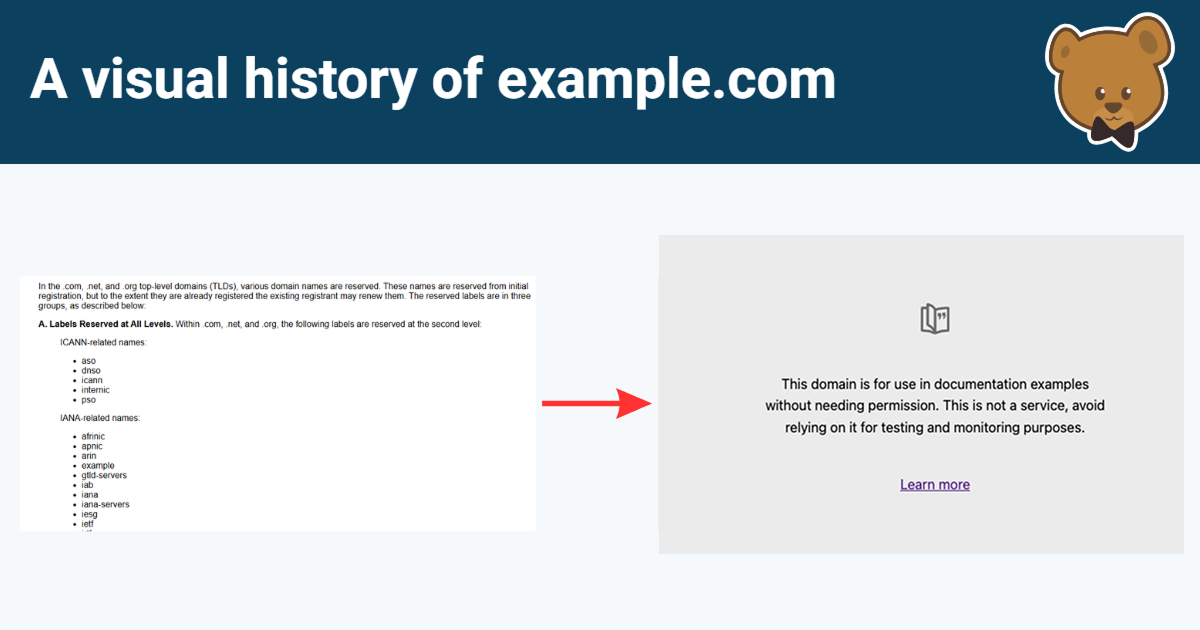
example.com, the domain the Internet Assigned Numbers Authority (IANA) reserves for documentation, received what DebugBear calls its biggest redesign in decades on 28 September 2026. Until that date the page was a static, English-only document. It now rotates through six languages — English, Arabic, Chinese, French, Russian and Spanish — showing a different one every five seconds, driven by JavaScript.
The wording was tightened as well. The English text now states that the domain can be used in documentation examples without needing permission, and cautions that it is not a service and should not be relied on for testing or monitoring. The script also inserts an SVG book icon into the page.
How the animation works
As DebugBear explains, the language switch is not a simple content swap. Each character of the message is wrapped in its own span element, and every span is given a slightly larger CSS transition-delay than the one before it. The opacity animation itself is just a 0.4-second transition, but the staggered delays make each character fade at a slightly different moment, producing a ripple across the text as one language dissolves into the next.
IANA's reasoning
In a statement to DebugBear, IANA said its occasional changes to the site are usually driven by either reducing the bandwidth cost of serving it or improving its usefulness. Because the domain is heavily trafficked, bandwidth is a key consideration: the recent change split the page into a more basic document, augmented by a separate JavaScript file carrying the additional content. Since most traffic to the site is automated and does not fetch JavaScript, overall data requirements drop.
IANA also reiterated the domain's purpose. It exists for documentation, such as illustrative examples in instructions, and some incidental traffic comes from people pasting sample configuration files without customising the example entries. But it is not intended as a general-purpose endpoint for availability testing, and there is no requirement for an HTTP service on the host at all — IANA operates the web page as a courtesy.
Twenty-plus years of history
According to Wikipedia, cited by DebugBear, example.com launched on 1 January 1999. The earliest Wayback Machine capture, from 20 January 2002, shows a table-based layout with the ICANN logo in the corner, served by Apache 1.3.22. The familiar wording telling visitors they had typed an example domain into their browser arrived in March 2002, and a link to RFC 2606, the document covering reserved top-level and second-level domain names, was added in February 2003.
The page then stayed largely still for years. example.edu joined the landing page in July 2010, and after a stretch from January 2011 redirecting to IANA's own website, example.com began serving its own page again in July 2013 from the EdgeCast content delivery network, alongside the rounded card design many developers remember. A 2019 update kept the layout but modernised the font stack with more fallback fonts and tweaked the copy.
The infrastructure churned more recently. The Server header disappeared in January 2025, around the time EdgeCast — rebranded as Edgio after its acquisition by Limelight Networks — went through Chapter 11 bankruptcy, with Akamai acquiring select customer contracts. October 2025 brought a redesign that dropped the card, minified the HTML and changed the link text to "Learn more". December 2025 moved the site behind Cloudflare, and a June 2026 tweak added an empty data-URI favicon so browsers stop requesting /favicon.ico unnecessarily.
DebugBear adds that its own uptime monitoring data shows the example.com server occasionally failing to respond — supporting the page's new warning against depending on it.
Why it matters
example.com is baked into documentation, tutorials, sample configuration files and test fixtures across the industry, so even a cosmetic change ripples outward. Anyone who lands on the page — deliberately or because an example URL was never customised — now meets an animated, multilingual page rather than the static placeholder they may have had memorised.
More substantively, the split between the basic HTML page and the JavaScript-delivered content changes what automated clients receive: a script that fetches and parses the page now gets a slimmer document than a human visitor sees in a browser. And IANA's statement makes the operating contract explicit — the domain is a documentation courtesy, not a monitoring endpoint — which matters for any tooling that still uses example.com as a connectivity or liveness check.
- #iana
- #example-com
- #domains
- #web
- #javascript