· via Hacker News – Front Page (hnrss.org)
Infinite Mac now boots BeOS versions for Power Macintosh in the browser
Infinite Mac, the browser-based Macintosh emulator, has added BeOS support — and the developer says compatibility fixes to DingusPPC make it the only emulator able to run PowerPC BeOS.
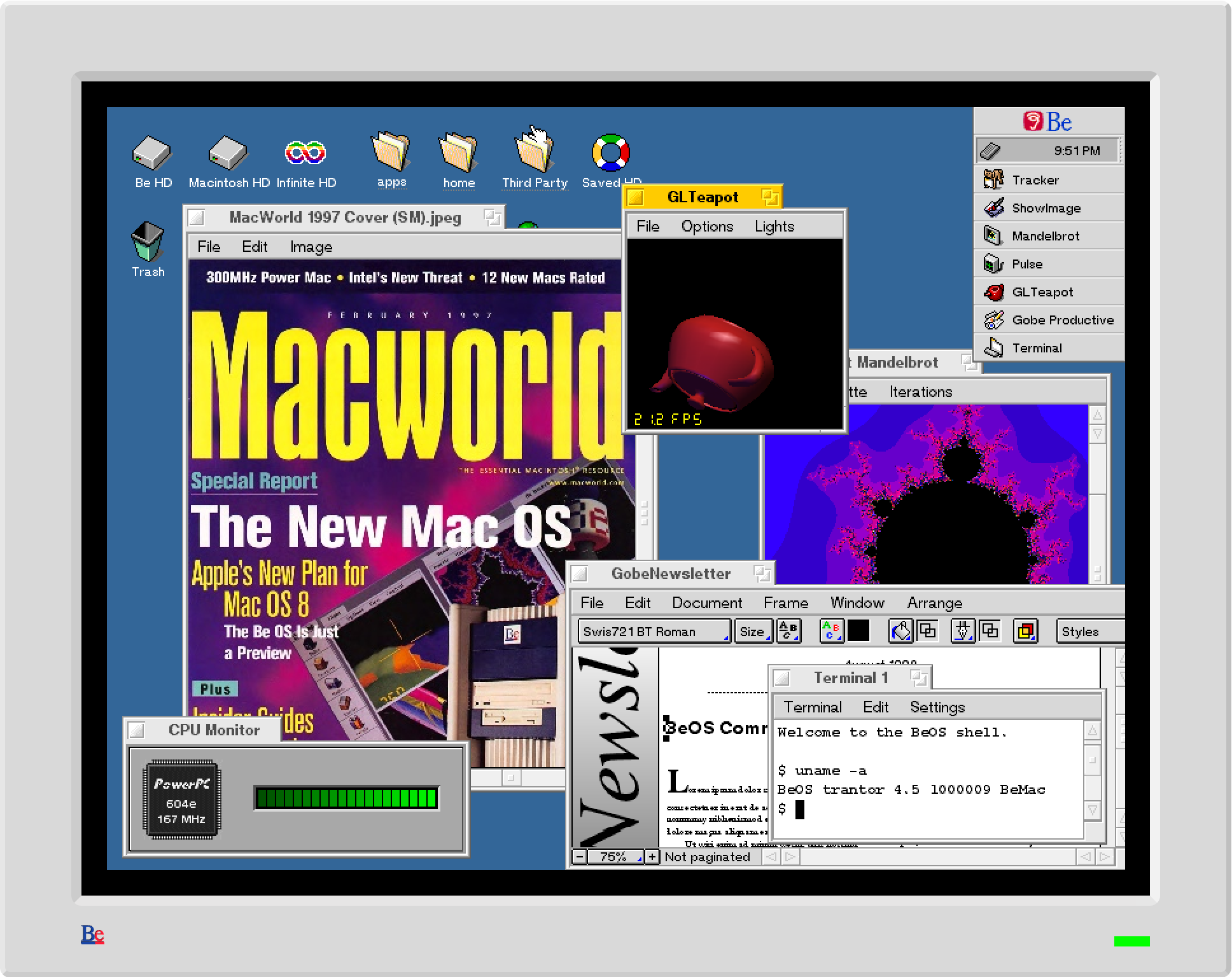
BeOS arrives on Infinite Mac
Infinite Mac, the browser-based emulation site that lets visitors boot Macintosh systems from 1984 through 2005, now runs many versions of BeOS. According to a post on persistent.info that reached Hacker News' front page, the BeOS installs are full peers to the site's Mac systems: machines boot quickly because large disks are streamed in, pre-installed software is available from the Infinite HD library, CD-ROMs can be loaded from the Internet Archive, and files can be saved to a persistent Saved HD drive.
BeOS was a multimedia-focused, multitasking and heavily multithreaded operating system eventually ported to the mid-90s Power Macintosh line. It impressed much of the Mac community at the time, including Apple, which considered acquiring its maker, Be. The post frames the release as a chance to explore, hands-on, a branch of computing history that never happened.
What it took to get working
BeOS runs on DingusPPC, a PowerPC emulator Infinite Mac had already integrated. Adding a Power Macintosh 7300 configuration — one of the officially supported machines — plus an install CD image got an initial version running quickly, but wider testing surfaced a string of bugs:
- The BeOS boot loader behaved as though every modifier key were held down, because of a bug in the ADB emulation, so a BIOS-style partition picker appeared at every boot.
- Changing the screen depth requires notifying two hardware components, the video controller and the digital-to-analog converter. DingusPPC had implicitly relied on the order Mac OS used for those notifications; BeOS chose the opposite order and ended up with a corrupted display.
- Early BeOS releases updated video memory in little-endian mode, a hardware capability DingusPPC did not model.
- Later BeOS versions could mount HFS partitions but were stricter than Mac OS about how on-disk data structures should be populated, which broke volumes generated with the machfs Python library.
The developer writes that most commits upstreamed to DingusPPC over the past month were aimed at BeOS compatibility. SheepShaver, another Power Macintosh emulator embedded in Infinite Mac, originated on BeOS, so it was tested under emulated BeOS as well; that required a fix for how the emulator modeled the mapping of the ROM to physical memory addresses.
The pattern behind the fixes, the post explains, is that DingusPPC and Infinite Mac were built around Mac OS and had quietly become dependent on its quirks. Running an independently developed operating system exercised new code paths and improved the accuracy of the emulated hardware. The developer believes DingusPPC is now the only emulator capable of running PowerPC versions of BeOS, and hopes the groundwork will help bring up alternate operating systems such as MkLinux and Rhapsody.
On the site itself, the work included a BeOS appearance for the custom controls, software collection for the library, and a dynamically generated disk overlay that makes the OS preselect a screen resolution matching the browser window. That last task involved reverse-engineering the file BeOS writes to disk to record the screen size — work the developer says an AI agent, Codex, was useful for, since the format's nuances changed across releases.
One historical wrinkle: Developer Release 8.2, the initial BeOS version for Power Macs, shipped with a time bomb that stopped it booting after April 1, 1997, tied to a licensed font renderer Be could not distribute indefinitely. DR8.3 resolved that, but to keep the first notable version bootable, the site uses custom date support to hardcode a working date whenever that disk is selected.
Using BeOS in 2026
The developer's impressions after living with it: BeOS is strikingly fast to boot and to use, especially next to contemporary Mac OS releases, which did far less. The POSIX subsystem and Unix-like shell feel genuinely modern, and BFS, Be's file system with attributes and live queries, remains one of its most interesting ideas. The system also reads as developer-focused and unfinished — many bundled applications are technology demos, and much third-party software of the era had a version 0.1 feel, though Gobe Productive, from the former ClarisWorks team, stands out. Interface choices like tabbed window titles, a hand-shaped default cursor and a Deskbar that can act like a Start menu give it a Windows/Mac hybrid character. Be also open-sourced its Tracker file manager around the time it pivoted to internet appliances.
Why it matters
This is more than a novelty release. Getting BeOS to run well forced DingusPPC to emulate PowerPC hardware more faithfully, which benefits every future guest OS and improves preservation of a platform whose fate fed into Apple's own history. Browser delivery removes the usual hurdles — no disk images to hunt down, no emulator to configure — and the date workaround means even a release designed to expire in 1997 stays usable today. For anyone curious what the operating system Apple once considered buying was actually like, it is now a browser tab away.
- #emulation
- #beos
- #retro-computing
- #browser
- #powerpc