· via Hacker News – Front Page (native)
Kiri 0.2.0 launches as cross-platform Docker alternative claiming 8× faster container starts
Kiri 0.2.0, a free beta container runtime for Mac, Windows and Linux, keeps the docker CLI, Compose and Docker API working while reporting 22 ms container starts versus 178 ms on Docker Desktop.
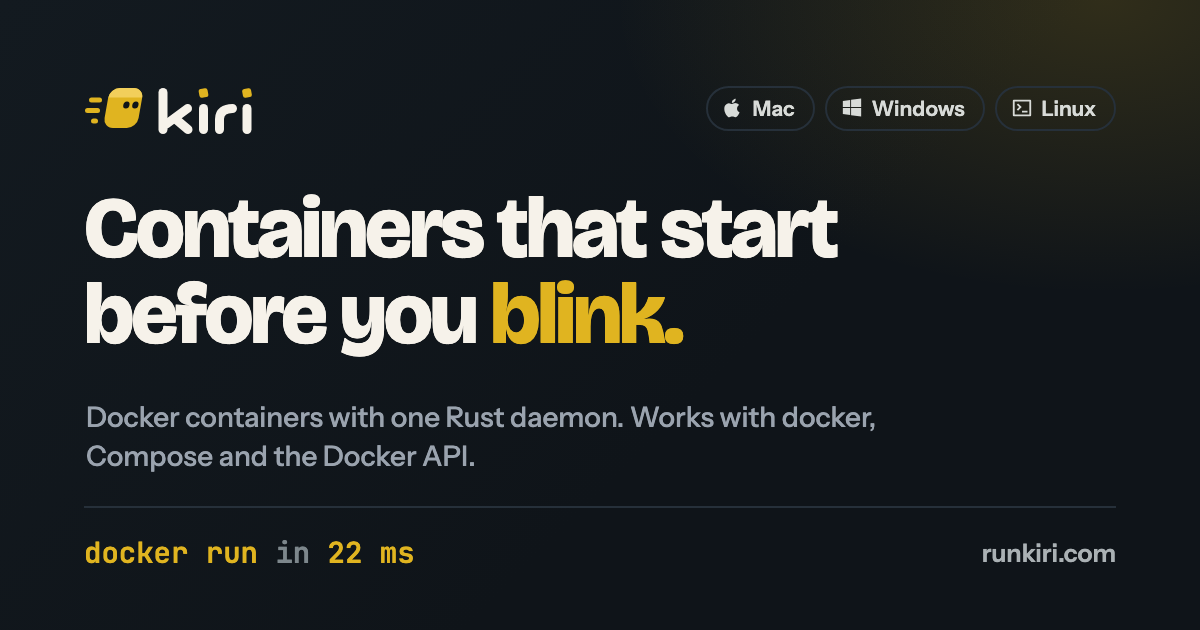
Kiri, a container runtime positioned as a modern alternative to Docker Desktop, has shipped version 0.2.0 for macOS, Windows and Linux. The project, which reached the front page of Hacker News on 15 November 2026, is free and in beta. Its central claim is speed: docker run completes in 22 milliseconds on Kiri versus 178 milliseconds on Docker Desktop, an eightfold difference.
The benchmark numbers, with caveats
According to Kiri's website, the comparison gave every engine the same budget of 2 CPUs and 8 GB of memory. Colima measured 152 ms and OrbStack 279 ms on the same test. Kiri adds that most of its remaining 22 ms comes from the docker CLI starting up; going through the Docker Engine API directly, a complete container lifecycle takes 3.1 ms. The site attributes the gap to architecture rather than tuning and publishes a fuller breakdown on a separate benchmarks page. All of these figures are vendor-measured on a single Apple Silicon Mac, and the CPU and memory comparison chart still carries placeholders pending real numbers, so the 8× figure is a claim rather than an independently verified result.
Built around the Docker you already use
Kiri's compatibility pitch is broad: the docker CLI, Compose, buildx, the Docker Engine API, Docker Hub, ghcr.io, OCI images and Dockerfiles all behave as they do today, answered by a single daemon. With the Kiri app open, ordinary docker commands execute on Kiri, while a supplementary kiri CLI adds things Docker lacks, such as named containers, Kubernetes, Linux machines and public links. On Apple silicon, amd64 images run through Rosetta. A migration tool imports existing images, volumes and containers from OrbStack or Docker Desktop, and the desktop window is localised into 15 languages.
More than containers
The release bundles the surrounding tooling developers typically install alongside Docker. Builds run through BuildKit, with a vulnerability scan shown on each image's page. kiri k8s start brings up a k3s cluster in roughly 20 seconds, and kind works too. kiri machine create provisions full Linux machines with the user's own account and host folders mounted at the same paths. Containers get stable addresses like web.kiri.local, served with HTTPS from Kiri's own certificate authority, and Kiri Share exposes a running container at a public runkiri.cloud address behind a warning page on a visitor's first stop. Kiri also says the daemon stays around 15 MB, the VM sleeps after a minute idle and wakes in 0.15 seconds.
One daemon instead of five hops
On macOS, Kiri boots a single Linux VM through Apple's Virtualization.framework, running a custom kernel with a small Rust init as PID 1, and connects host and guest over vsock. Inside, the Kiri daemon creates each container directly with clone3. The site contrasts this with OrbStack and Docker Desktop, where a container start passes through five programs with separate sockets and a shim process remains resident for every running container. Kiri's daemon handles namespaces, cgroups and mounts itself and leaves nothing per container running, which is where the claimed speedup comes from.
Why it matters
Docker Desktop is the default for most developers, and existing alternatives each trade something away: Colima is free but slower, OrbStack is fast but paid and Mac-only, and native Linux setups do not travel across platforms. Kiri is aiming at the whole matrix at once — cross-platform, free, Docker-compatible, with Kubernetes and Linux VMs folded in. If the latency and footprint claims hold up under independent testing, sub-25 ms starts matter most for workflows that constantly spin up short-lived containers: test suites, local CI loops and Compose-heavy development. At version 0.2.0 it is still a beta with self-reported benchmarks, but it is a credible challenge to a market that has felt settled for years.
- #containers
- #docker
- #developer-tools
- #virtualization
- #kubernetes