· via Hacker News – Front Page (hnrss.org)
Ladybird's first downloadable alpha brings a from-scratch web engine to macOS and Linux
After four years of development, the Ladybird browser has released its first downloadable alpha for macOS and Linux, offering the web a rare fourth engine written entirely from scratch.
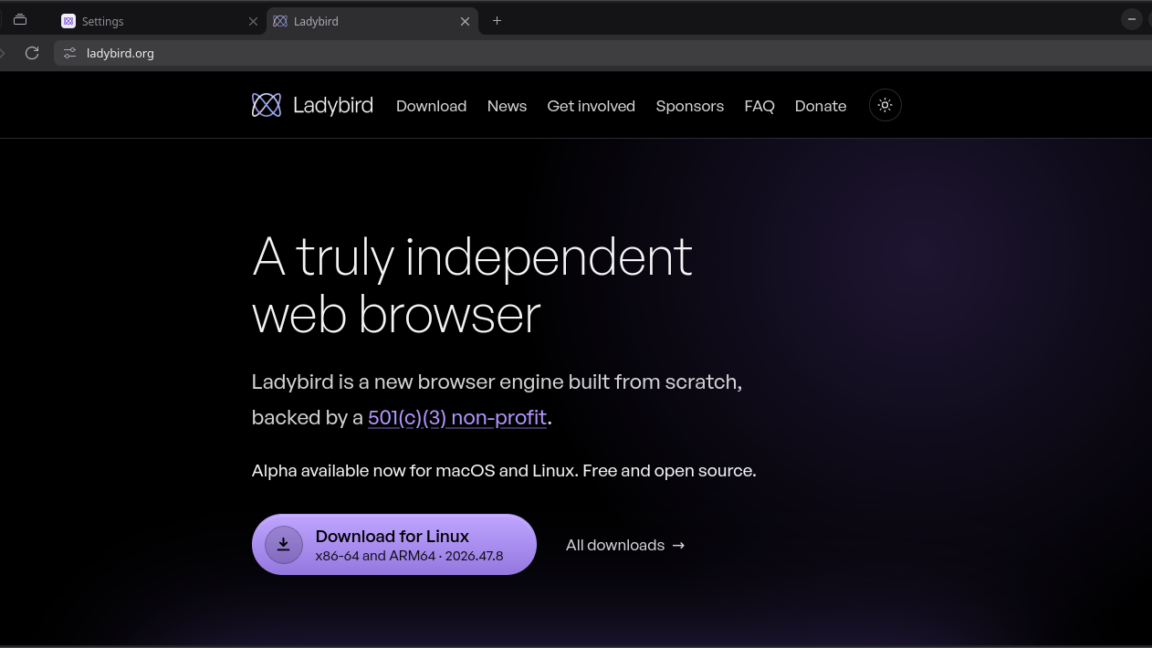
First installable release
After four years of work building a browser engine from the ground up, the Ladybird project shipped its first downloadable alpha on November 23. According to Ars Technica, prebuilt packages are now available for macOS and Linux, with automatic updating included, making this the first time the browser has been distributed as an ordinary install rather than something users had to compile from source themselves.
The release is deliberately narrow in scope. "The engine is our own, built from the ground up, and not a fork," project lead Andreas Kling wrote in Monday's announcement, adding that "the browser around it is modest, but functional."
A fourth engine, not a fork
Ladybird matters mostly because of what it is not: another Chromium derivative. As Ars Technica points out, Chrome, Edge, Brave and Opera all run on Google's Blink engine, Firefox depends on Gecko, and Safari uses WebKit. Ladybird instead ships its own rendering engine paired with LibJS, a JavaScript engine that was likewise written from scratch. That makes it a genuine fourth implementation of the web platform rather than a rebranding of an existing one.
Why an independent implementation matters
Nearly the whole modern web currently runs on three engines, and Blink is by far the largest. That concentration has a practical consequence: developers tend to optimise their sites for Chromium because that is where the majority of traffic sits, and the platform as a whole then drifts toward whatever the dominant engine supports.
An independent implementation of the standards cannot help revealing where sites depend on Chromium's behaviour rather than the published specifications. Ars Technica notes that Ladybird's existence is unlikely to shift the market any time soon, but every new engine increases the number of implementations that standards can be tested against, which exposes Chromium-specific assumptions and pushes the ecosystem back toward the spec.
Origins and funding
The project grew out of SerenityOS, Kling's effort to build an independent operating system from scratch, before splitting off as a separate effort. It now operates under the Ladybird Browser Initiative, a 501(c)(3) nonprofit funded by sponsorships and donations. The project's site stresses two points of independence: there are no sponsored search engine deals of the kind that support many popular browsers, and sponsoring organisations have no say in the roadmap.
Criticism of the founder
The Ars Technica article carries a note stating that its author was unaware, at the time of writing, of criticism directed at Kling's public statements, and pointing readers toward accounts by Kelson Vibber and Drew DeVault for further context.
Why it matters
A from-scratch browser engine reaching the point of downloadable, auto-updating releases is a rare event in any era. Engine consolidation is one of the web platform's structural risks: when nearly everything funnels through Blink, the line between what Chromium does and what the web actually is becomes blurry. Ladybird will not dethrone anything tomorrow — by its own lead's description, the browser around the engine is modest — but as a fourth independent implementation it gives standards bodies and developers a reference point descended from no existing engine, and a tool for catching the web's quiet dependencies on a single vendor's behaviour. That it reached this milestone on donations and sponsorship, without search engine money, is itself a signal about how much engine diversity the web can still support.
- #browser
- #web-standards
- #open-source
- #ladybird