· via Hacker News – Front Page (native)
Machine learning reveals first readable text from Vesuvius scroll PHerc. 306B
The Vesuvius Challenge has awarded its $50,000 First Letters Prize for PHerc. 306B after Liam Warner and Nicola Bodill used machine learning to recover readable Greek text from a scroll buried in AD79.
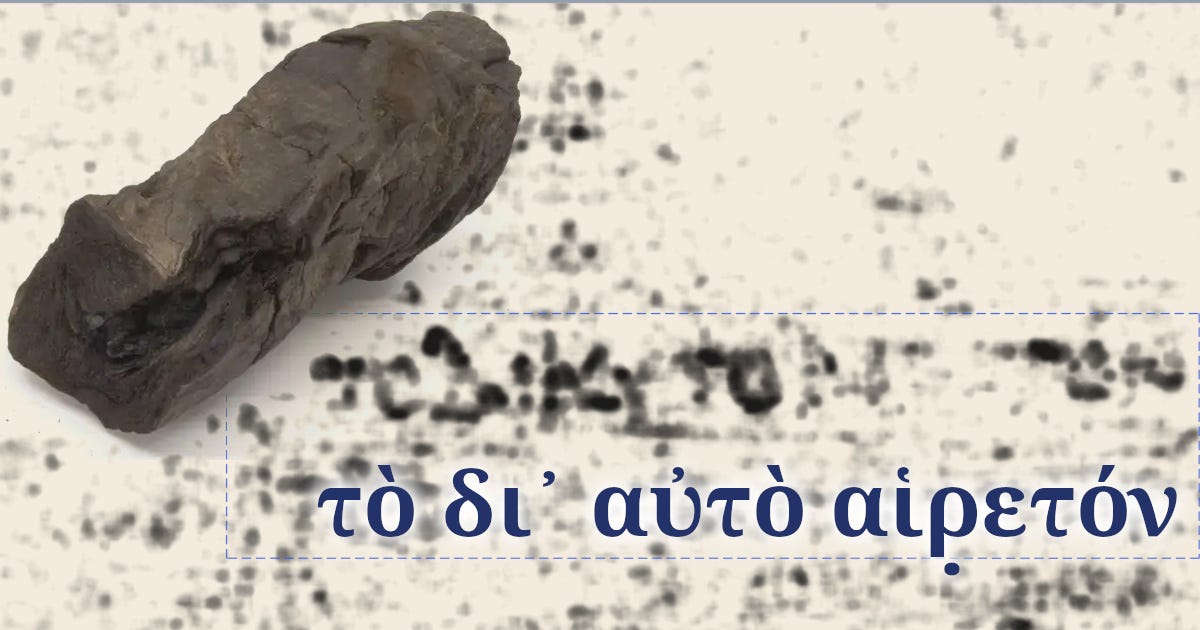
First words from a scroll buried in AD79
PHerc. 306 was carbonized by the eruption of Mount Vesuvius in AD79 and has kept its contents secret since being excavated in the 1750s. According to the Vesuvius Challenge, which announced the result on its blog, participants in the competition have now recovered readable text from the scroll for the first time in roughly 2,000 years. The team awarded a $50,000 First Letters Prize to Liam Warner, a freelance software engineer from northern England, and Nicola Bodill, a University of Sydney MA student with a degree in Latin and Ancient Greek.
The roll is broken into two pieces, PHerc. 306A and PHerc. 306B, both held at the Biblioteca Nazionale di Napoli, about 10km from where they were excavated at the Villa dei Papiri in Herculaneum. With ink now identified in 306B and the orientation of the script known, the Vesuvius Challenge says 306B is the upper section of the original scroll and the smaller 306A the lower part. That previously unknown detail makes 306A a more valuable target for future scanning and virtual unwrapping.
A close-run competition
The prize required 10 readable characters within a 4 cm² area, and the organization reviewed 25 submissions on this scroll. Several entries recovered 7, 8 or even 9 characters before Warner and Bodill cleared the bar. The Vesuvius Challenge acknowledged eight near-miss efforts, including The Gold Panners, the Grilli Security Research Team and the Doom Scrollers.
The stumbling block was a short Greek sequence. The sequence τοδιαυτο had appeared in submissions for almost a month, but the traces that followed were too faint for the papyrology team to agree on: some read them as a mu, others as a nu. Warner and Bodill's images were clearer, and for the first time the papyrologists agreed on the letters αι. Distinguishing Μ, Ν and ΑΙ is difficult in majuscule Greek, and the blog notes that scribes confused these forms even in antiquity. The clinching evidence was the second alpha's middle stroke, rising diagonally from the bottom of the left oblique stroke, matching the first alpha.
With that settled, the reading τὸ δι᾽ αὑτὸ αἱρετόν, meaning "that which is in itself desirable," becomes plausible. The Vesuvius Challenge says the expression has parallels in works by Aristotle and Sextus Empiricus, and in Philodemus' ethical treatise On Anger; in an Epicurean context it should refer only to good and pleasure.
How machine learning found the ink
The scroll was scanned with micro-CT at the ESRF in Grenoble, producing cross-sections that show how badly distorted and compressed the papyrus is within its tight windings. The winning patch of surface was isolated with VC3D's GrowPatch tool on top of the m7 surface predictions from the Vesuvius Challenge team, seeded along a line found by a publicly available spiral-fitter.
Ink detection multiplies the outputs of two neural networks, so a pixel shows as ink only where both agree. One is TRACE v3B, a public model by Jashanjot Singh Gill and Nhat Nam Tran. The other, called A-hn, was fine-tuned by the winners from Youssef Nader's v8-in model, the same model used to discover the first letters in PHerc. 1447. Training averaged three 600-step runs over a mix of the PHerc. 1447 labels and machine-generated labels averaged from four public models on other parts of PHerc. 306B, with an extra loss penalty for marking blank papyrus as ink.
Warner says he had intended only to contribute small fixes and optimizations, but with a spare RTX 4090 idle he tried ink detection. Bodill has spent hundreds of hours since 2023 manually creating ink labels to train machine learning models, work she presented at the 2025 International Congress of Papyrology. The pair's code, model and data are available on GitHub and Hugging Face for others to reproduce and extend.
Why it matters
The result shows that the pipeline behind the earlier PHerc. 1447 breakthrough — micro-CT scanning, surface prediction and machine-learned ink detection — works on another badly damaged scroll, with open-source models and a prize structure letting a distributed community iterate until papyrologists can reach consensus on a reading. Every recovered sequence adds to the small corpus of legible Herculaneum texts, and the orientation finding gives researchers a concrete next target: PHerc. 306A, now confirmed as the lower half of a scroll whose upper half has finally started to speak.
- #machine-learning
- #computer-vision
- #archaeology
- #digital-humanities
- #vesuvius-challenge