· via Hacker News – Front Page (native)
MIT's soft optical-fiber sheet maps its own 3D shape as it bends and twists
MIT engineers built a stretchable silicone sheet threaded with soft optical fibers that reconstructs its own 3D shape in near real time, with error under 0.4 cm, beating rigid-sensor motion-capture designs.
A sheet that senses its own shape
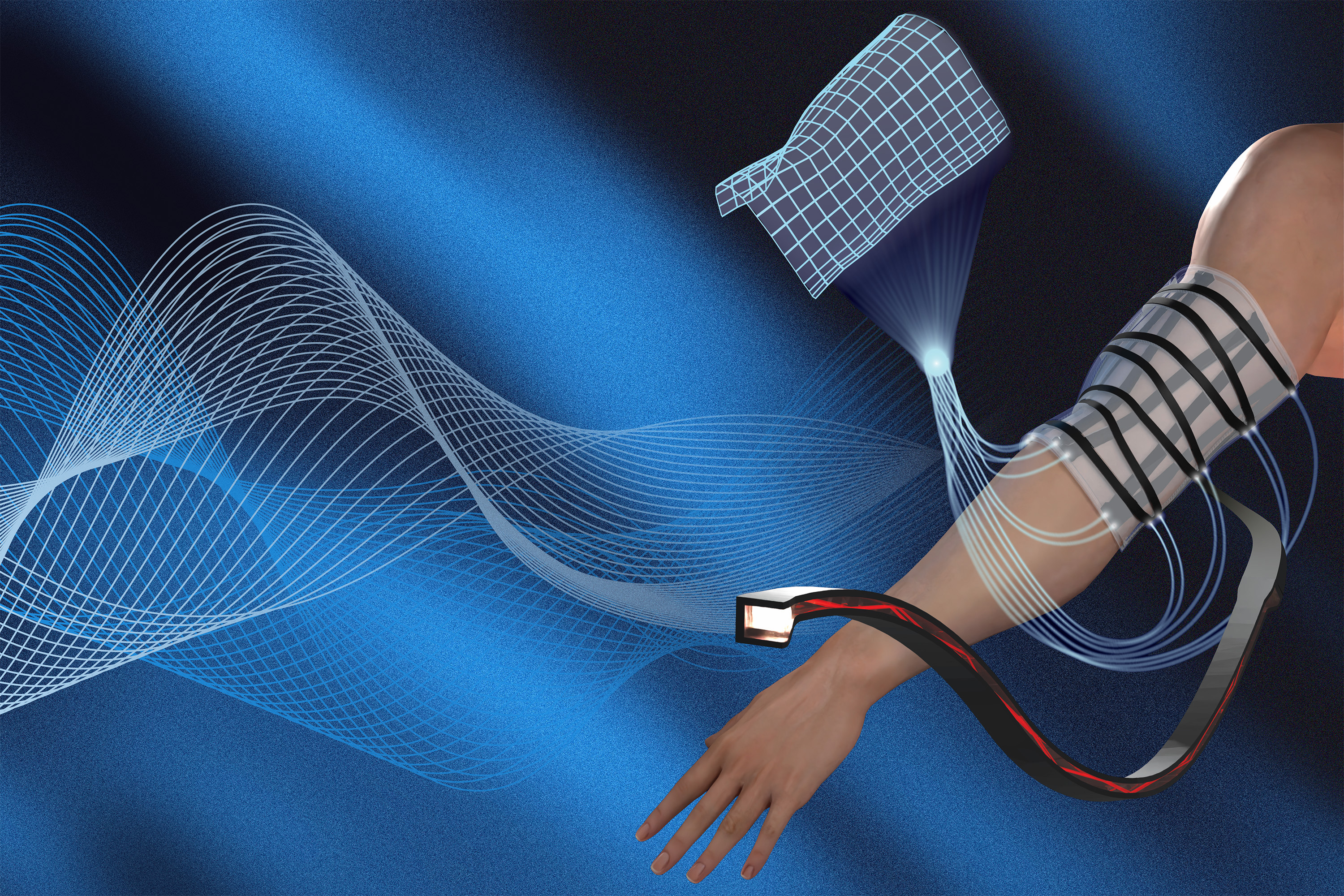
Engineers at MIT have built a flexible, stretchable sheet that continuously works out its own three-dimensional shape as it bends, folds and twists, using patterns of light travelling through soft fibers embedded in the material. According to MIT News, the design is a departure from motion-capture suits, which rely on rigid sensors stitched into fabric at fixed points. The new sheet instead uses optical waveguides arranged in a zig-zag pattern through silicone, paired with an algorithm that translates changing light readings into a live digital reconstruction of the surface.
The work, by graduate student Qifan Yu, graduate student Nina Cao and assistant professor Kaitlyn Becker of MIT's Department of Mechanical Engineering, is published in the journal Advanced Intelligent Systems. The research was supported in part by MathWorks.
How the fibers do the sensing
Conventional optical fibers guide light through a smooth, transparent core wrapped in opaque cladding. Prior work has used such waveguides as simple curvature sensors: the more a fiber bends, the less light emerges from the far end. But those setups could only measure how a line, such as a robot arm segment, curves — not the full shape of a surface.
The MIT team modified the recipe. Instead of glass, they made fibers from a clear, flexible rubber core surrounded by cladding of the same rubber dyed black. Crucially, they deliberately roughened one side of each core. Because light scatters differently depending on whether the fiber bends toward its rough or smooth side, each fiber acts as a bidirectional sensor, reporting not just how much it is bending but in which direction.
To find the best arrangement, the researchers simulated sheets embedded with various fiber layouts, from checkerboards to criss-crossed and zig-zag patterns, and compared the reconstructed shapes against the simulated originals. A particular spacing of zig-zagging fibers proved closest to recreating the sheet's true form. The final prototype pairs an LED at one end of each fiber with a light sensor at the other, both connected to an external circuit board that collects and amplifies the signals, while software converts the readings into a 3D reconstruction on the fly.
Accuracy and resilience
In demonstrations, the virtual twin mirrored the physical sheet almost in real time as researchers folded it diagonally in alternating directions. To measure precision, the team draped the sheet over 3D-printed molds with known geometries and compared the digital reconstruction to the actual surface. Using a distance metric between real and reconstructed surfaces, they found an error below 0.4 centimeters — tighter than the roughly 1 to 2 centimeter errors typical of existing rigid-sensor designs, as Yu noted.
The architecture is also fault-tolerant. When the researchers cut or disconnected a few fibers, the remaining ones could still reconstruct the sheet's overall shape accurately, a property that matters for garments subjected to daily wear and tear.
From lab bench to wearable
The immediate roadmap involves making the hardware thinner. The current fibers are 1 millimeter thick, but the researchers say other fabrication processes could bring that down to tens of micrometers — thinner than a human hair — allowing many more fibers to be embedded in a garment to capture fine-grained changes in shape.
The team envisions soft, pliable clothing that a wearer could use to physically control a video game character or a tele-operated robot, and wraps for physical therapy that record a patient's mobility and range of motion during each session. Yu pointed out that rehabilitation clinicians routinely need data on how a patient moves and stretches, and surface shape sensing fits that task well. Becker framed the goal as building tools that help therapists quantify progress over time, so an evaluation today can be compared precisely with one from months and many appointments earlier.
Why it matters
Motion capture and shape sensing today largely depend on rigid electronics, which limit comfort and can be unsafe around soft, delicate environments — including human bodies. A fully soft, stretchable sensing surface changes that trade-off, and its tolerance to damaged fibers addresses one of the biggest practical obstacles for wearable sensors: durability. Sub-centimeter accuracy approaching or matching rigid systems suggests the approach could move beyond novelty into clinical rehabilitation tracking, human-robot control and next-generation interfaces where knowing precisely how a soft surface deforms is the whole point.
- #mit
- #sensors
- #wearables
- #robotics
- #optical-fibers