· via Hacker News – Front Page (native)
Monumental Labs demos end-to-end autonomous robotic marble carving with KUKA robots
Monumental Labs says it has demonstrated the first end-to-end autonomous CNC stone carving system, using KUKA robots to turn a 3D model and a raw marble block into a finished sculpture with no human involved.
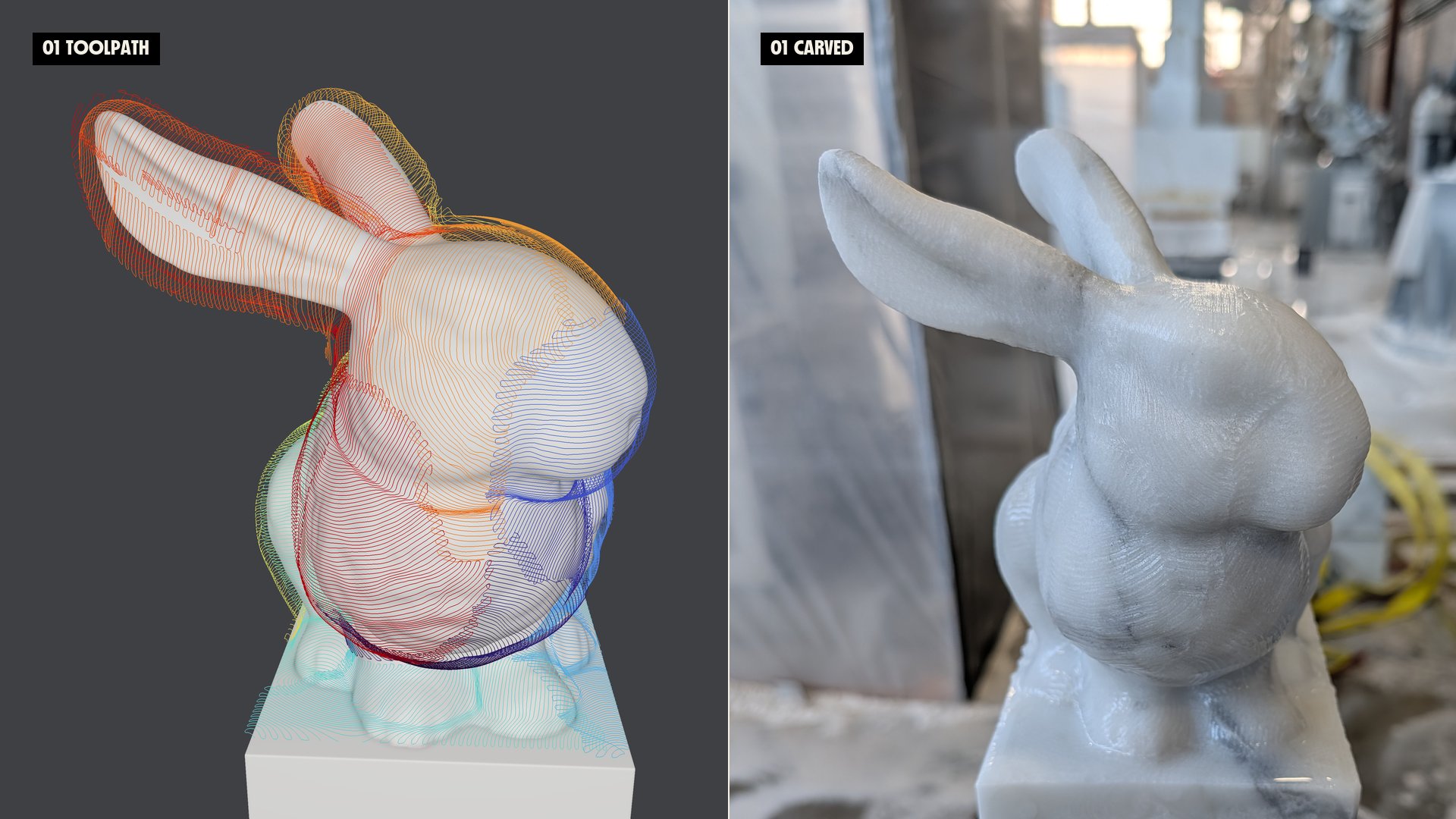
Monumental Labs, based in Greenpoint, Brooklyn, says it has demonstrated the first end-to-end autonomous CNC stone carving system of its kind: a pipeline that takes a 3D model and a raw block of marble and produces a finished sculpture with no human in the loop. The system runs on KUKA KR240 industrial robots, and the work was presented at Embodied AI NYC, an event hosted by NY Robotics and ZeroSpace Labs in Brooklyn. Monumental Labs' Eleanor Wiesler documented the pipeline in a November blog post, a write-up of the talk she gave with colleagues Sebastian Marino and James Darby, which reached the front page of Hacker News.
A magic trick as a benchmark
The demonstration is staged as a magic trick. The robot carves a top hat from the block, then carves the Stanford bunny, a classic test model from computer graphics, out of the hat. Wiesler notes the hat was chosen partly for fun and partly as a nod to what happens when robots meet art. The team ran the same sequence in simulation and in real marble to show that planned toolpaths carry over from one to the other.
Roughing with voxels and G-code
Everything starts with a voxel representation of the stone. According to Wiesler, voxels let the system accept arbitrary mesh inputs and store them sparsely, which matters because a dense grid grows with the cube of its resolution. From the voxel grid the system computes a signed distance field along with surface normals and gradients, providing a basis for constructive solid geometry: subtractive manufacturing framed as the original stone minus everything the tool removes.
Roughing begins with bulk material removal to get from raw block to rough shape. Toolpaths end up as G-code programs the robot executes step by step, with early passes descending through the stone in successive levels, each route shaped by how much of the cutter is buried in the material. As the part nears its final form, the system switches to smaller tools and finer passes, and adds off-axis roughing that cuts along tilted planes to clear material under overhangs such as the bunny's ears and chin.
Finishing without a human
Finishing is the harder half of the problem. The system takes two inputs, a simulation of the surface roughing left behind and the target design model, and closes the gap between them. It works in layers, using voxel grid dilation and mesh intersection cuts to peel the remaining stone down through a series of progressively offset surfaces until the final layer coincides with the design. Each layer is automatically segmented into regions that can be machined together, and every region gets a dedicated toolpath and tool orientation.
Within a segment, toolpaths are derived from geodesic rather than Euclidean distances. Straight-line distance would pass through a curved part; distance measured across the surface yields isolines that follow the sculpture's curvature and are spaced for efficient machining. Machine learning is paired with this geometry to plan toolpaths that adapt to each sculpture, and to stitch separate isolines into one continuous route so the cutter remains engaged with the stone rather than retracting and plunging back in between passes. The system also solves for collision-free tool orientations per segment, using access directions the robot can physically reach.
Humans remain in the workflow
Despite aiming for lights-out manufacturing, meaning fully automated production with no one on the floor, the company is not cutting people out entirely. Artists and designers still decide the final sculpture, and hand carvers still finalize surface quality on many pieces. Wiesler frames the mission as reviving a craft rather than replacing its practitioners: stone carving never disappeared, but rising costs pushed it out of ordinary construction after an era when civic buildings such as Penn Station and Grand Central were expected to be monumental.
Why it matters
If the claim holds up, it is a notable example of machine learning and computational geometry automating a subtractive process long treated as the preserve of skilled craftspeople. The potential consequences are cheaper architectural stone, faster restoration of historic buildings, and a template for applying the same voxel-plus-learning approach to other materials. It is also a concrete instance of sim-to-real transfer in manufacturing, with toolpaths proven in simulation before being executed in stone. The caveats: the first-of-its-kind claim is the company's own, it was presented at a community event rather than in peer-reviewed form, and the post does not include cost, timing or precision figures that would allow independent comparison with conventional CNC stoneworking.
- #robotics
- #machine-learning
- #cnc
- #automation
- #manufacturing