· via Hacker News – Front Page (native)
NUS team weaves washable touchscreen display into fabric sleeve
Engineers at the National University of Singapore wove LED fibers into a sleeve to create a 96-by-54-pixel textile display that survived 50 machine-wash cycles, pointing toward computing built into clothing itself.
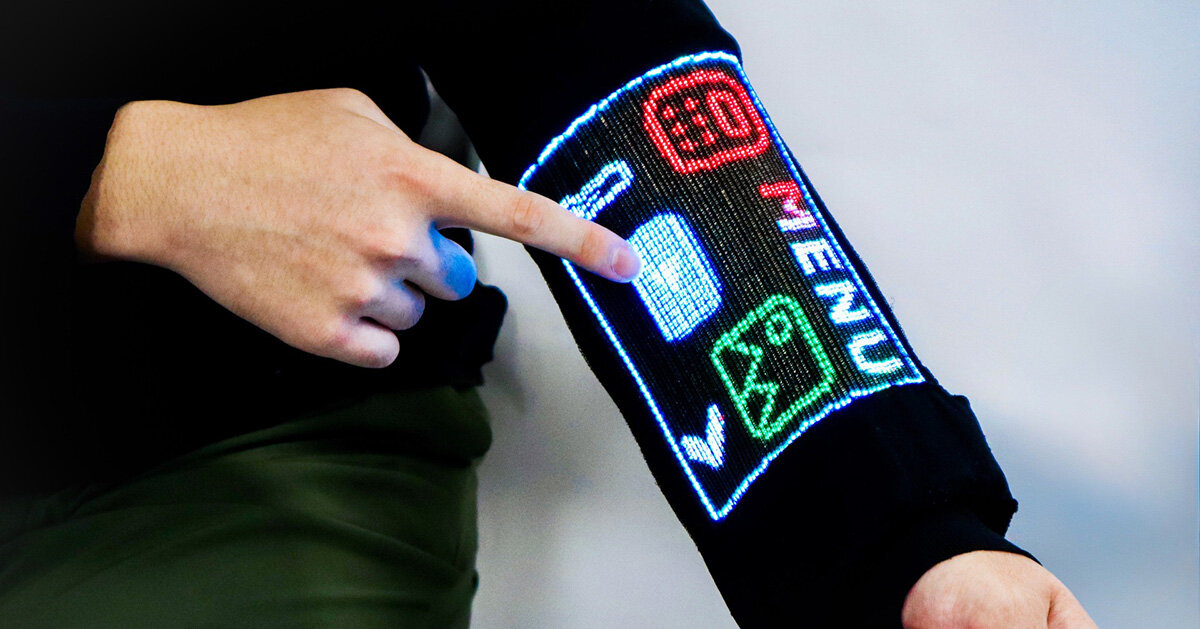
A display woven from thread
Researchers at the National University of Singapore (NUS) have built a touchscreen directly into clothing using electronic fibers that carry their own LEDs and touch sensors. According to designboom, the team led by Assistant Professor Tural Khudiyev threaded 54 of these fibers into the forearm of a sleeve, producing a flexible display that shows images and video, registers finger presses and connects wirelessly to other devices, all while behaving like ordinary fabric.
The approach differs from most wearable technology, which tends to strap a miniaturized gadget onto the body. Here, the display and touch functions live inside the threads themselves, each roughly one millimeter thick, so the garment needs no rigid screen panel.
Turning a thread into a circuit
Circuit boards are flat, which makes it easy to lay out components and wiring across two dimensions. A fiber is narrow and cylindrical, leaving almost no room for the connections a display requires. The NUS group addressed this with an interconnection architecture that chains thousands of microelectronic devices along a single fiber.
The process starts with thin insulated wires. A laser exposes chosen points along their surface, and controlled wetting steers molten solder onto exactly those spots, forming electrical joints without bridging neighboring areas. Designboom reports that the team integrated more than 5,000 chips through over 20,000 connections in this way.
The linked LEDs are then embedded into a multilayer fiber using a thermal drawing process, yielding a thread about one millimeter in diameter and ten meters long. A touch-sensitive layer sits beneath the light-emitting elements: pressing the fiber completes a circuit, the system works out where the contact happened, and the nearest pixel lights up. Display and input therefore happen inside the same thread rather than through parts attached afterward.
What the sleeve can do
The prototype's 54 fibers each carry 96 LEDs, combining into a 96-by-54-pixel display measuring 168 by 105 millimeters. It refreshes at 30 frames per second with 8-bit color depth, which is modest next to a smartphone but enough to play video and photographs, run a calculator and a compass, receive images over Bluetooth, respond to voice commands and adjust orientation and brightness automatically.
The sleeve also carries additional fibers holding a microphone, a speaker and sensors for movement, temperature, magnetic orientation and ambient light. A temperature-sensing thread positioned under the arm can read body temperature and show the result on the sleeve itself. Multi-touch works, and every pixel fiber has its own control channel, so a fault in one line does not necessarily interrupt the others.
Built to be laundered
The durability numbers are the most striking part. The researchers report that the display kept nearly unchanged light output and touch response after 50 machine-washing cycles with detergent, and after 1,000 bends around a five-millimeter radius. The textile is said to be as breathable as cotton, polyester and denim, and to remain within established skin-contact safety limits.
Why it matters
Most wearable computing so far has shrunk existing devices and strapped them to wrists or faces. This work points somewhere else: interfaces built into the material that is already in contact with the wearer, with no separate screen at all.
Healthcare is the application the team highlights. Fibers carrying physiological sensors could gather data continuously and present it on the garment itself, and the researchers suggest that pairing such systems with AI could eventually support personalized monitoring and feedback, though that is a stated future direction rather than something the current prototype demonstrates.
The team's next steps are higher resolution, additional sensing functions and on-device AI. Those goals also hint at the distance between a lab sleeve and a shipping product: a 96-by-54 panel is far from a phone display, and 50 wash cycles, while impressive, is a starting benchmark rather than years of daily wear. Even so, as evidence that ordinary fabric can host a working display with touch input, the NUS fibers mark a real step toward clothing as a computing interface.
- #wearable-computing
- #e-textiles
- #display-technology
- #materials-science
- #hardware