· via Hacker News – Front Page (native)
OccupySaaS: laid-off engineers ship clean-room open source replacements for Auth0 and Salesforce
OccupySaaS, a new protest movement of laid-off engineers, is publishing Apache-2.0 clean-room drop-in replacements for SaaS platforms, starting with an Auth0-compatible identity server and a Salesforce-compatible CRM.
What OccupySaaS is
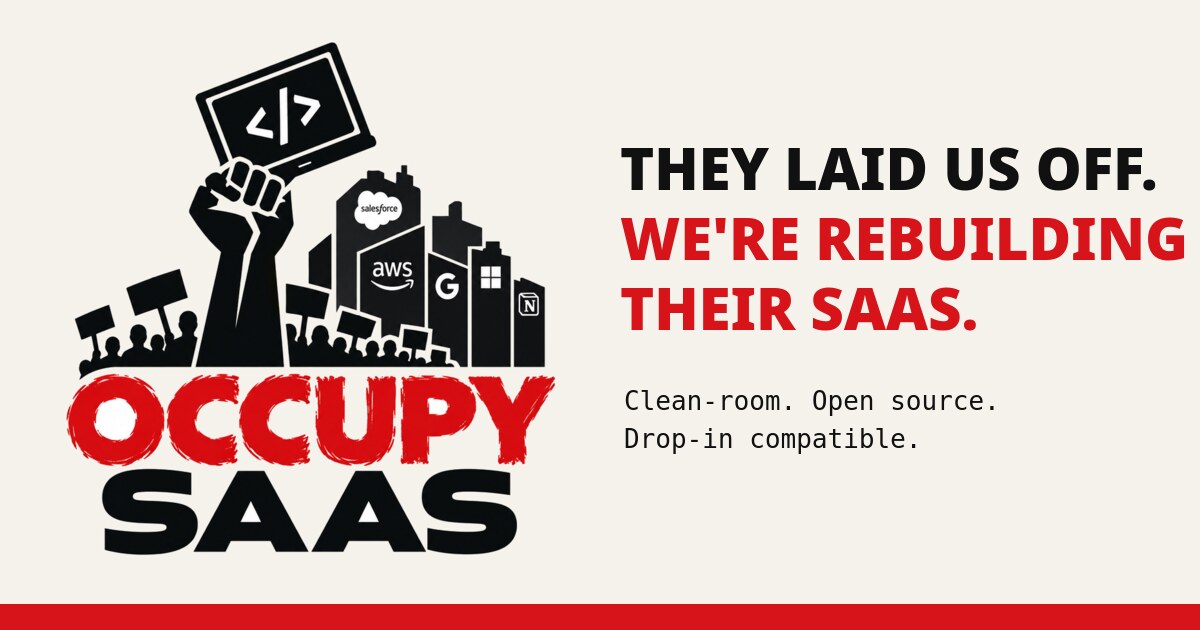
A new protest movement called OccupySaaS, which surfaced on Hacker News's front page in early November 2026, is attacking subscription software in an unusual way: by writing replacement code. According to the project's website, the group was established in October 2026 by engineers who lost their jobs, and its members are using AI tooling and public documentation to build free, self-hostable alternatives to the commercial platforms their industry runs on. Everything is released under the Apache-2.0 licence.
The site explicitly borrows the framing of Occupy Wall Street, arguing that the 2011 question of who the economy serves now applies to the cloud, where the tools companies depend on have become toll collectors. Its stated grievances are per-seat pricing that grows with every hire, lock-in through proprietary APIs and export barriers, and engineering layoffs. The group claims a million engineers have been let go while the platforms kept growing — a figure that is the movement's own and is not independently verified.
The method: clean-room rebuilds with AI
The group's distinguishing discipline is a strict clean-room process. According to the site, no leaked, decompiled or former-employer material is ever used. Every project is rebuilt solely from public API references, open standards such as OAuth 2.0, OIDC and REST, and the documented behavior of public vendor SDKs, with black-box test results also permitted. Each repository carries a CLEAN_ROOM.md policy file, specification writers and builders are kept organisationally separate, and the origin of every test fixture is recorded.
Implementation is handed to AI agents that work from the written specification alone — the OpenAPI contract comes first, then code, then tests — with human review required at every merge. Compatibility is then proven in what the project calls a laboratory that runs the vendors' own public client SDKs against the replacement server. The stated bar is simple: if existing client code needs changes to work, the port is not finished.
First releases: ZeroAuthy and SalesCompel
The first two targets are identity and CRM, described on the site as the two subscriptions nearly every company pays for and almost nobody enjoys.
ZeroAuthy is a self-hostable identity server written in Go that implements the Auth0 Authentication API. The site claims an existing Auth0 SDK can be pointed at a ZeroAuthy tenant domain and work with no code changes. It supports OIDC discovery, JWKS, multi-tenant domains, hosted login, the authorization-code flow with PKCE, the client-credentials grant, rotating refresh tokens, and logout and revocation. Compatibility has been verified against auth0-spa-js, auth0-react and nextjs-auth0, and storage is pluggable across SQLite, PostgreSQL and MySQL, with gRPC plugins also supported.
SalesCompel targets Salesforce. It is a CRM built on a tenant-isolated Go and PostgreSQL core with a Vue-based record editor, plus its own compatibility lab that checks behavior against Salesforce's public API contract. Current capabilities are deliberately narrow: persistent account and contact CRUD, object describe, limited queries, external-ID upserts and bearer authentication, governed by an OpenAPI 3.2 contract and an offline test suite. Both projects are labelled early-stage and open to contributors now.
The roadmap
The project's public map lists further proposed categories: documentation and wiki tools, issue tracking, feature flags, observability, and customer support. The site stresses that these proposals are open for discussion rather than commitments, and that the next target is chosen in public through issue trackers. It also notes that vendor and product names are used purely to describe compatibility, not affiliation.
Why it matters
The cost of building a credible SaaS substitute has collapsed. AI code generation plus published API references make it feasible for a small, motivated group to produce API-compatible servers — work that once required a funded company years to attempt. If the compatibility claims hold up, organisations gain a genuine self-hosting exit from per-seat billing, and incumbent vendors face pressure precisely where their pricing is most resented.
The clean-room discipline is also the movement's legal shield: rebuilding from public specifications with recorded provenance is a long-established technique for avoiding copyright claims, though compatibility work can still raise trademark and patent questions that the site does not fully address. And since all substantive claims here come from the project itself, its verification laboratory deserves outside scrutiny. Still, whether or not ZeroAuthy and SalesCompel mature, the pattern on display — organised, licence-clean, AI-accelerated replacement of subscription software by the people who used to build it — is worth watching.
- #open-source
- #saas
- #clean-room
- #self-hosting
- #authentication
- #crm