· via Hacker News – Front Page (native)
Only Denmark and Italy Have Live EU Digital Identity Wallets, Public Tracker Shows
A public MyID dashboard tracks the EU Digital Identity Wallet rollout across all 27 member states. Its October update found only Denmark and Italy with publicly available wallets, about two months before the bloc's legal deadline.
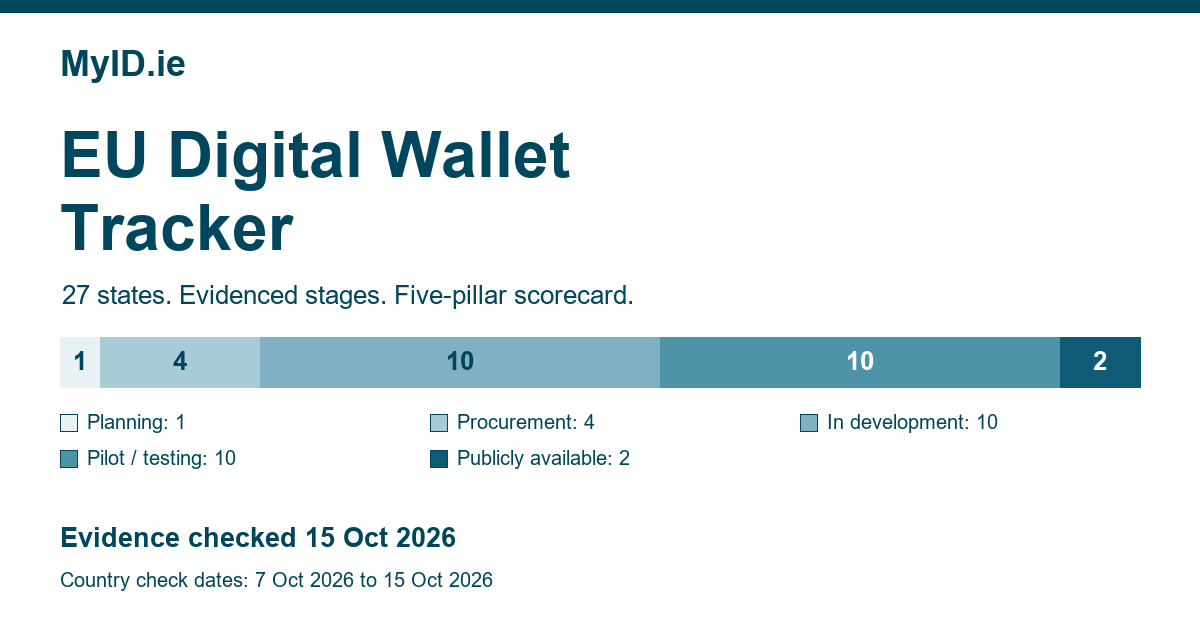
A public dashboard from MyID now tracks the European Union's Digital Identity Wallet (EUDI) programme across all 27 member states, and its October 2026 update underlines how uneven the rollout remains. According to MyID, which checked country evidence between 7 and 15 October 2026, only Denmark and Italy have wallets that are publicly available to citizens, and neither has completed EUDI certification. The tracker surfaced on Hacker News' front page on 13 November.
Only two wallets are live
MyID arranges every country on a six-step ladder: law in force, builder named, pilot evidenced, public beta, generally available and EUDI certified. Denmark (grade C, 62.7) and Italy (grade B, 77.6) have reached the publicly available stage. Ireland is the third state with a wallet in real users' hands, through an invitation-only beta of its Government Digital Wallet built by the OGCIO, with a wider launch stated for 2026 and an eIDAS omnibus bill still at Heads stage.
The rest of the bloc sits earlier on the ladder. Bulgaria is still at the planning stage, with a revised draft Wallet Act out for consultation since 6 October. Malta, Estonia, Czechia and Cyprus are in procurement. Most of the remaining states, Germany and France among them, are in development or pilot and testing.
Grades measure evidence, not quality
MyID is explicit that its A-to-E grades score the strength of published evidence across five pillars, not legal compliance or wallet quality. The result is a table that rewards documentation over availability. Finland grades B (70.3) even though its stage is in development, and its wallet and digital identity credential acts only entered into force on 1 October. Live but more thinly documented Denmark manages a C (62.7), below in-development Finland.
At the bottom, Romania grades E (30.0), although its interior ministry published a RO Wallet calendar and onboarding phases on 6 October. Germany grades D (48.0): the Bundestag adopted its DIdG wallet law on 15 October, but MyID says commencement is unconfirmed, and the federal data protection authority BfDI has said the January version of the German wallet is not yet a full EUDI wallet. France is also D (49.6), and Spain, at D (49.4), published a draft EUDI governance Royal Decree for consultation on 1 October. Ireland grades D (42.4).
Two deadlines, one year apart
The tracker marks two EU legal baselines. Member states must offer wallets by 24 December 2026. Then, from 24 December 2027, banks and other private services that must use strong customer authentication have to accept the wallet, under eIDAS 2 Article 5f(2); micro and small enterprises are exempt.
Seven states, Estonia, Finland, Germany, the Netherlands, Romania, Slovakia and Sweden, have announced public availability targets that fall after the December 2026 deadline, which MyID stresses are announced targets rather than legal findings. Eleven states have a general eID law in force: Belgium, Croatia, Denmark, Finland, France, Greece, Hungary, Italy, Malta, Slovakia and Slovenia.
Pilots, consortia and a watch list
Much of the practical work is running through shared EU pilots. MyID counts the POTENTIAL pilot across 19 states, WE BUILD with 22, the EU Digital Identity Wallet Consortium with 20, DC4EU with 20 for education and social-security credentials, APTITUDE with 12, the Nordic-Baltic payments pilot NOBID with 4, plus single-state efforts mDL4EU and EUDIW-PACT.
Outside the EU, the tracker keeps a watch list for Ukraine's Diia, which has offered digital documents with domestic legal equivalence since August 2021. The European Commission's pilot overview, updated 22 July 2026, lists Ukraine among EUDI pilot participants, though MyID cautions that this does not establish completed interoperability.
Why it matters
When the tracker's evidence was gathered in October, two months before the 24 December 2026 deadline, 25 of 27 member states had no publicly available wallet, and the two that did were not yet EUDI-certified. MyID's board makes that gap measurable in public, naming builders, dating milestones and linking primary sources, with a next quarterly review promised for January 2027. The December 2027 acceptance rule also turns wallet availability into a compliance question for banks and other regulated services, not just a government IT milestone. One caveat applies throughout: where the tracker marks something unconfirmed, that reflects missing primary evidence rather than proof that nothing has happened.
- #digital-identity
- #eu
- #eidas
- #govtech
- #regulation