· via Hacker News – Front Page (native)
Open-source Covid-19 vaccine PVX-001 enters first-in-human trial in Australia
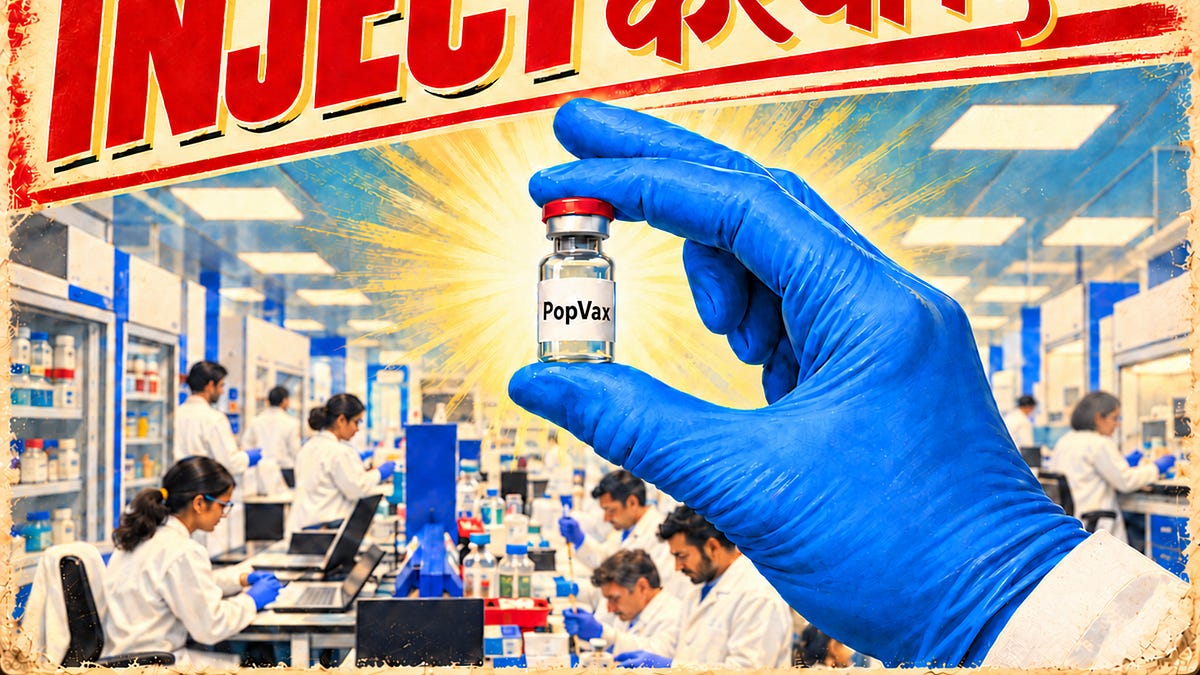
PopVax reports the first doses of its variant-resilient Covid-19 vaccine candidate were given in Melbourne on 31 August, with 14 of 36 volunteers dosed so far and a pledge to open-source the design after Phase 1.
First doses delivered in Melbourne
On 31 August 2026, two volunteers in Melbourne, Australia, became the first people dosed with PVX-001, a Covid-19 vaccine candidate from India-based developer PopVax. The company announced the milestone in a blog post that reached the front page of Hacker News. The first-in-human Phase 1 trial, registered as ACTRN12626000891325, plans to enroll 36 healthy adults to assess safety and tolerability, while also collecting early evidence on the strength and breadth of immune responses against multiple SARS-CoV-2 variants. As of 6 October 2026, PopVax reports that 14 participants had been enrolled and dosed, with no serious adverse events reported and safety monitoring still under way.
mRNA that assembles its own particle
PVX-001 combines two vaccine approaches. The messenger RNA encodes an engineered version of the SARS-CoV-2 receptor-binding domain attached to a scaffold that self-assembles inside cells into a virus-like particle (VLP) covered in many copies of the immunogen — the same display strategy used in vaccines such as Gardasil and the malaria vaccine R21. By letting the body assemble the particle instead of manufacturing it in a bioreactor, PopVax says it gets the stronger and broader antibody response associated with VLP display while keeping the manufacturing simplicity of RNA.
That simplicity is the point. Conventional VLP vaccines are slow to produce, and the company notes that Merck's Gardasil 9 can take as much as four years from start to finish because each immunogen variant needs its own assembly and purification optimization. PopVax instead produces its mRNA in a one-pot in vitro transcription reaction completed in a day, with a full production run taking about a week at its RNA Foundry in Hyderabad. Delivery uses a fridge-stable lipid nanoparticle built on the company's own ionizable lipid, PVXL-150, which PopVax presents as key to transporting doses around the world. The entire stack — the computational protein design pipeline, the delivery vehicle and the manufacturing process — was built in-house over roughly four and a half years.
Company-reported preclinical numbers
Every efficacy claim so far comes from PopVax's own animal work rather than a peer-reviewed publication or the trial itself. In mice, the RNA-encoded VLP design reportedly elicited neutralizing antibody titers more than 50 times higher than the same dose of RNA encoding the immunogen on its own, and more than 20 times higher than an equal dose of an FDA-approved first-generation mRNA vaccine sequence. The wild-type construct neutralized the Gamma, Lambda and Omicron BA.1 variants, while the approved-vaccine comparator at the same dose did not. The version now in the trial, based on a more recent variant, is described as competitive with Moderna's second-generation mNEXSPIKE in mouse immunogenicity. PopVax hopes the design will need fewer boosters and less frequent variant-specific updates than existing shots.
A pledge to open-source the design
The commitment that carried the story into tech circles is PopVax's plan to release PVX-001 as an open-source design once Phase 1 concludes, so that others can build on it. The company frames the trial as an early step toward what it calls its Million Lives Mission, and says platform safety data will help move a single-dose rabies vaccine, a multivalent hepatitis C vaccine, a tuberculosis vaccine and a Strep A vaccine into clinical trials within two years. Early backing included a 100,000-dollar bet arranged by Harish Iyer at the Gates Foundation and support from Balvi, the science fund of Ethereum co-founder Vitalik Buterin, at a stage when, according to the founder, Indian investors were declining to back the idea. The founding motivation was the years-long absence of variant-updated boosters in India after Delta and Omicron emerged.
Why it matters
Vaccine candidates that reach human trials are almost always wrapped in proprietary claims, so a design that will be openly released after being dosed in people is unusual — and, if it holds, a useful starting point for labs and manufacturers that cannot license or recreate proprietary platforms. The variant-resilience goal addresses a real weakness of current mRNA vaccines, which need periodic sequence updates, and fridge-stable delivery would ease distribution logistics. The caveats are equally real: this is a 36-person safety study, the headline numbers are company-reported mouse data, and the open-source release depends on the trial concluding. It is a milestone for open science, but an early one.
- #open-source
- #vaccines
- #mrna
- #biotech
- #clinical-trials