· via Hacker News – Front Page (native)
OpenAI and Anthropic slash LLM prices up to 80% as open-weight rivals close in
OpenAI and Anthropic cut mainstream LLM prices by as much as 80% between June and September 2026, per a minimaxir.com analysis that points to cheap open-weight rivals like DeepSeek as the real trigger.
Between late June and late September 2026, the cost of running OpenAI and Anthropic's mainstream large language models collapsed, with reductions on individual models reaching 80%. A detailed timeline published on minimaxir.com, which surfaced on Hacker News' front page, traces the cuts across both companies' line-ups and argues they were driven as much by cheap open-weight competitors as by the two labs undercutting each other.
A four-month price war
All prices below are per million tokens, in the format input / output / cache read, as compiled in the minimaxir.com post.
The sequence starts on June 26, when OpenAI released GPT-5.6 Sol at $5 / $30 / $0.50 alongside Luna, a small model for inexpensive workloads, at $1 / $6 / $0.10. Four days later Anthropic launched Claude Sonnet 5 at $2 / $10 / $0.20, a rate initially described as temporary but made permanent on August 10. Claude Opus 5 arrived July 24 at $5 / $25 / $0.50.
Then the cuts accelerated. On July 30, OpenAI dropped GPT-5.6 Luna's price by 80%, to $0.20 / $1.20 / $0.02, and on August 21 it trimmed GPT-5.6 Sol by roughly 20% to $4 / $20 / $0.40 for a limited period. On September 1, Anthropic's Fable 5.1 kept the $10 / $50 input and output prices of its predecessor but cut cache reads from $1 to $0.25. OpenAI answered on September 3 with GPT-6 Astra at $10 / $50 / $1.
September 22 was the pivotal day: OpenAI introduced GPT-6 Sol at $2 / $10 / $0.20 — half the input and output price of even the discounted GPT-5.6 Sol — plus GPT-6 Luna at $0.10 / $0.50 / $0.01. Anthropic released Claude Opus 5.5 the same day at $4 / $20 / $0.20, saying the model needs less compute to serve and that its pricing reflects that; the author estimates the total cost of use fell 40–60%. After GPT-6 Sol proved weak in practice, OpenAI shipped GPT-6.1 Sol a week later at $2 / $10 / $0.10, halving cache reads and leaving the family roughly 75% cheaper overall than in June.
Cache pricing is the real lever
Headline input and output prices obscure where the money actually goes, according to the post. In agentic coding — the workload driving much of the current growth — cache reads account for 96–99% of total token spend, because every turn re-sends the accumulated conversation, and hit rates run around 90–100% depending on the provider's infrastructure. That is why Fable 5.1's 75% cache read reduction translates into a 70–75% cut in effective cost despite unchanged sticker prices, and why GPT-6.1 Sol matching Anthropic's ratio of cache reads at 5% of the input price matters more than its list price.
The open-weight squeeze
The author's central claim is that tit-for-tat between OpenAI and Anthropic cannot fully explain reductions of this size. DeepSeek's V4 Flash, released in April 2026 at $0.14 / $0.28 / $0.0028, went viral largely because its cache reads cost just 2% of its input price, versus 5–10% for the US labs, and the 80% Luna cut looks aimed squarely at it. The updated DeepSeek V4.1 Flash 1017 nearly doubled its Artificial Analysis index score, from 24 to 45, at similar list prices, and the number of providers hosting it on OpenRouter has grown from 13 in May to 29 — with Cloudflare and DeepInfra within 10% of DeepSeek's effective cost. Moonshot AI's recently announced Kimi K3.1 Pro scores 55 to Opus 5.5's 58 at half the input and output price and the same cache read cost. Since switching models is often just a toggle in a coding agent or a different endpoint string through OpenRouter, the post argues, models have become commodities with few defenses beyond quality.
Why it matters
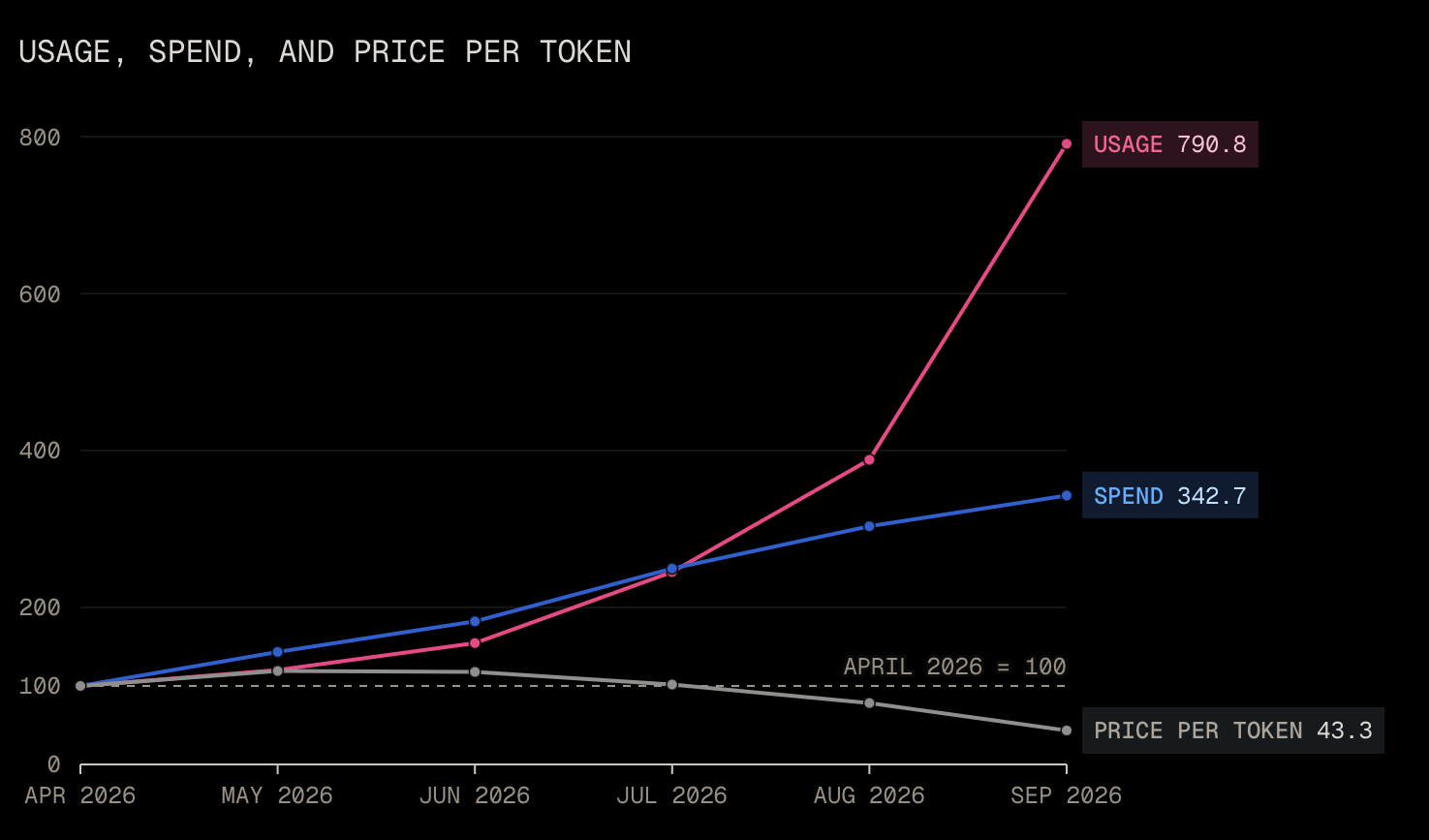
Data from Vercel's AI model gateway cited in the post shows cost per token falling to 43.3% of its April 2026 level — yet aggregate spending keeps rising, because capability gains are outpacing the per-token declines. For developers, the unit economics of every application built on these APIs have shifted dramatically within a single quarter, and the cuts carry through to subscription tools such as Codex and Claude Code. Notably, the author finds no evidence that output quality was sacrificed to reach the new prices. For OpenAI and Anthropic, the pressure is now to maintain a quality gap over free open-weight alternatives that are closing fast — which, the post notes, is why both continue to pour billions into R&D.
- #llm
- #openai
- #anthropic
- #pricing
- #deepseek
- #open-weights