· via Hacker News – Front Page (native)
Optimizely compromise pushed wallet-swapping malware to Zoom, BBC and GitLab visitors
Malicious code written into Optimizely's Project JavaScript field reached 178 organisations including Zoom, the BBC and GitLab, swapping crypto addresses, skimming cards and attacking iPhones, Report URI reports.
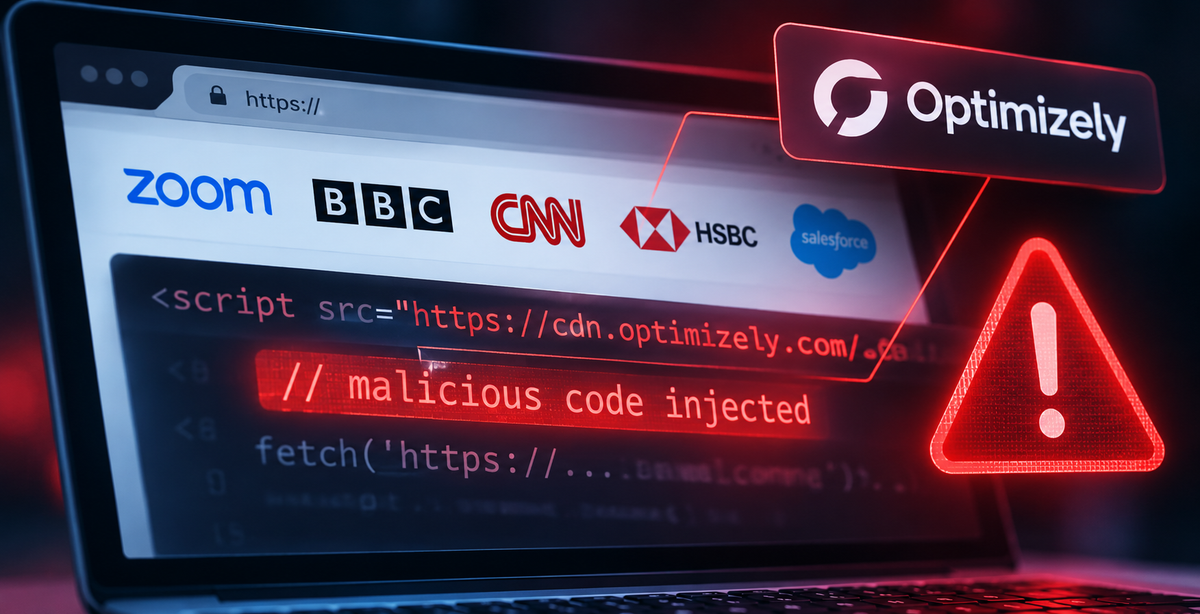
Attack reached 178 organisations
On 16 November 2026, malicious JavaScript was delivered to visitors of 178 organisations through Optimizely Web, a widely used experimentation and A/B testing platform. According to security firm Report URI, whose analysis was surfaced on Hacker News, the affected properties include Zoom, the BBC, CNN, Salesforce, GitLab, IKEA, HSBC, Equifax, Air France-KLM, Ledger and Peacock. In an evening scan of 1,611 Optimizely snippets, Report URI found 186 carrying the malicious code; a mass clean-up followed, and by 21:52 UTC only one snippet, TalkTalk's, remained infected.
How the code got in
Optimizely customers embed a JavaScript snippet served from the company's CDN. The file combines Optimizely's runtime, the customer's experiments and an optional Project JavaScript field: custom code maintained in the Optimizely dashboard that runs on every page. Report URI says the attacker wrote a small loader into that field across many unrelated customer projects, leaving the rest of each snippet untouched. The file kept being served from cdn.optimizely.com with Optimizely's own certificate, from a host every affected site already trusted, and customers who re-hosted the snippet on their own domains were hit as well, since the content comes from the same project.
Notably, Report URI states this was not cache poisoning: the CDN served exactly what it was given, and even Optimizely's own websites carried the injected code. How the attacker obtained write access to so many projects, whether through a compromised Optimizely system, stolen credentials with cross-customer reach or something else, remains unknown.
Three loader variants were observed: a plain script tag fetching a payload from 1688360.cc; the same URL obscured with base64 so a simple domain search misses it; and a fully inline copy that falls back to eval if the external host is blocked. One customer, Smartsheet, had its snippet cleaned only to be re-infected with the obfuscated variant, suggesting the attacker still had access at that point.
What the payload did
Report URI describes track.js as a multi-purpose kit, rebuilt 26 times during the day, with every feature active simultaneously. Its effect varied by device and user action:
- Cryptocurrency address swapping was the direct money-maker. The script detects valid wallet addresses across Bitcoin, Ethereum and EVM chains, TRON, Solana, TON, Litecoin, Bitcoin Cash and Dogecoin, verifying checksums so only genuine addresses are replaced. It swaps them in page content, form fields, links, images, the clipboard, outgoing fetch and XHR requests, window.open, page navigation and the iOS share sheet, re-scanning whenever the page changes.
- Card skimming, added at 13:43 UTC, watches form submissions and POST requests for a Luhn-valid card number, expiry date and CVV, then exfiltrates the trio via sendBeacon. Cards entered in hosted payment iframes such as Stripe or Adyen were out of reach; cards typed into a site's own fields were not.
- Cookie and screenshot theft: when an address was swapped near wallet or payment wording, the script sent the page URL, non-HttpOnly cookies, the replaced addresses and an html2canvas screenshot to the attacker's server.
- iOS exploit chains: on iPhones and iPads the script loaded the Coruna kit on iOS 13 through 17 and DarkSword on 18.x, with a separate chain on iOS 26 that so far only fingerprints devices. Per comments inside the kit itself, iOS 18.7.3 and later and iOS 26.3 and later are patched; pages visited on iOS 18.6 or earlier reloaded every 60 seconds to retry the exploit, a visible symptom.
As of 19:25 UTC, the attacker's wallets had received roughly 7,040 US dollars in about nine hours, with funds already swept to exchanges at 13:03 UTC, according to Report URI.
Timeline points to a broader campaign
The first Optimizely injection was captured at 04:21 UTC on a BBC snippet; the payload domain was registered at 05:23 UTC the same morning; Zoom's snippet was modified at 11:20 UTC. Report URI also links the same actor to an earlier wave from 13 to 16 November, in which similar loaders were injected through scripts from Kissmetrics, StorifyMe and Minute Media on sites including faz.net, smh.com.au and foxsports.com, and notes that the actor's injector first appeared on Turkish sites back in September.
Why it matters
This is a textbook supply-chain compromise: none of the affected brands had their own code or servers breached, yet their visitors ran attacker-controlled JavaScript because they had delegated code execution to a third-party platform. Report URI argues that a Content-Security-Policy in enforcement mode and integrity monitoring that flags unexpected changes to trusted scripts would have detected or blocked key steps of the attack; the firm sells such monitoring, so it has an interest in that framing, but the technical point stands. For users, the risks linger: anyone who copied a cryptocurrency address while an affected tab was open may have pasted the attacker's address instead, and cards typed into site-owned payment forms may have been captured. The outstanding question, how one actor gained write access across so many unrelated Optimizely customer projects, now sits with Optimizely, which had not publicly explained the intrusion at the time of the analysis. Details currently rest on a single firm's reporting, so expect figures to be revised as more becomes known.
- #security
- #supply-chain
- #javascript
- #malware
- #optimizely